Railway OCS Solutions

Railway OCS engineering solutions: 25kV AT catenary, third-rail composite contact rail, heavy-haul reinforcement & maintenance guides.

Overhead contact systems fail where mechanical, electrical and dynamic demands meet: a neutral section that a high-speed pantograph strikes hard, a heavy-haul catenary whose tension drifts with the seasons, a metro section insulator that tracks arcs until it flashes over. Each engineering note below takes one recurring failure or design problem on mainline and urban rail, explains the mechanism behind it, and shows how Chuangwit components resolve it in practice.

The notes are written for OCS design institutes, metro maintenance depots and railway EPC contractors. They draw on the same engineering data published across this catalogue, so every recommendation links to the concrete device that implements it - compensation devices sized for the span, insulators matched to the suspension type, disconnectors rated for the section current.

  • AT-fed full-compensation catenary - how automatic tensioning keeps 25 kV AC contact wire geometry stable across seasonal temperature swings.
  • Heavy-haul high-tension catenary - reinforcement strategy for high-tonnage freight corridors.
  • Metro section insulator failure analysis - root causes of DC section insulator flashovers and the maintenance optimisation that prevents them.
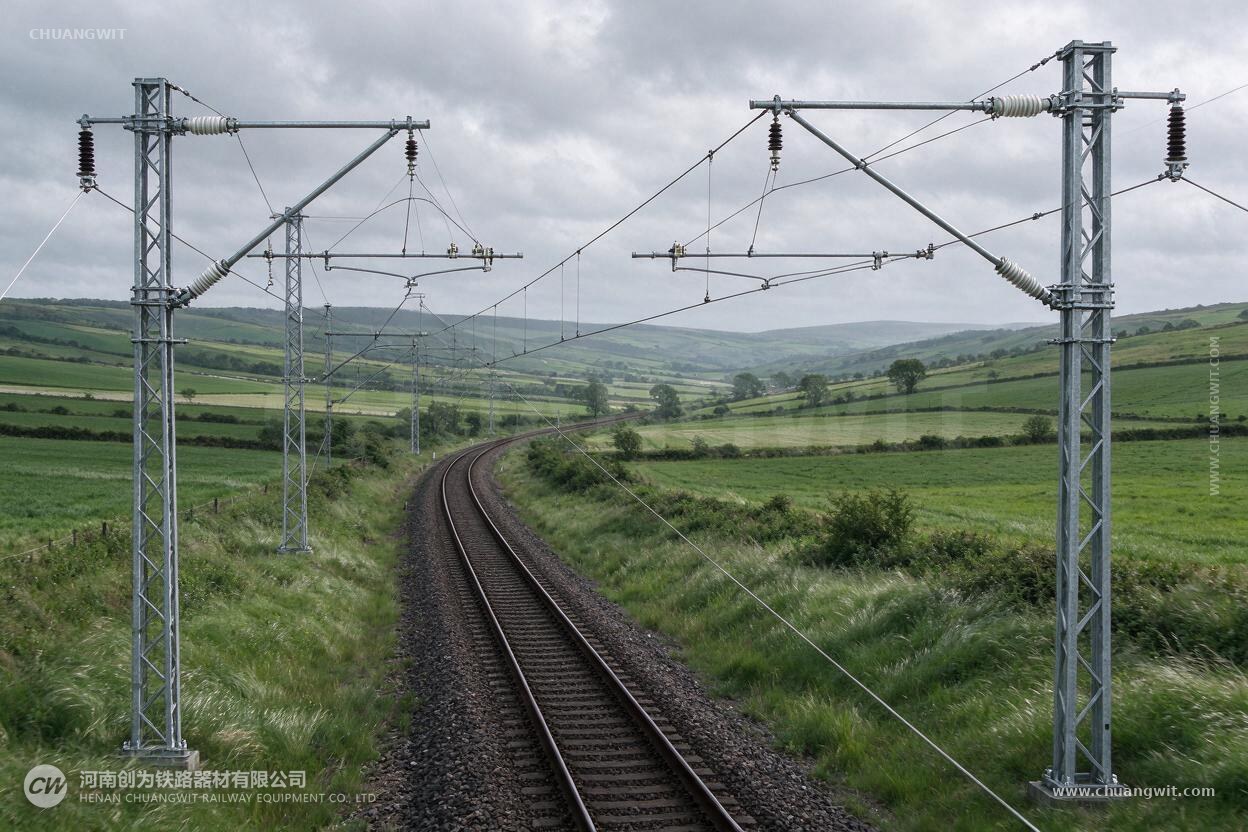
Span Length in Catenary Design: What Changes When Spans Grow

Span Length in Catenary Design: What Changes When Spans Grow

What changes when catenary spans grow: sag rises with span squared, wind deflection and loads climb, and speed class res...

Why Silicone Rubber Sheds Stay Clean: Hydrophobicity Explained

Why Silicone Rubber Sheds Stay Clean: Hydrophobicity Explained

Silicone rubber sheds stay clean because the surface is hydrophobic. Learn why water beads and how hydrophobicity transf...

Shielding Wire vs Arresters: Two Layers of OCS Lightning Defense

Shielding Wire vs Arresters: Two Layers of OCS Lightning Defense

Shielding wire and arresters as two layers of OCS lightning defense: interception above the catenary versus clamping at ...

Section Insulator Standards: EN 50406 in Context

Section Insulator Standards: EN 50406 in Context

Section insulator standards explained: what EN 50406 covers in Europe and how the duty maps onto TB/T 3036-2016, TB/T 30...

Section Insulator Price Factors: What Actually Drives Cost

Section Insulator Price Factors: What Actually Drives Cost

Section insulator price factors mapped: standard family, speed class, insulation level, materials and testing terms that...

Rod Insulators in OCS Cantilevers: The Hidden Workhorses

Rod Insulators in OCS Cantilevers: The Hidden Workhorses

Rod insulators carry OCS cantilever loads between mast and tube. Ratings, materials, failure modes and selection practic...

Rigid Overhead Conductor Rail vs Flexible Catenary in Tunnels

Rigid Overhead Conductor Rail vs Flexible Catenary in Tunnels

Rigid overhead conductor rail versus flexible catenary in tunnels: structure, clearance, speed and maintenance differenc...

Return Conductors in AC Electrification: Booster Transformer Alternative

Return Conductors in AC Electrification: Booster Transformer Alternative

A return conductor carries AC traction return current along the masts instead of rails and earth. Booster transformers f...

Railway Insulators vs Utility Insulators: What Differs

Railway Insulators vs Utility Insulators: What Differs

Railway insulators vs utility insulators compared: duty, standards, creepage basis and inspection regimes, with guidance...

Railway Electrification Cost per km: What Drives the Bill

Railway Electrification Cost per km: What Drives the Bill

Railway electrification cost per km is not one number: the cost structure, its drivers, and where projects save without ...

Railway Earthing System Basics: Keeping Structures at Safe Potential

Railway Earthing System Basics: Keeping Structures at Safe Potential

A railway earthing system bonds masts and switch frames to the return circuit, keeping touch voltage inside EN 50122-1 l...

Railway Bonding Practice: Bonds, Jumpers and Welded Connections

Railway Bonding Practice: Bonds, Jumpers and Welded Connections

Railway bonding joins rails, structures and return conductors into one continuous circuit. How welded bonds, jumpers and...

Rail Potential and Touch Voltage: Limits and Countermeasures

Rail Potential and Touch Voltage: Limits and Countermeasures

Rail potential rises as return current flows through rail impedance. EN 50122-1 caps permissible touch voltage at 60 V A...

Post Insulator Price: The Factors That Actually Drive It

Post Insulator Price: The Factors That Actually Drive It

Post insulator price factors explained: how voltage class, creepage, housing material, mechanical rating and testing sha...

Polymer Insulator Aging: Tracking, Erosion and Brittle Fracture

Polymer Insulator Aging: Tracking, Erosion and Brittle Fracture

Polymer insulator aging explained: how tracking, erosion, hydrophobicity loss and brittle fracture develop, and how insp...

Pollution Classes for Insulators: Reading IEC 60815 Site Severity

Pollution Classes for Insulators: Reading IEC 60815 Site Severity

How IEC 60815 site pollution severity classes a to e are assessed from ESDD and NSDD data and mapped to creepage distanc...

Pin Insulator vs Post Insulator: What Actually Differs

Pin Insulator vs Post Insulator: What Actually Differs

Pin insulator vs post insulator: mounting, mechanical duty and voltage class compared, with selection guidance for railw...

Pantograph Types: Single-Arm vs Double-Arm Diamond

Pantograph Types: Single-Arm vs Double-Arm Diamond

Pantograph types compared: how single-arm and double-arm diamond pantographs differ in geometry, duty and standards, plu...

Pantograph Monitoring: Cameras, Force Sensors and Automation

Pantograph Monitoring: Cameras, Force Sensors and Automation

Pantograph monitoring pairs EN 50317:2025 contact force measurement with wayside cameras and automated image analysis to...

Pantograph Head Geometry: Width, Stagger and Working Range

Pantograph Head Geometry: Width, Stagger and Working Range

Pantograph head width must cover contact wire stagger at every speed. How the geometry is set and verified per EN 50206-...

179 items · Page 3 of 9FirstPrev12345···NextLast

Need a project-specific OCS solution?