Post insulator price is not one number; it is the outcome of five structural factors: voltage class, pollution severity and creepage, housing material, mechanical rating, and the testing and batch terms attached to the order. This article maps that cost structure with qualitative weights only, because a unit price quoted without a specification misleads more than it informs. For orientation, composite families to GB/T 11030-2008 and the TB/T 3199 series span bending classes from 8 to 20 kN and suspension ratings to 100 kN.
Key Takeaways
- No unit prices appear here by design: cost structure and factor weights only, because specification, market and batch terms move any quoted figure.
- Voltage class is the first-order driver — an 11 kV, a 33 kV and a 66 kV post insulator differ primarily in insulation length and creepage requirement.
- Pollution class converts environment into creepage: under IEC TS 60815-2, phase-to-earth reference unified specific creepage runs from about 22.0 mm/kV at class a to 53.7 mm/kV at class e.
- Mechanical class scales the body: FQX/FQB composite families offer bending classes from 8 to 20 kN and suspension tension to 100 kN, to GB/T 11030-2008 and the TB/T 3199 series.
- Testing amortizes over batch size — type test and delivery test cost weigh heaviest on small orders and lightest on frame agreements.
Why Discuss Cost Structure Instead of Unit Prices?
Searches for post insulator price usually want a number; a responsible answer is a structure. The same catalog code can carry materially different prices depending on creepage class, housing material, test scope, order size and delivery terms, and a published figure without those qualifiers creates false anchors that distort tenders.
What can be stated firmly are the engineering reference points: the standards that apply and the rating steps that exist between them. Those follow, factor by factor, with the weights that experience assigns to each.
One caveat belongs up front: cheapest and most expensive are not ends of a quality scale. A low figure can reflect a heavier pollution class being quietly ignored, and a high figure can reflect test scope a project does not need. The five factors are the levers, and knowing them is what turns a quote into a decision.
Factor 1: Voltage Class Sets the Insulation Dimension
Post insulators serve switching and support duty across power and traction systems, and buyers ask about classes such as 11 kV, 33 kV and 66 kV alongside the 25 kV AC traction class used on railway overhead contact systems. Voltage class drives struck length, section thickness and, through insulation coordination, the creepage that wet and polluted performance must deliver.
Moving up a voltage class therefore raises material volume and processing time together — a double step in the cost structure, and the reason class is weighted first. Within one voltage class, the remaining factors then fight over what is left. For traction buyers, the anchor point is the 25 kV AC class of the overhead contact system, where creepage is specified on the phase-to-earth basis that IEC TS 60815 uses.
On railway cantilevers the same logic arrives through combined bending and voltage duty; the division of labor between device types is explained in post insulator versus suspension insulator duties in railway OCS.
Factor 2: Housing Material — Porcelain vs Composite
Housing choice reshapes both the manufacturing cost and the failure anatomy. Porcelain bodies — high-strength ceramic with zinc-sleeve steel pins in combinations validated across decades of mainline service under the TB/T 3199 series — carry mature tooling and long, stable production runs. Composite housings trade that maturity for hydrophobic pollution performance and lighter logistics, and their failure mode is shed tracking rather than porcelain shatter, which matters wherever personnel or equipment sit below the insulator.
Neither family wins on paper; each wins in an environment. The material trade-off, including how the two housings age, is mapped in porcelain versus composite insulator choice for OCS cantilevers.
Factor 3: Mechanical Rating Scales the Body
Electrical class sets the length; mechanical class sets the diameter and the metalwork. Composite long-rod families such as FQX and FQB illustrate the ladder: suspension types rated to 100 kN tension and cantilever bending types through the 8 to 20 kN bending classes, all to GB/T 11030-2008 and the TB/T 3199 series. Each step up in rating means more insulating volume and larger, stronger end fittings, so mechanical duty is weighted close behind voltage class.
Cantilever loading — wind, ice and wire tension combined — is where the bending classes get consumed. The structural context is covered in catenary cantilever types and speed classes.
Factor 4: Pollution Class Converts Environment into Creepage
Creepage is the surface distance the housing must provide, and pollution severity is what forces it upward. Two IEC frameworks coexist, and the voltage basis difference matters when comparing quotes written against different tables.
| Framework | Voltage basis | Pollution classes | Reference creepage (mm/kV) |
|---|---|---|---|
| Legacy IEC 815:1986 | Phase-to-phase | I light to IV very heavy | 16 / 20 / 25 / 31 |
| IEC TS 60815-2 (2008, editions 2025) | Phase-to-earth | a very light to e very heavy | 22.0 / 27.8 / 34.7 / 43.3 / 53.7 |
Source: legacy IEC 815:1986 minimum nominal specific creepage on a phase-to-phase basis; IEC TS 60815-1/-2 reference unified specific creepage on a phase-to-earth basis, with diameter corrections such as increases for housings above 500 mm.
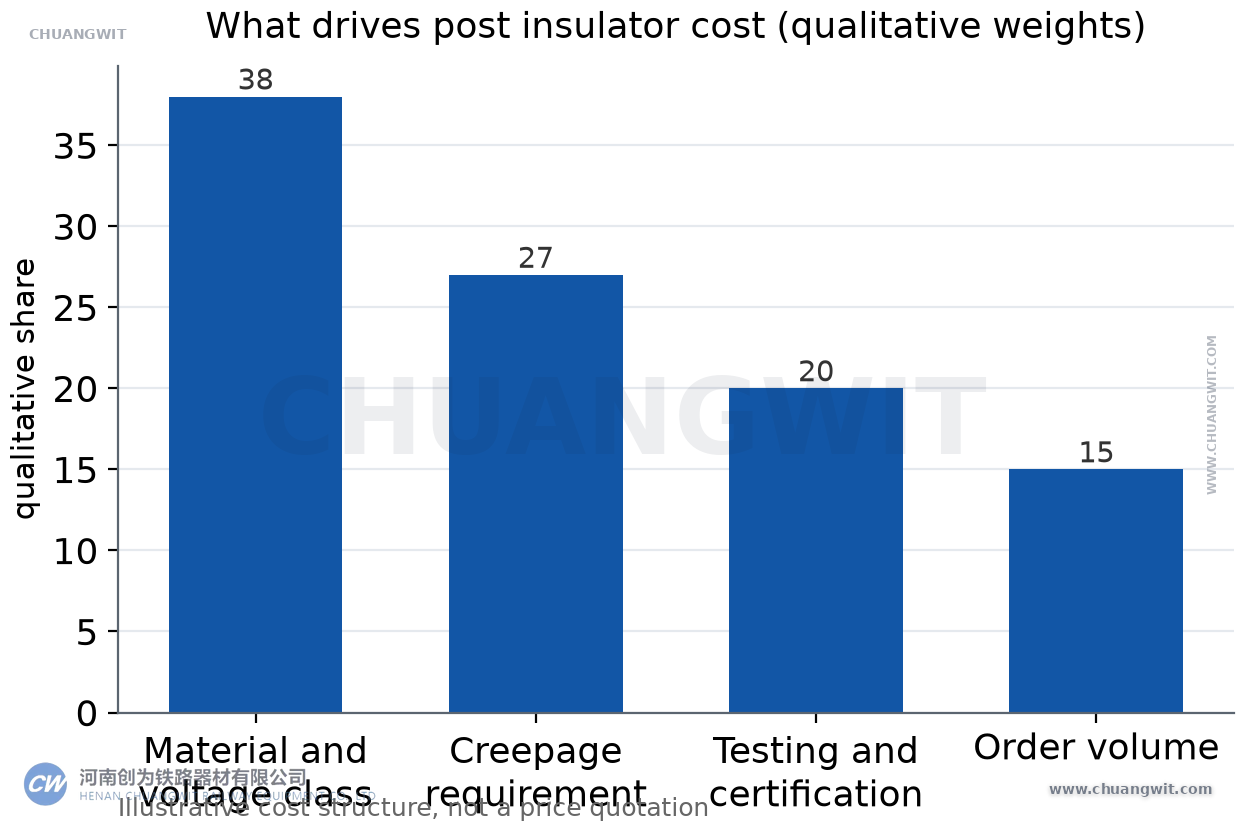
The cost consequence is direct: heavier pollution classes multiply creepage, which multiplies shed count or profile depth, which raises material and processing time. On the IEC TS 60815-2 basis the heaviest class demands well over twice the creepage of the lightest, so pollution class can outweigh housing material in the final structure. Always confirm which table, and which voltage basis, a quotation assumes.
Factor 5: Testing, Certification and Batch Size
Every compliant batch carries test cost. Type tests against the product standard, routine tests on each piece — the glass disc family, for comparison, puts every body through an individual mechanical load test before release under the same TB/T 3199 and GB/T 11030-2008 discipline — and documentation per delivery all enter the structure. Type test cost is largely fixed, so it amortizes over quantity: small orders carry proportionally heavy test overhead, while frame agreements spread it thin.
Logistics closes the structure. Porcelain travels as fragile, heavy freight with individual packing; composite housings shed much of that weight and packing intensity. Ask also what the test file contains, not just that it exists: type test reports against the product standard, routine records per batch and, for traction duty, evidence of railway service conditions — the minus 40 to plus 70 degrees Celsius range common to TB/T 3199 families — all cost money to generate and add real value at acceptance. For the audit questions that separate capable suppliers from price-only bidders, see the manufacturer selection guide, and for where post insulators sit in the assembly, the complete OCS components guide.
Frequently Asked Questions
What drives post insulator price?
Five structural factors: voltage class, which sets insulation length; pollution class, which sets creepage; housing material, porcelain or composite; mechanical rating, which scales body size and end fittings; and the testing and batch terms of the order. Voltage class and creepage dominate, mechanical rating follows closely, and test overhead weighs heaviest on small orders. Pin these five and most of the price structure is pinned.
How much does an insulator cost?
There is no honest single figure. The same nominal device varies with creepage class, housing material, mechanical rating, test scope, order size and delivery terms, so any standalone number misleads. The workable approach is to fix the specification — standard, class, rating — collect quotations against it, and compare like with like. Suppliers who answer in structure rather than a bare number are usually the ones who can evidence compliance.
Does voltage class change post insulator price?
Yes, and it is weighted first. Higher voltage classes — for example moving from an 11 kV toward a 33 kV or 66 kV rating — demand longer insulation, more creepage and heavier coordination margins, which together raise material volume and processing time. The cost structure steps up with class even before pollution or mechanical requirements are added, which is why class is the first question a quotation needs.
Polymer or porcelain post insulator: which costs more?
Neither answer is universal. Porcelain enjoys mature tooling and stable material cost but adds weight and fragile-goods logistics; polymer housings cost differently in raw material and process while saving transport and installation effort and adding hydrophobic pollution performance. Both families must satisfy their standards requirements — GB/T 11030-2008 and the TB/T 3199 series — so the comparison belongs in lifecycle terms, not catalog terms.
Comparing Quotes Honestly
Ask every supplier the same five questions: voltage class and basis, creepage class and its framework, housing material with failure anatomy, mechanical class with test evidence, and batch and test terms. Answers that cite GB/T 11030-2008, the TB/T 3199 series or IEC TS 60815 classes with a stated voltage basis are comparable; answers that quote a bare number are not. Repeat the comparison at every specification change, because a single class step re-ranks the whole structure.
Send the specification to our engineering team for a structure-level response — rating ladder, creepage options and test scope — before price enters the conversation.