Pollution classes describe how dirty the environment around an insulator is, and they decide how much creepage distance the insulation needs. IEC TS 60815-1 defines site pollution severity (SPS) classes a to e, from very light to very heavy, each mapped to a reference unified specific creepage distance. Measuring deposits on insulator surfaces, mainly ESDD and NSDD, is how a site earns its class.
Key Takeaways
- IEC TS 60815-1, editions 2008 and 2025, defines site pollution severity classes a to e, from very light to very heavy, replacing the four legacy classes of IEC 815:1986.
- Each class maps to a reference unified specific creepage distance of 22.0, 27.8, 34.7, 43.3 or 53.7 mm/kV per IEC TS 60815-2, on the phase-to-earth basis.
- The classes are quantified by measuring deposits on insulator surfaces: ESDD for soluble salts and NSDD for the insoluble fraction, together with wetting behavior.
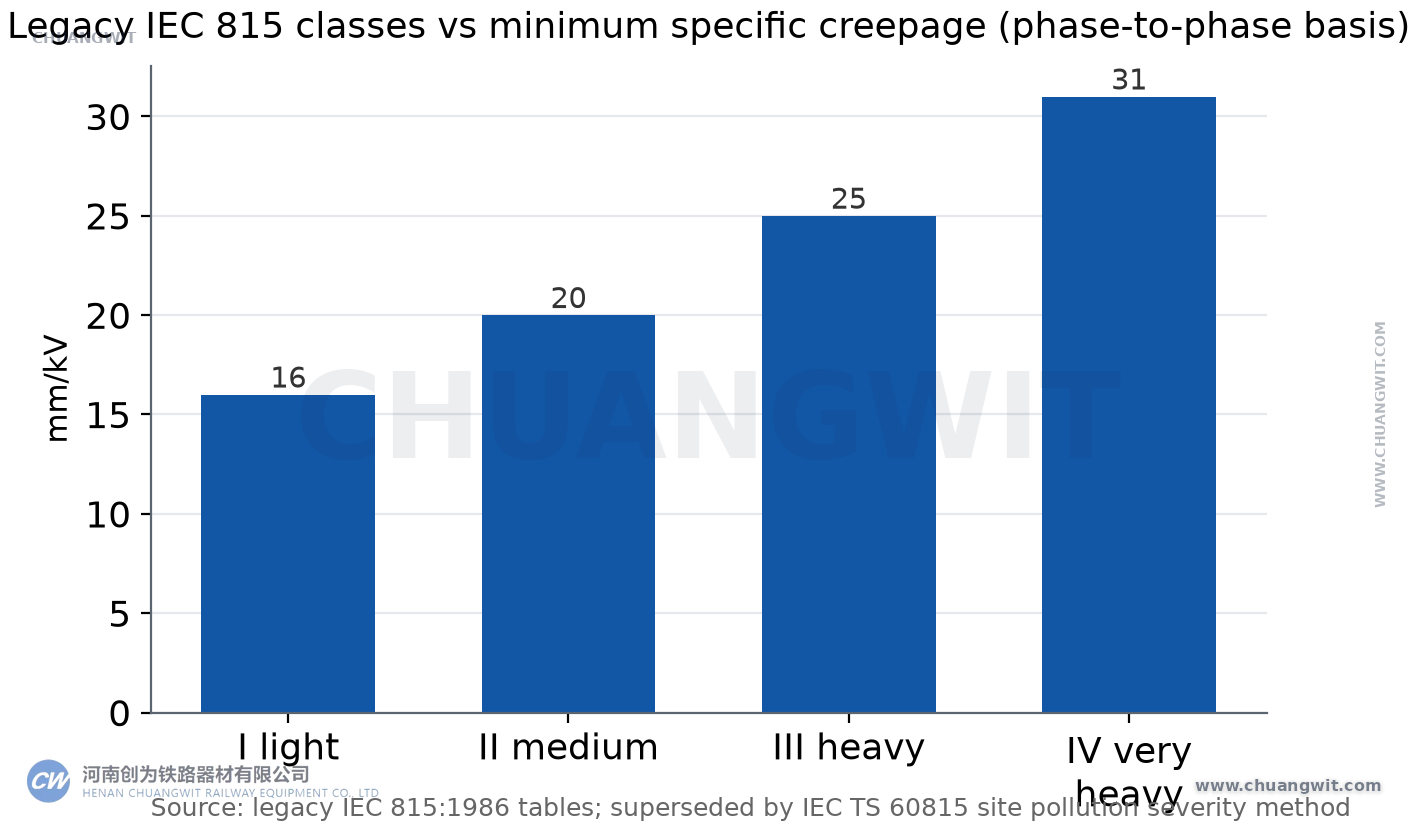
- Legacy classes I to IV of IEC 815:1986 carried minimum nominal specific creepage of 16 to 31 mm/kV on the phase-to-phase basis, and the two systems must not be mixed.
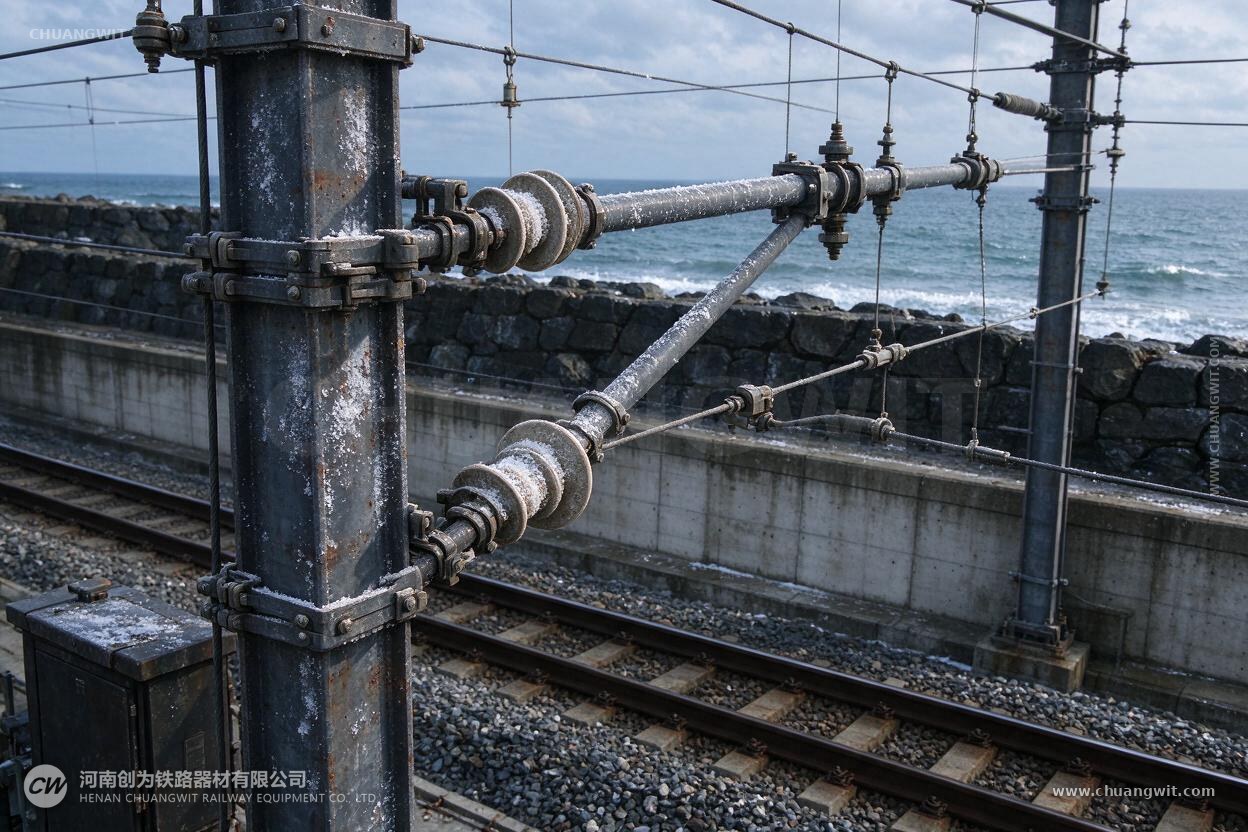
- Railway corridors earn their classes from specific sources: coastal salt, industrial emissions, tunnel grime and metal dust from brakes and pantograph wear.
- Class selection flows downstream into insulator material choice, with composite housings favored for their hydrophobic sheds in polluted environments.
What site pollution severity means
Pollution flashover is a surface event. Deposits accumulate on the insulator, moisture wets them into a conducting film, and the resulting leakage current dries the surface into bands until the voltage concentrates across them and flashover occurs. The severity of that process at a given location is what site pollution severity measures: not how much dirt is in the air in general, but how much conducting deposit ends up on the insulation surface and how often it gets wet.
IEC TS 60815-1 grades this reality into five classes, a to e. Class a describes very light pollution, where natural rain alone keeps surfaces effectively clean. Class e describes very heavy pollution, typical immediately downwind of heavy industry or on exposed coastal sites, where surfaces need substantial specific creepage distance to survive between cleanings. Classes b, c and d interpolate between those extremes.
The five pollution classes a to e
The table sets out the current classes with the creepage value each one drives. The mm/kV figures are the reference unified specific creepage distances (RUSCD) of IEC TS 60815-2, referenced to phase-to-earth voltage.
| SPS class | Severity | RUSCD (mm/kV, phase-to-earth) | Typical environment |
|---|---|---|---|
| a | Very light | 22.0 | Clean inland sites with regular rain washing |
| b | Light | 27.8 | Agricultural land, light dust, distant industry |
| c | Medium | 34.7 | Mixed corridors, urban fringe, moderate coastal influence |
| d | Heavy | 43.3 | Industrial zones, strong coastal salt exposure |
| e | Very heavy | 53.7 | Immediate vicinity of heavy pollution sources |
Source: IEC TS 60815-1 site pollution severity classification and IEC TS 60815-2 RUSCD values, referenced to phase-to-earth voltage.
The typical-environment column is guidance, not classification. A site is classified by measurement or by established service experience, and the full working table with all its cautions is tabulated in our companion page on specific creepage distance by pollution class, which also carries the legacy values for comparison.
How ESDD and NSDD are measured
Equivalent salt deposit density (ESDD) quantifies the soluble, conducting fraction of the pollution. A measured surface area of the insulator is wiped with demineralized water, the conductivity of the resulting solution is measured, and the result is expressed as the equivalent mass of sodium chloride that would produce the same conductivity, normalized to the wiped area. Higher ESDD means more soluble salt on the surface and a more conducting film when it rains.
Non-soluble deposit density (NSDD) quantifies everything that does not dissolve: dust, soot, sand and fibers. The residue is filtered, dried and weighed, again normalized to area. NSDD matters because insoluble layers hold moisture longer, extending the time the surface stays conductive, and they can interfere with the natural washing effect of rain.
The two numbers are read together, with wetting information, to fix the site class. Measurements are taken over a sufficient exposure period and repeated across seasons, because a class set from one dry month will be wrong for the year. The physical quantity these classes ultimately drive, creepage distance, is defined carefully in our article on what creepage distance is.
How the legacy classes I to IV map across
The predecessor, IEC 815:1986, used four classes, I light through IV very heavy, with minimum nominal specific creepage distances of 16, 20, 25 and 31 mm/kV. Two differences complicate any comparison. First, the scale changed from four classes to five. Second, and decisively, the legacy values were referenced to phase-to-phase voltage while the current RUSCD values are referenced to phase-to-earth voltage, so the numbers must never be read as a simple succession.
Historically many railways specified 25 mm/kV for polluted 25 kV traction sites, the legacy class III value, and that figure remains embedded in older network documents. When such documents are revised, the site should be reclassified to the a-to-e scale and the RUSCD taken from the current table, with the basis change recorded explicitly rather than assumed.
Choosing a class for a railway corridor
Railway corridors are classified like any other line, but their pollution sources are distinctive. Coastal routes collect salt aerosol that scales with exposure to onshore wind. Industrial corridors collect soot and chemical dust. Tunnels and underground sections accumulate grime that rain never washes away, and every OCS adds its own contribution: metal dust from brake wear and pantograph strips drifts onto insulators positioned directly above the source. Station areas add exhaust from diesel traffic where mixed traction remains.
Practical classification uses both measurement and experience. Deposit measurements give the defensible number for a new line; the behavior of existing insulators on a parallel route gives the sanity check for an upgrade. Where the corridor passes through several environments, class boundaries follow the geography, and it is entirely normal for one route to carry two or three classes along its length, with the corresponding corrections applied at the design stage.
What class selection changes downstream
The class drives the specific creepage distance, and the specific creepage distance drives hardware: more or deeper sheds, longer strings, sometimes a different material. Between porcelain and composite bodies, polluted sites increasingly favor composite insulators, whose silicone sheds retain hydrophobicity, beading water into droplets instead of continuous films, and shed surface degradation modes differ between the families. The trade-offs are laid out in our comparison of porcelain versus composite insulators for OCS cantilevers, and the same logic applies to arrester housings as discussed in our piece on composite versus porcelain arresters.
Corrections complete the design. Above 500 mm insulator diameter, IEC TS 60815 adds roughly 10 to 20 percent to the required creepage, and profile corrections adjust for shed geometry. Verification of the finished specification is then a testing question, covered in our overview of how insulators are tested, where pollution and tracking tests confirm that the chosen class and housing material behave as predicted.
Frequently Asked Questions
What is specific creepage distance?
Specific creepage distance is total creepage distance divided by the reference voltage, in mm/kV. IEC TS 60815-2 tabulates reference unified specific creepage distance for site pollution severity classes a to e at 22.0 to 53.7 mm/kV, referenced to phase-to-earth voltage. The legacy minimum nominal values of IEC 815:1986, 16 to 31 mm/kV, used a phase-to-phase basis.
What is creepage distance?
Creepage distance is the shortest distance along the insulator surface between conductive parts, following the sheds. It is the dimension that resists pollution flashover, because leakage and tracking travel on the wetted surface rather than through the air gap. Pollution classes exist to decide how much of this surface length a given site requires.
Why is creepage distance important?
Because pollution flashover follows the surface. Soluble deposits measured as ESDD, held wet by insoluble layers measured as NSDD, form conducting films that concentrate voltage and eventually flash over, tripping the line and damaging insulation. Adequate creepage distance, selected through the IEC TS 60815 classes, is the designed defense against that failure mode.
What is a composite insulator?
A composite insulator uses a fiberglass resin core for mechanical load with a polymer, typically silicone rubber, molded as the weathered shed structure. In polluted service the hydrophobic sheds bead water and suppress leakage films, which is why polluted corridors often favor composites. On OCS cantilevers, FQX and FQB composite long-rod families are rated to GB/T 11030-2008 and TB/T 3199.
Practical takeaways for classifying a site
Classify from evidence, not habit. Take ESDD and NSDD measurements over representative seasons, weigh the service history of nearby lines, and assign the class per IEC TS 60815-1 with the wetting regime in mind. Then carry the class cleanly into the specification: RUSCD value, phase-to-earth basis, diameter and profile corrections, and the material decision, so that nothing between assessment and purchase silently changes the insulation coordinate.
For corridor-specific review of pollution class and the matching OCS insulation hardware, our engineering team can cross-check the assessment against the standards quoted above.