A rigid overhead catenary system (ROCS) replaces the tensioned pair of messenger and contact wire with aluminium conductor rail bolted directly to tunnel supports, while a flexible catenary keeps the classic assembly suspended on droppers and held taut by automatic tensioning. Chinese metro practice formalizes rigid suspension busbar and its components under TB/T 3252-2022. The choice between the two constructions sets clearance demand, speed behavior and the maintenance load for the life of the line.
Key Takeaways
- Rigid overhead conductor rail is fixed to supports at close spacing; it needs no tensioning devices, no sag calculation and no droppers.
- Flexible catenary keeps messenger wire, droppers and tensioning hardware from the TB/T 2075 series, giving tunable elasticity and higher speed tolerance where clearance allows.
- TB/T 3252-2022 is the Chinese standard for rigid suspension catenary busbar and components on urban rail at DC 1500 V.
- Section insulators bridge both worlds: the FYFH-1.0TG-DC, built to the TB/T 3252 series, is rated up to 120 km/h and comes in rigid or flexible suspension variants.
- Rigid overhead conductor rail is not a third rail: third rail sits at track level, typically runs 750 V DC on legacy UK networks, and is practically capped near 160 km/h with a world record of 175 km/h set in 1988.
What Is an Overhead Catenary System?
An overhead catenary system delivers traction power to a moving train through a pantograph pressing against a contact wire. In its flexible form it consists of a messenger wire, a contact wire suspended below it on droppers, steady arms that register the lateral position, and tensioning equipment that keeps the mechanical force constant as temperature changes. The complete parts inventory, from masts to splice fittings, is cataloged in the OCS components guide.
The word catenary survives from the curve the messenger describes under its own weight between supports. That curve is also the engineering asset: it lets the designer tune elasticity along the span so that the pantograph follows the wire without losing contact at speed.
What Is a Rigid Overhead Conductor Rail (ROCS)?
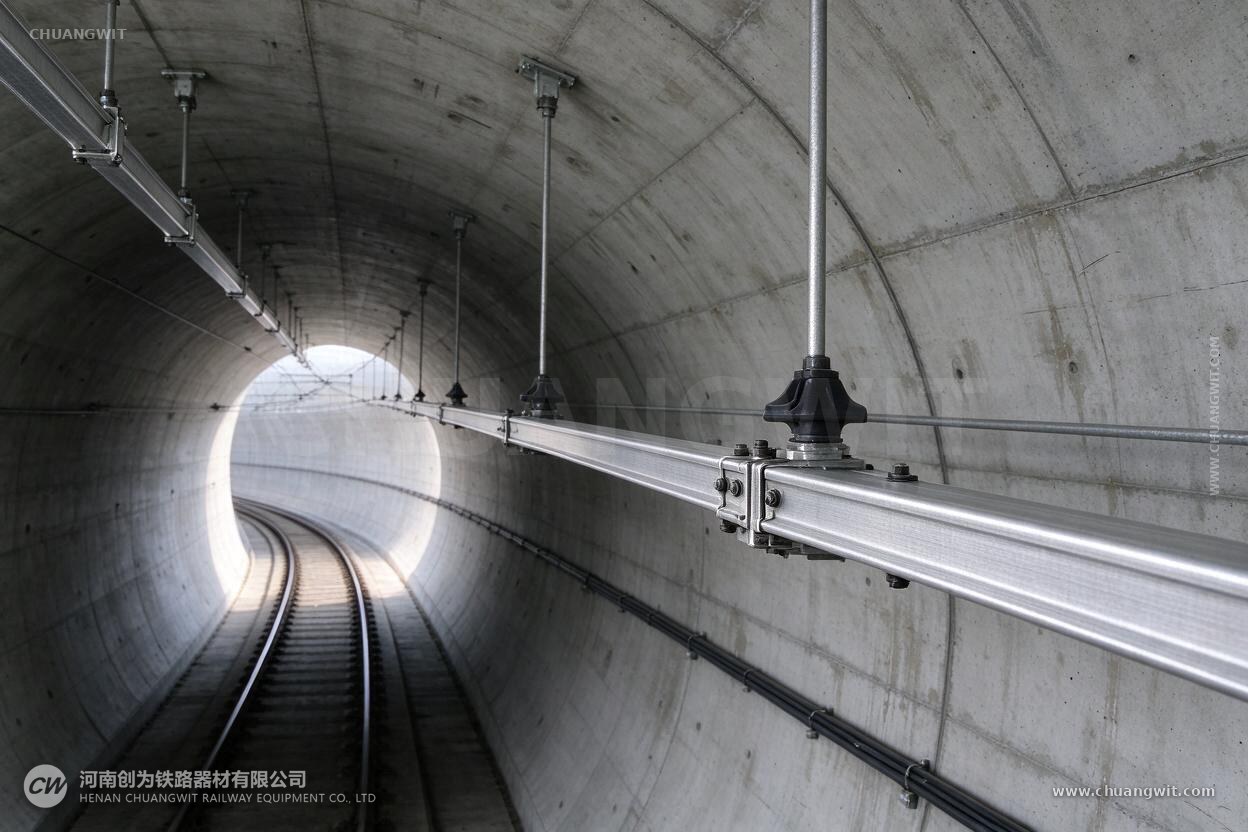
A rigid overhead catenary system mounts one or more aluminium conductor rails, each with a wear-resistant contact strip, directly on insulated supports at close spacing along the tunnel ceiling or wall. Because the rail supports itself structurally, there is no messenger, no dropper, no sag table and no compensation stack to install or maintain. Chinese metro practice standardizes the rail and its components as rigid suspension catenary busbar under TB/T 3252-2022.
The construction suits small bores: the assembly hugs the arch, tolerates lower headroom, and holds contact surface geometry by stiffness rather than by tension. Device integration — section insulators, anchors, expansion joints — draws from the same TB/T 3252-2022 component family, a chain described in rigid section insulators for metro tunnel conductor rail systems.
Rigid vs Flexible Catenary: Where the Two Constructions Differ
Both constructions feed a pantograph from above and both serve DC metro and AC mainline voltage levels, but almost every engineering quantity behind them diverges. The table compresses the comparison into the six rows that recur in tunnel design reviews.
| Aspect | Rigid overhead conductor rail | Flexible catenary |
|---|---|---|
| Support principle | Rail stiffness at close support spacing | Tensioned messenger carrying the contact wire on droppers |
| Tensioning hardware | None; expansion joints absorb length change | Compensation devices per the TB/T 2075 series |
| Clearance demand | Lowest; hugs the tunnel arch | Higher; needs room for sag and pantograph sweep |
| Elasticity behavior | Stiff, uniform contact surface | Tunable through dropper and stitch wire design |
| Typical venue | Metro tunnels at DC 1500 V | Main line, high speed and large tunnels |
| Behavior after a wire break | Rail stays in place | Assembly must be re-tensioned and re-sagged |
Source: TB/T 3252-2022 for rigid suspension busbar and components; TB/T 2075 series for flexible catenary fittings, as published in the Chinese railway standards corpus.
Note that the table compares construction, not quality: a well-executed line of either type collects current reliably. What the table does fix is which failure modes, tooling and spares a maintenance organization inherits.
Weight and packaging tell the same story. Flexible catenary arrives as reels and fittings; rigid systems arrive as rail lengths and support assemblies, which changes site logistics, crane time and the shape of the delivery schedule. Projects that plan handling early rarely feel the difference; projects that discover it mid-installation always do.
Speed, Current Collection and the Third-Rail Distinction
Rigid overhead conductor rail is regularly confused with third rail supply, and the distinction matters. Third rail sits beside or between the running rails at track level and collects through sliding shoes on the train; typical UK third-rail networks run 750 V DC, and the practical speed ceiling of the technology sits around 160 km/h, with a world record of 175 km/h set by a British Class 442 train in 1988. Overhead collection, rigid or flexible, works with standard pantographs and avoids that ceiling.
Within overhead systems, flexible catenary still leads where speed dominates, because elasticity can be tuned span by span through dropper placement and stitch wire assemblies governed by TB/T 2075.8-2024. Rigid conductor rail concentrates on metro duty, where running speeds sit comfortably inside the 120 km/h device class of hardware such as the FYFH-1.0TG-DC section insulator.
For the ground-level alternative used on fully enclosed light rail, see steel-aluminium composite contact rail power supply.
How Do Section Insulators Differ Between the Constructions?
Every electrically divided tunnel line needs section insulators, and the construction choice defines their body type. On rigid busbar the device seats into the rail profile; on flexible catenary it hangs in the contact wire run. The rating logic, however, is shared across the model families.
| Device family | Governing standard | Suspension forms | Rated speed (km/h) |
|---|---|---|---|
| FYFH-1.0TG-DC | TB/T 3252 series | Rigid and flexible | Up to 120 |
| FYFH series for 25 kV AC mainline | TB/T 3036-2016 | Flexible | Per design speed class |
| XFXP series | TB/T 3037 series | Flexible | Per design speed class |
Source: FYFH-1.0TG-DC rating to the TB/T 3252 series; FYFH to TB/T 3036-2016 and XFXP to the TB/T 3037 series, as published in the section insulator model corpus.
Model-by-model selection, including the DC families built to TB/T 3252-2022 for urban rail, is tabulated in the section insulator model guide.
How to Choose for a Tunnel Project
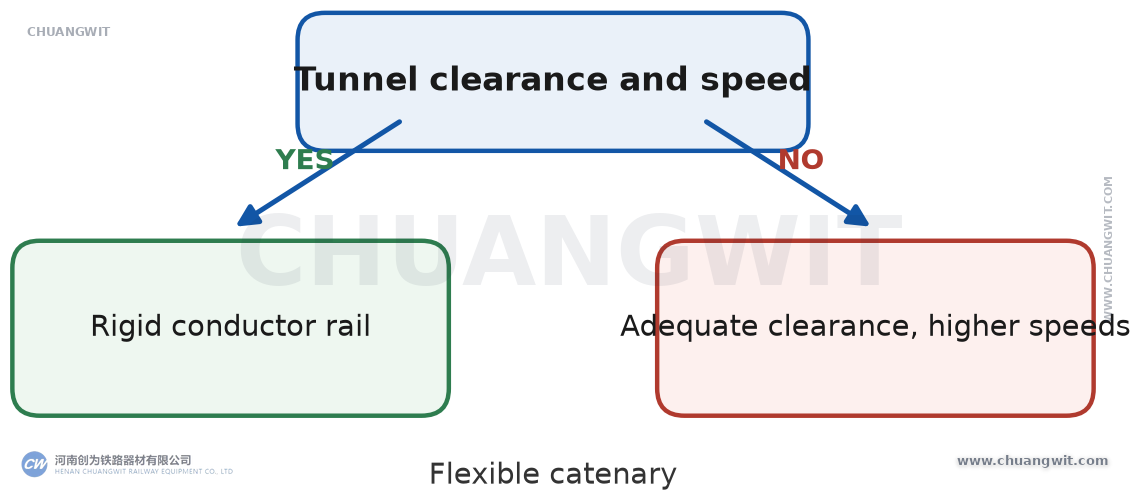
Let three questions decide. First, clearance: if the bore cannot host sag plus pantograph sweep, rigid conductor rail to TB/T 3252-2022 is the default. Second, speed and duty: metro stopping patterns sit inside the 120 km/h device class, while anything faster argues for flexible catenary. Third, maintenance philosophy: rigid systems trade tensioning hardware for more support points and joint inspections.
Hybrid lines — a bored core with open approaches — mix both constructions, which makes interface components and shared spares worth negotiating early. Support hardware for the flexible sections follows tunnel catenary supports where clearance is tightest and the hanging post and bracket families.
Frequently Asked Questions
What is an overhead catenary system?
An overhead catenary system delivers traction power to trains through a pantograph pressing against a contact wire. In flexible form, a tensioned messenger wire carries the contact wire on droppers so the collecting surface stays nearly level, steady arms set lateral position, and compensation devices hold tension. In rigid form, an aluminium conductor rail bolted to supports replaces the whole suspended assembly inside tunnels.
What is a rigid overhead conductor rail?
A rigid overhead conductor rail is an aluminium rail with a contact strip, bolted to insulated supports along a tunnel ceiling at close spacing. It carries current to the pantograph while supporting itself structurally, so it needs no messenger wire, droppers, sag tables or tensioning devices. In China the rail and its components are standardized as rigid suspension catenary busbar under TB/T 3252-2022 for DC urban rail.
What is a ROCS catenary system?
ROCS stands for rigid overhead catenary system, the international term for rigid overhead conductor rail supply. The rail is fixed rather than tensioned and keeps its geometry by stiffness, which suits tunnels with the tightest clearance. It differs from third rail, which sits at track level and is practically limited to speeds near 160 km/h, while overhead rigid rail works with standard pantographs.
Which is better in a tunnel: rigid conductor rail, flexible catenary or third rail?
Clearance usually decides. Tight bores favor rigid overhead conductor rail to TB/T 3252-2022; larger tunnels and higher speeds favor flexible catenary; third rail suits ground-level collection where speeds stay low, accepting exposure, icing and gap constraints. Each option changes the whole component chain, so the decision belongs at the start of tunnel design, not after it.
Choosing the Construction Early
Rigid versus flexible is one decision with project-long consequences: it fixes the support layout, the section insulator bodies, the spares list and the maintenance regime. Anchor the choice in measured clearance and a confirmed speed class, then hold every component to its standard — TB/T 3252-2022 for rigid busbar, the TB/T 2075 series for flexible fittings — with type test evidence in the delivery file. Revisit the decision at every change of tunnel diameter along the route, because a bore that fits one construction can rule out the other further along the line.
To cross-check device availability for both constructions on a single line, our engineering team can map the FYFH families and support hardware against your tunnel envelope and speed class.