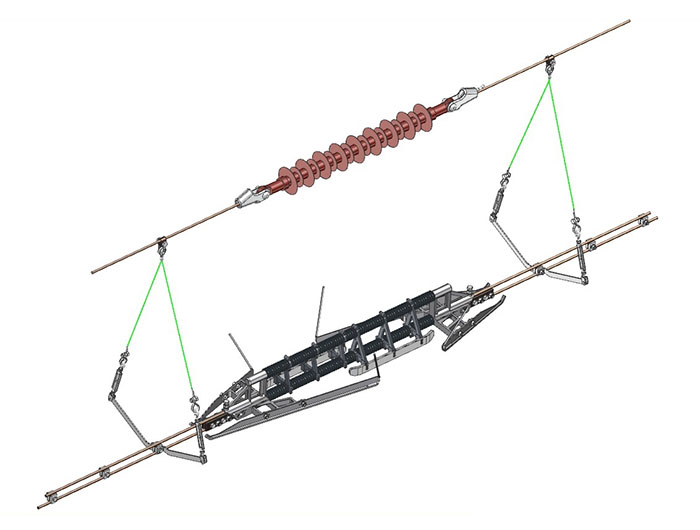
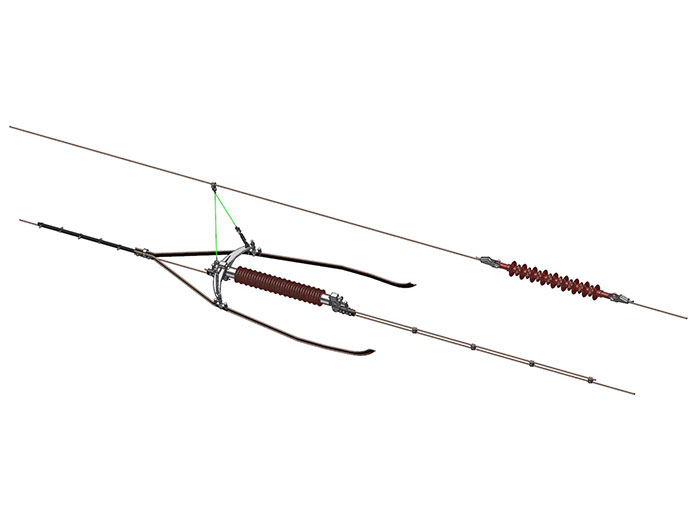
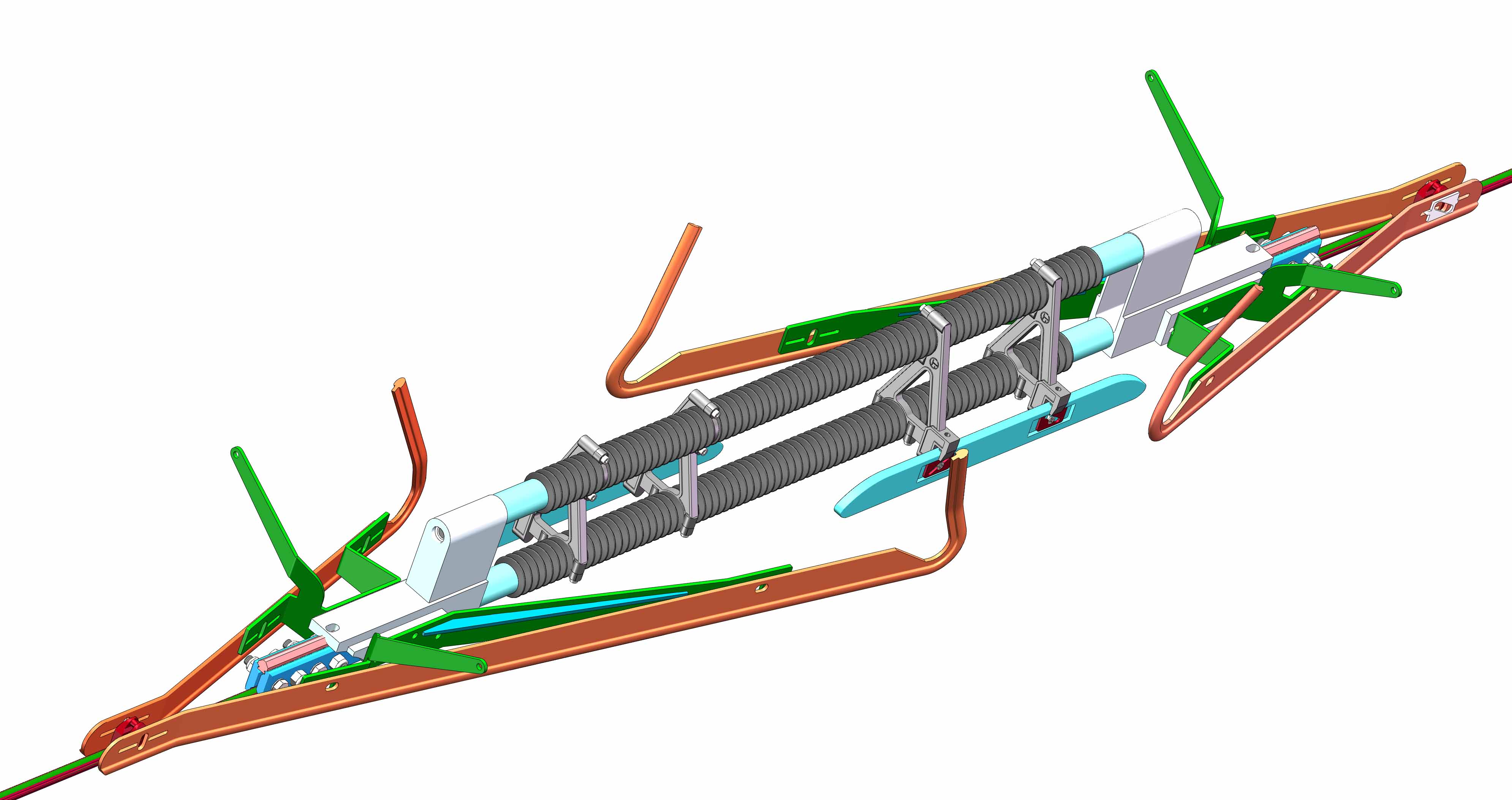
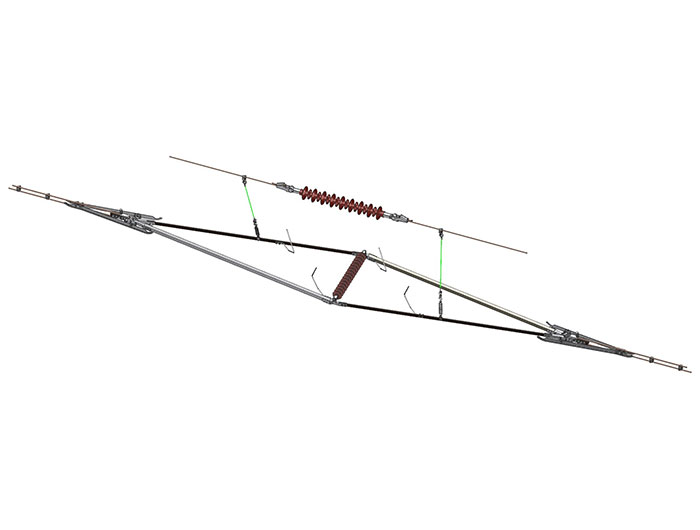
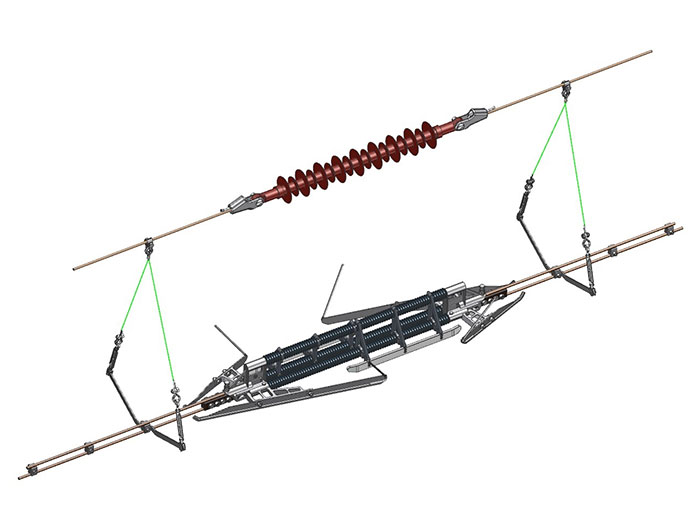
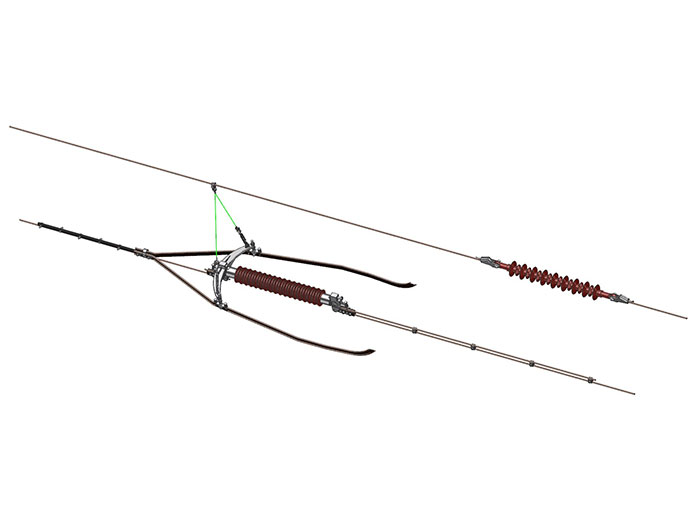
Henan Chuangwit section insulators create in-phase electrical sections in 25 kV AC overhead contact systems: short, self-contained insulating assemblies spliced into the contact wire that let operators de-energise, maintain or isolate one catenary section without disturbing its neighbours. A section insulator must do two opposing jobs at once — insulate reliably across a gap of a few hundred millimetres, and let a pantograph running at line speed cross the gap smoothly, without hard impacts, without arcing damage, and without measurable loss of current collection quality.
The Chuangwit range is designed and manufactured to TB/T 3036-2016, Section insulators for electrified railway overhead contact systems, and covers the two official type classes: Type A for lines up to 160 km/h and Type B for lines up to 200 km/h, in shuttle, wing, rhombic and flexible constructions. All units are rated 27.5 kV working voltage on the 25 kV nominal AC system, and the enhanced-insulation -E series adds reinforced creepage and an air gap of 430 mm or more for high altitude, heavily polluted, coastal and tunnel sections.
Product Groups
- Type A — up to 160 km/h — FYFH-1.6AT-S Shuttle Section Insulator · FYFH-1.6AT-Y Wing Section Insulator (lightweight runner, good collection quality) · FYHH-1.6AT Rhombic Section Insulator (uniform loading, stable running) · RXFG-27.5kV Flexible Section Insulator (adapts to complex installation geometry, -40 to +70 °C)
- Type B — up to 200 km/h — FYFH-1.8AT Shuttle Section Insulator (smooth transition, arc-resistant) · FYFH-1.8BT Inter-Phase Section Insulator (reinforced creepage for phase-separation approach sections)
- Enhanced Insulation (-E series) — FYFH-1.6AT-E (severe service, ≤160 km/h) · FYFH-1.8BT-E (inter-phase severe service, ≤200 km/h) · FYFH-2.0AT-E (heavy-tension 20 kN contact wire systems, ≤160 km/h)
Selection Guide
By line speed. Type A assemblies cover registration-to-registration sectioning on lines up to 160 km/h; Type B shuttle designs carry the sectioning duty up to 200 km/h with a smoother runner transition and higher arc resistance. Match the type class to the highest speed of the section, not the average.
By environment. Standard insulation suits normal atmospheric service. For high altitude, heavy pollution, coastal salt fog and tunnel humidity, specify the -E enhanced series: reinforced creepage distance and an air gap of at least 430 mm keep the insulation margin where contamination is aggressive.
By mechanical duty. Conventional contact wire tensions are covered by the 1.6 and 1.8 families; for heavy-tension 20 kN contact wire systems — heavy-haul and high-utilisation lines — the FYFH-2.0AT-E is the reinforced choice.
By construction. Shuttle types give the smoothest pantograph transition and are the default for mainline sections; wing types minimise runner mass; rhombic types distribute load evenly for stable long-term running; the flexible type suits complex geometry where a rigid assembly is hard to align. Send us your section list and speed class — our engineers will confirm the type per location.
Standards & Compliance
| Product design standard | TB/T 3036-2016 Section insulators for electrified railway overhead contact systems |
| Working voltage | 27.5 kV on the 25 kV nominal single-phase AC system |
| International system context | Suitable for overhead contact line projects specified to IEC 60913:2024 (international) and EN 50119:2020 (Europe) |
| Test evidence | CRCC railway product certification and type test reports available on request; additional testing to IEC/EN methods negotiable per project |
Chuangwit section insulators are produced under CRCC railway product certification; documentation packages for projects specified to IEC 60913 or EN 50119 are available on request.
Frequently Asked Questions
What does a section insulator do in an overhead contact system?
It divides the contact wire into electrically separate, in-phase sections so one section can be de-energised for maintenance or isolated after a fault. The pantograph crosses the insulating gap at line speed on its runner, so the assembly must combine reliable insulation with smooth mechanical passage.
Shuttle, wing, rhombic or flexible — which section insulator type should I choose?
Shuttle (S) types are the mainline default with the smoothest transition; wing (Y) types minimise runner mass; rhombic types load evenly for very stable running; the flexible type adapts to complex installation geometry. All four are TB/T 3036-2016 designs and share the same sectioning function.
When do I need the enhanced-insulation -E series?
Where the insulation margin is stressed: high altitude, heavy pollution, coastal salt fog, tunnels. The -E series adds reinforced creepage and an air gap of at least 430 mm; the FYFH-2.0AT-E variant in addition carries 20 kN heavy-tension contact wire systems.
Which speed classes are covered?
Type A assemblies up to 160 km/h, Type B shuttle designs up to 200 km/h, per TB/T 3036-2016. Confirm the sub-model against the fastest section it will serve.
What information do you need to quote section insulators?
Line speed class, section list with locations (station, depot, junction, tunnel), contact wire tension, environment (altitude, pollution, coastal), and quantity. Datasheets and type test documentation are available for all models.