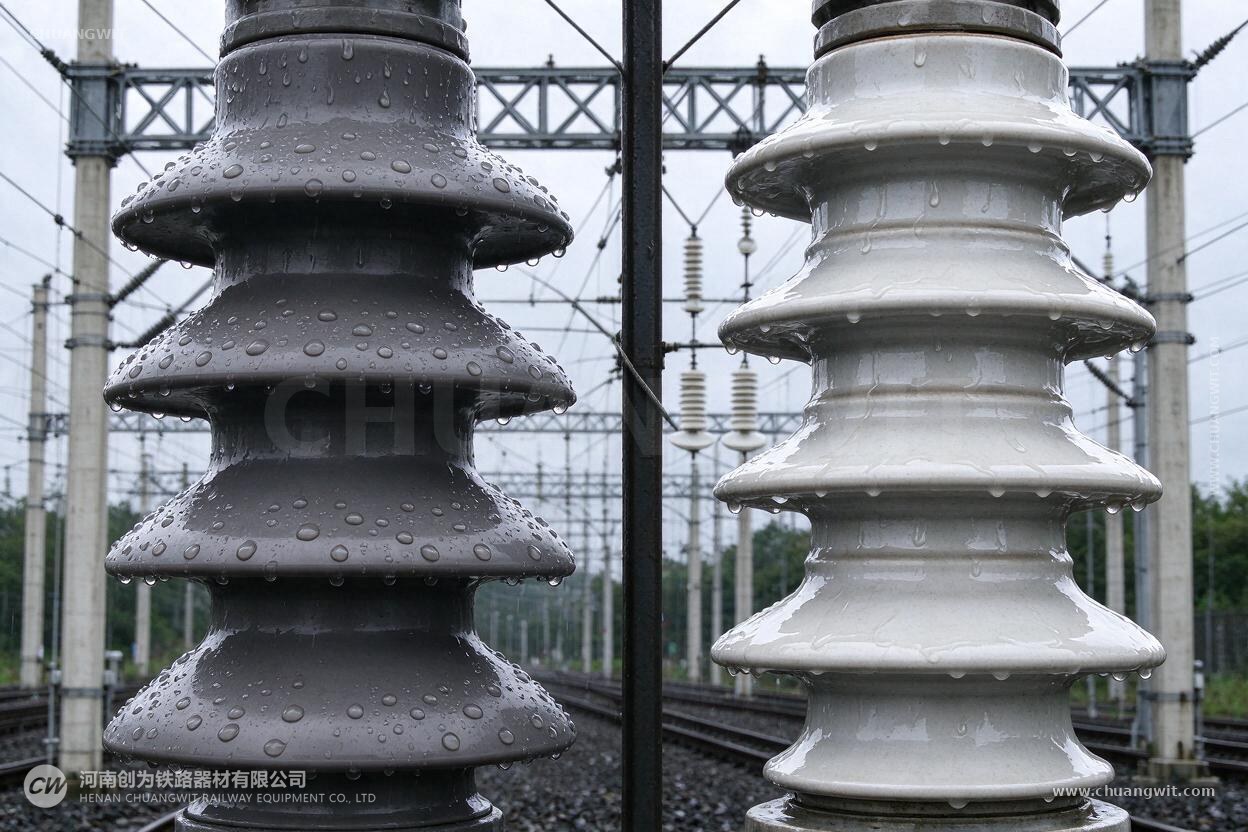
Silicone rubber sheds stay clean because the surface is hydrophobic: water beads into droplets instead of spreading into a film, so pollution never gets the wet layer it needs to conduct. Silicone chemistry provides the property, and low molecular weight silicone species renew it in service, migrating outward to make even the pollution layer water repellent. This hydrophobicity transfer is why composite insulators outperform their creepage in polluted corridors.
Key Takeaways
- Hydrophobicity means water beads rather than wets: without a continuous film, leakage current and dry band arcing are suppressed at the source.
- The property is built into silicone chemistry, an inorganic silicon oxygen backbone carrying non polar organic side groups, not a coating that wears away.
- Low molecular weight silicone species migrate to the surface and into the pollution layer, transferring water repellence to deposits, and the mechanism recovers after washing or light abrasion.
- Silicone rubber absorbs very little water in bulk; its moisture behavior is a surface phenomenon, which is what makes the property so durable.
- Pollution specification still applies: reference unified specific creepage distance of approximately 22.0 to 53.7 mm/kV across site pollution severity classes a to e per IEC TS 60815-1, phase-to-earth basis.
- Hydrophobicity can be lost temporarily through discharge activity and permanently through severe aging, so wetting behavior is a leading condition indicator.
What Is a Hydrophobic Insulator Surface?
Hydrophobicity is the tendency of a surface to refuse wetting. On a hydrophobic shed, arriving water pulls itself into rounded droplets that sit high on the surface, touching only a small footprint, while on a hydrophilic surface the same water spreads into a thin continuous film. The distinction is not cosmetic: a film connects pollution particles into a conductor, while droplets leave dry insulating gaps between them.
That difference decides the leakage current. A continuous film on glass or porcelain lets current flow along the whole polluted surface, heating it unevenly, producing dry bands and then small arcs, which is the classical pollution flashover chain. Droplets on silicone break the chain at the first link, so the surface stays quiet even when visibly dirty. The full failure chain that follows when water does film is traced in our article on polymer insulator aging, tracking and erosion.
Engineers describe the state of a surface by how it beads. New silicone rubber is strongly hydrophobic; aged or discharge damaged silicone becomes less so; glass and porcelain are hydrophilic at best. Because wetting behavior predicts flashover behavior under pollution better than almost any quick field check, it has become a standard condition indicator for composite hardware.
Why Is Silicone Rubber Hydrophobic by Nature?
The answer is in the backbone. Silicone rubber is built on alternating silicon and oxygen atoms, an inorganic main chain carrying organic side groups, typically methyl groups, on the silicon atoms. Those non polar side groups present a low energy surface that water has little affinity for, so the water pulls itself into droplets to minimize contact.
The formulation adds fillers for tracking and erosion resistance and processing aids, so a real shed is a compound, not a pure polymer. The ingredients matter because filler loading must be balanced: enough to resist dry band arcing damage, not so much that the surface turns hydrophilic. A well formulated railway housing keeps its beading for decades of outdoor exposure, which is one reason compound selection is a procurement decision and not a commodity detail.
Contrast explains the value. Porcelain glaze and toughened glass are high energy, fully wettable surfaces whose pollution performance depends on creepage geometry, profile and washing. Silicone changes the surface physics itself, which is why identical creepage delivers very different pollution margins on the two material families, a comparison developed in our article on porcelain versus composite insulator choice for railway OCS cantilevers.
What Is Hydrophobicity Transfer?
Hydrophobicity transfer is the ability of silicone to export its water repellence into material sitting on top of it. Low molecular weight silicone species are mobile within the polymer matrix; they migrate to the surface and diffuse into any pollution layer deposited there. The deposit itself then repels water, even though it is dust, salt or industrial fallout.
This is the mechanism that keeps silicone sheds functional in dirty air. On glass or porcelain, each new pollution deposit is hydrophilic until washed or rained on strategically; on silicone, the deposit is converted. The same mobility restores the surface after insults: rain washing, light abrasion or cleaning strips the outermost layers, and fresh species diffuse outward and re-establish beading, a recovery behavior with no equivalent in ceramic materials.
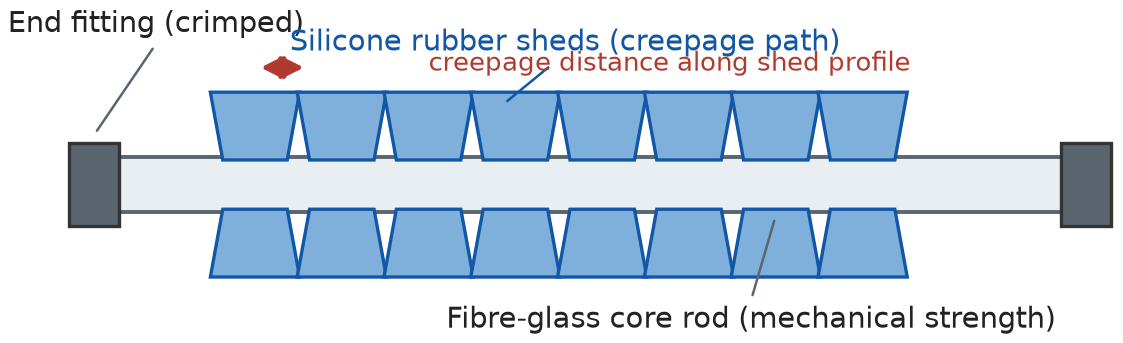
The mechanism has limits, and they define end of life thinking. Heavy or thick deposits can overwhelm the diffusion, discharge activity can temporarily consume the surface repellence, and prolonged severe aging depletes the reservoir of mobile species. Between those limits, hydrophobicity transfer is why a silicone insulator can look filthy and still test quiet, and why cleaning programs for composite hardware are scheduled differently from ceramic strings.
Does Silicone Rubber Absorb Water?
Bulk absorption is minimal. The polymer network of silicone rubber does not take up significant water into its volume, so its moisture behavior is dominated by what happens at the surface rather than inside the material. This is why hydrophobicity, a surface property, tells almost the whole moisture story for a shed.
The engineering consequences run in two directions. First, dielectric performance is stable under humidity, because there is no slowly saturating sponge inside the housing. Second, when wetting behavior does degrade, the cause is almost always surface state, discharge damage or deposits, rather than absorbed moisture, so remedial action targets the surface: cleaning, assessment of discharge sources, or replacement if aging is confirmed.
Moisture matters most where it is unwelcome and hidden: at the interfaces between housing and core, and at end fitting seals. Those zones are managed by design and by the type testing under GB/T 11030-2008 and the TB/T 3199 series, which is where composite railway insulators such as the FQX/FQB family earn their qualification, with suspension types rated to 100 kN tension and cantilever bending types spanning 8 to 20 kN classes.
Why Hydrophobicity Matters on Polluted Railway Corridors
Railway corridors pollute aggressively: freight dust, brake wear, agricultural salt, industrial fallout and, in tunnels, fouled humid air. Pollution performance is dimensioned in unified specific creepage distance per IEC TS 60815-1, with reference values below on the phase-to-earth basis that suits a 25 kV AC traction system.
| Site pollution severity class | Pollution level | Reference unified specific creepage distance (mm/kV, phase-to-earth) |
|---|---|---|
| a | Very light | 22.0 |
| b | Light | 27.8 |
| c | Medium | 34.7 |
| d | Heavy | 43.3 |
| e | Very heavy | 53.7 |
Source: IEC TS 60815-1 site pollution severity methodology, phase-to-earth basis, with diameter and profile corrections per IEC TS 60815-2. The legacy IEC 815:1986 classes I to IV quoted 16 to 31 mm/kV phase-to-phase, and many 25 kV railways historically specified 25 mm/kV for polluted sites.
Hydrophobicity changes how that table converts into performance. Two insulators with identical creepage, one ceramic and one silicone, behave differently in class c or d air precisely because droplets do not form films. The same reasoning applies to arrester housings, where polymer housed units bring silicone surface behavior to surge protection duty, a trade against porcelain shatter risk examined in our comparison of composite versus porcelain arresters for railway overhead lines.
How Does Hydrophobicity Behave Over Service Life?
Hydrophobicity is dynamic. It can drop after heavy pollution events, corona activity or extended wetting, and then recover with time as low molecular weight species redistribute to the surface. This temporary loss and recovery is normal life for a silicone shed. Permanent loss, where recovery no longer comes, is the aging signature that matters, and it flags a unit for closer assessment of tracking and erosion.
Practical monitoring therefore reads wetting rather than cleanliness. A spray test that beads says the surface is healthy regardless of appearance; a surface that wets into films says the aging mechanisms of our companion article are progressing. Railway inspection regimes increasingly capture this through image based condition monitoring, whose role across the whole hardware fleet is described in our overview comparing porcelain, glass and composite insulator materials and in the material specific articles linked there, including the visible failure signature of glass suspension discs and self-shattering.
Frequently Asked Questions
Does silicone rubber absorb water?
Bulk absorption is minimal, because the silicone polymer network does not take up significant water into its volume. Moisture behavior is therefore a surface phenomenon, dominated by hydrophobicity rather than by saturation. When wetting behavior degrades, the cause is surface state such as deposits or discharge damage, not absorbed water, so remedial action targets the surface.
Why do silicone rubber insulator sheds stay clean?
Water beads on the low energy silicone surface, so pollution deposits never receive the continuous wet film they need to conduct. Leakage current and dry band arcing stay suppressed, which slows the aging that makes surfaces degrade further. Low molecular weight silicone species also migrate into deposits and make them water repellent, so sheds function even when visibly dirty.
What is hydrophobicity transfer?
It is the export of water repellence from silicone rubber into material deposited on it. Mobile low molecular weight silicone species migrate to the surface and diffuse into the pollution layer, converting the deposit itself to a hydrophobic state. The same mobility restores beading after washing or light abrasion, a recovery behavior ceramic insulators do not have.
What is silicone rubber made of?
It is a polymer built on an inorganic backbone of alternating silicon and oxygen atoms, carrying organic side groups, typically methyl groups, on the silicon atoms. Those non polar side groups create the low energy, water repellent surface. Practical insulator housing compounds add fillers for tracking and erosion resistance plus processing aids, balanced so the surface stays hydrophobic.
Practical Takeaways
Treat hydrophobicity as a design margin and a condition indicator in one. Specify silicone housing where corridors are polluted and washing is impractical, dimension creepage to the honest IEC TS 60815-1 severity class of the site, and read wetting behavior as the fastest health check available on a composite fleet.
To match shed material and creepage to a specific corridor severity, or to review condition findings on an existing composite fleet, contact our engineering team for a materials level assessment.