Railway insulators and utility insulators follow the same dielectric physics but live in different electrical and mechanical worlds. A railway insulator serves an overhead contact system (OCS): a phase-to-earth traction supply, a moving pantograph load and vibration rich supports. Utility insulators serve three phase networks. Chinese railway service anchors in the TB/T 3199 series with GB/T 11030-2008, qualified from minus 40 to plus 70 degrees Celsius.
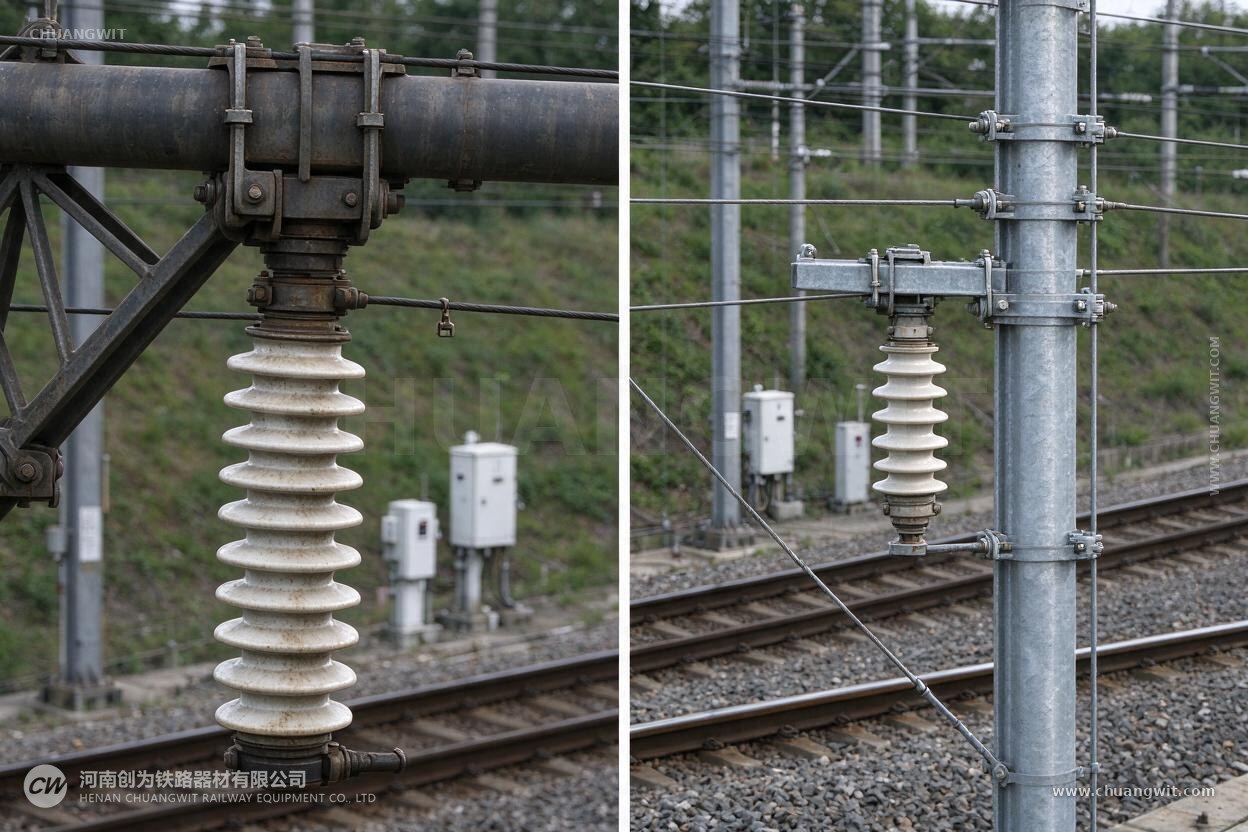
Key Takeaways
- The voltage basis differs at the root: traction creepage is dimensioned phase-to-earth, while classic utility tables were compiled phase-to-phase, per the IEC TS 60815-1 revision of the legacy IEC 815:1986 approach.
- Reference unified specific creepage distance spans approximately 22.0 to 53.7 mm/kV across site pollution severity classes a to e on the phase-to-earth basis per IEC TS 60815-1.
- Railway mechanical duty is anchored in numbers: composite suspension types rated to 100 kN tension and cantilever bending types spanning 8 to 20 kN classes, to GB/T 11030-2008 and the TB/T 3199 series.
- Railway service is verified from minus 40 to plus 70 degrees Celsius, with glass disc strings built on a 146 mm disc spacing.
- Insulation coordination for railways is its own discipline, framed for traction by standards families such as EN 50124 alongside the OCS specific EN 50406 for section insulators.
- Inspection regimes differ in kind: the railway 6C system processes up to 120 GB of data per day under TB/T 2076-2020, a scale utility patrols approach differently.
Is a Railway Insulator Just a Utility Insulator with a Different Drawing?
The temptation is understandable, because both are porcelain, glass or composite bodies whose job is to hold voltage off steel. The answer is no, and the differences compound. A utility insulator supports conductors that move only with wind and ice; an OCS insulator supports hardware that a pantograph strikes and loads dynamically at speed, on masts that vibrate with the traction return current environment around them.
The electrical environment differs just as much. A 25 kV AC traction system is a phase-to-earth system by construction, the catenary being the phase and the rails the return. Pollution collects along corridors that share space with freight, braking and industry. And the administrative environment differs: railway hardware answers to railway standards families and to infrastructure manager acceptance procedures, not only to utility purchasing frames.
Substituting a utility catalogue part into an OCS position is therefore not a procurement shortcut but an engineering decision that needs requalification. The rest of this article sets out what has to be requalified, and why, starting from our two deeper dives into post insulator versus suspension insulator duties in railway OCS and catenary cantilever types and speed classes.
How Does the Electrical Environment Differ?
Creepage specification is the clearest example. The legacy IEC 815:1986 tables, which shaped a generation of utility specifications, quoted minimum nominal specific creepage of 16 to 31 mm/kV for pollution classes I to IV on a phase-to-phase basis, because three phase networks dimension between phases. The current IEC TS 60815-1 methodology moves to a phase-to-earth basis with five site pollution severity classes, and for traction that basis is native: 25 kV to earth is exactly how the OCS operates.
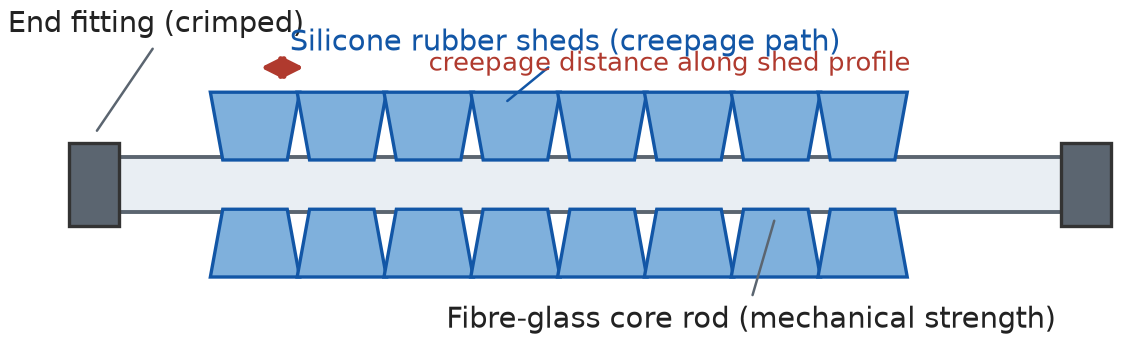
The practical consequence is a conversion trap. A figure lifted from a legacy utility table cannot be compared with a modern traction specification without changing the voltage basis, and the difference is not a rounding error but a structural factor. Historically, many 25 kV AC railways specified 25 mm/kV for polluted sites, echoing the legacy class III figure, and dimensioning practice still carries that memory.
Insulation coordination also branches. Utilities coordinate against their overvoltage and earthing practice; railways coordinate a traction specific mix of switching and lightning overvoltages, working earths and return circuit constraints, framed for traction installations by standards families such as EN 50124, and at component level by families such as EN 50406 for section insulators. The arrester world mirrors the split, with traction classes such as the Y5WT-42/120 built to GB/T 11032 carrying 1600 mm of creepage for 25 kV catenary duty, under the international classification of IEC 60099-4.
How Does the Mechanical Duty Differ?
A utility insulator is designed against steady state tension, wind and ice, with generous static margins. An OCS insulator carries static load plus the recurring dynamic contribution of pantograph passage, registration forces that change with temperature and sag, and the vibration environment of an electrified railway. The numbers that anchor railway selection are as follows.
| Anchored value | Unit | Application in OCS selection |
|---|---|---|
| 100 | kN suspension tension rating | Composite long-rod suspension types, FQX/FQB family |
| 8 to 20 | kN bending classes | Cantilever bending, post type duty |
| 146 | mm disc spacing | Glass suspension disc string length build up |
| minus 40 to plus 70 | degrees Celsius | Service envelope for railway insulator families |
Source: GB/T 11030-2008 together with the TB/T 3199 series for insulators in electrified railway overhead contact systems.
The bending class row is the railway signature. Utility supports rarely sell bending class granularity, because their loads are static; cantilever design lives on it, since each support is computed individually for wind, ice, temperature and pantograph dynamics. The families that carry these ratings are compared in our article on porcelain versus composite insulator choice for railway OCS cantilevers.
Which Standards Govern Each World?
Railway practice anchors in the TB/T 3199 series for insulators in electrified railway overhead contact systems, with GB/T 11030-2008, which is why railway catalogues quote the minus 40 to plus 70 degrees Celsius envelope and per body mechanical proof for glass discs as identity documents rather than options. European OCS practice adds families such as EN 50406 for section insulators, with modern specifications calling for polymer insulating components.
Utility practice works from the general high voltage apparatus and overhead line standard families of the power industry, dimensioned for three phase networks and utility maintenance regimes. The two worlds meet at component level, for example in surge arresters, where GB/T 11032 traction classes and the IEC 60099-4 classification both describe metal oxide technology, but the duty sheets and test emphasis differ.
For a specifier the operational rule is simple: the standard family that qualifies a part for one world is evidence, not qualification, for the other. Demand the railway test file, including the temperature range verification and the bending class documentation, before any substitution crosses the boundary.
How Do Inspection and Maintenance Regimes Differ?
Railways inspect by data. The 6C system standardized in TB/T 2076-2020, the technical specification for the operation, inspection and monitoring system of high speed overhead contact systems, processes up to 120 GB of data per day from train mounted and line side sensing, and its imagery includes insulators as installed. Published work has gone further, applying automatic detection to geometric anomalies of insulator strings and condition assessment by multi source data fusion, an approach our article on condition assessment and fault prediction for OCS insulators and disconnectors reviews.
Utilities patrol differently, mixing aerial inspection, climbing crews and periodic test programs, at rhythms set by asset management economics rather than by traffic windows. Neither regime is softer; they are shaped by access. A railway insulator is overflown by inspection trains at line speed, a utility insulator is examined on outage or from the air, and both feed the same material physics described in our comparison of porcelain, glass and composite insulator materials.
The failure signatures matter to both regimes, and they differ by material more than by world: glass self-shatters visibly, porcelain can hide cracks, composite ages at the surface. The inspection catalog that railway maintainers work from is collected in our OCS component inspection guide covering all 16 categories.
What Should a Specifier Check Before Substituting Between the Worlds?
Check the basis first: is the creepage figure phase-to-earth or phase-to-phase, which pollution severity class is the site, and does the offered unit actually deliver the reference unified specific creepage distance for that class, approximately 22.0 to 53.7 mm/kV across classes a to e per IEC TS 60815-1? A unit that passes a utility datasheet on the wrong basis can be seriously underspecified for traction.
Check the mechanics second: the bending class for cantilever duty within the 8 to 20 kN composite range, the tension rating for suspension duty up to 100 kN, and the temperature envelope from minus 40 to plus 70 degrees Celsius. Check the test file third: type and routine evidence to GB/T 11030-2008 and the TB/T 3199 series, with the per body mechanical proof test for glass discs and the polymer aging evidence for composites. Only then compare price, because by then the comparison is honest.
Frequently Asked Questions
What is the difference between railway and utility insulators?
Railway insulators serve a phase-to-earth traction supply on supports loaded dynamically by pantograph passage, qualified under the TB/T 3199 series with GB/T 11030-2008 for service from minus 40 to plus 70 degrees Celsius. Utility insulators serve three phase networks dimensioned historically on a phase-to-phase basis with mostly static loads. The creepage basis, the mechanical classes and the inspection regimes all differ accordingly.
What is creepage distance?
Creepage distance is the shortest distance along the insulator surface between the energized and earthed fittings. It is the dimension that pollution acts on, because a wet polluted layer conducts along the surface, not through the air. It is specified per unit of operating voltage, with reference unified specific creepage distance values of approximately 22.0 to 53.7 mm/kV across site pollution severity classes a to e per IEC TS 60815-1.
Why is creepage distance important?
Because pollution flashover follows the surface. A longer creepage path forces the wet conducting layer to bridge more distance, which raises the flashover voltage, and dimensioning that path to the site severity class is the primary defense against pollution outages. On a 25 kV traction system the dimensioning is done on a phase-to-earth basis, and historically many railways specified 25 mm/kV for polluted sites.
What is OCS in railway terms?
OCS stands for overhead contact system, the assembly of contact wire, messenger wire, droppers, cantilevers, insulators, section insulators and disconnectors that delivers traction power to the pantograph of an electric train. On 25 kV AC lines the catenary is the phase and the rails form the return. Its insulators are governed by the TB/T 3199 series with GB/T 11030-2008.
Practical Takeaways
Keep the two worlds separate in your documents and let the test file be the bridge when a part must cross over. Write traction specifications on the phase-to-earth basis of IEC TS 60815-1, select cantilever hardware by bending class, and demand the GB/T 11030-2008 and TB/T 3199 evidence that a utility catalogue line alone cannot supply.
If a project is tempting you to substitute utility stock into OCS positions, or you need the railway qualification file reviewed against a utility sourced design, contact our engineering team for a boundary check before order placement.