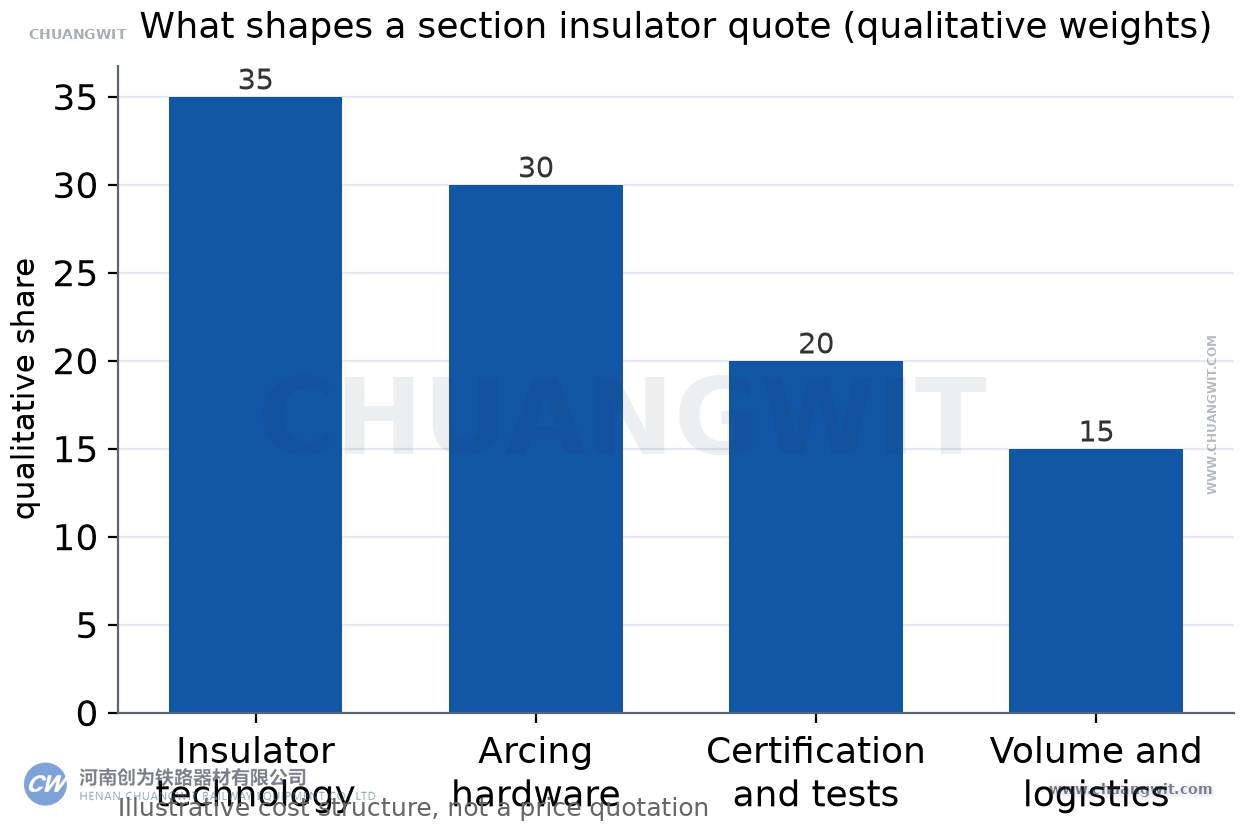
Section insulator price is not one number; it is the outcome of five structural factors: the system family and its standard, the insulation level the site demands, the speed class, the mechanical duty, and the materials, testing and batch terms attached to the order. This article maps that cost structure with qualitative weights only, because a unit price quoted without a specification misleads more than it informs. For orientation, the 25 kV AC families are built to TB/T 3036-2016 and the phase-separation families to the TB/T 3037 series, while DC urban rail uses TB/T 3252-2022.
Key Takeaways
- No unit prices appear here by design: cost structure and factor weights only, because specification, project terms and order size move any quoted figure.
- System family is the first-order driver — a 25 kV AC section insulator to TB/T 3036-2016, a phase-separation device to the TB/T 3037 series and a DC metro unit to TB/T 3252-2022 differ in insulation coordination, materials and test scope.
- Speed class steps the whole structure: design speeds of 120 km/h for urban flexible-suspension types, 160 km/h for mainline classes and up to 200 km/h for reinforced phase-break types each carry heavier test proof.
- Insulation converts environment into cost: heavier pollution demands more creepage, and heavier duty demands more clearance — the 25 kV AC family provides at least 430 mm of air insulation clearance per TB/T 3036-2016.
- Testing amortizes over quantity: type test evidence to the product standard and delivery test reports weigh heaviest on small orders and lightest on frame agreements.
Why Cost Structure Instead of a Unit Price?
Searches for section insulator price usually want a number; a responsible answer is a structure. The same nominal device family varies with voltage system, speed class, creepage class, runner materials, test scope, order size and delivery terms, and a published figure without those qualifiers creates false anchors that distort tenders. What can be stated firmly are the engineering reference points: the standards that apply and the rating steps that exist between them.
One caveat belongs up front: cheapest and most expensive are not ends of a quality scale. A low figure can reflect a speed class or creepage requirement quietly ignored, and a high figure can reflect test scope a project does not need. The five factors below are the levers, and knowing them is what turns a quotation into a decision.
Factor 1: System Family and Standard
The first question any price depends on is which system the device serves. The families differ in voltage, insulation coordination and suspension form, and they are built to different standards — so they differ in materials, dimensions and test scope before anything else is chosen.
| System | Standard | Representative models and duty |
|---|---|---|
| 25 kV railway AC | TB/T 3036-2016 | FYFH series for 25 kV applications; FYFH-1.8BT-E reinforced-insulation phase-break type for BT phase breaks on lines up to 200 km/h; FYFH-2.0AT-E 20 kN reinforced-insulation type for heavy haul and high-tension sections |
| 25 kV phase separation | TB/T 3037 series | XFXP series for inter-phase sectioning, including the XFXP-1.8T-C classic construction for continuity on existing lines |
| DC1500V urban rail | TB/T 3252-2022 | FYFH-0.8TG and 2.0TG types for flexible suspension, suitable for speeds up to 120 km/h, with rigid-suspension counterparts |
Source: model and standard assignments per the TB/T 3036-2016, TB/T 3037 series and TB/T 3252-2022 families as published for the FYFH and XFXP series.
The cost consequence is direct: the 25 kV families carry the insulation coordination of a phase-to-earth traction system, while DC metro hardware carries arc-resistance and tunnel-environment requirements instead — different materials, different tests, different structures. The model-level cross-reference is in the section insulator model guide.
Factor 2: Insulation Level, Clearance and Creepage
Insulation is where the environment enters the price. Insulation coordination sets the air clearance and the solid insulation of the assembly — the 25 kV AC family provides an air insulation clearance of at least 430 mm and altitude capability to 4,000 m per TB/T 3036-2016 — and site pollution then sets the creepage of the insulating components.
Creepage economics follow the pollution frameworks. Historically many railways specified creepage on the order of 25 mm/kV for polluted sites on the legacy phase-to-phase basis of IEC 815 class III; the current IEC TS 60815 series states reference unified specific creepage on a phase-to-earth basis, rising from about 22.0 mm/kV at site pollution severity class a to 53.7 mm/kV at class e. Heavier classes multiply creepage, which multiplies insulating component length or profile depth — which raises material and processing cost. Always confirm which framework, and which voltage basis, a quotation assumes.
Modern practice has also shifted the insulating components themselves toward polymer — resin and composite insulating parts per modern European specifications under the EN 50406 family — and that material transition has its own cost structure: lighter logistics against more demanding aging qualification. The physics of what creepage buys is covered where the concept is defined in depth across the insulator range.
Factor 3: Speed Class
Speed is the factor that steps the entire structure at once. Chinese practice expresses the limit as a design speed verified by type test — 120 km/h for the urban flexible-suspension types to TB/T 3252-2022, 160 km/h for the mainline FYFH classes to TB/T 3036-2016, and up to 200 km/h for the reinforced phase-break type. Each step up demands more of the runner aerodynamics, the mass balance of the assembly and the pantograph-passing dynamics, and each step is proven in testing that the manufacturer must amortize into the price.
The selection logic — why design speed matters and how to choose the class — is its own subject in section insulator speed limits. For cost purposes the rule is simple: pay for the speed the line actually runs, no more and no less.
Factor 4: Mechanical Duty and Materials
Mechanical duty scales the body and the hardware. The FYFH-2.0AT-E reinforced-insulation type carries a 20 kN rating for heavy-haul and high-tension sections — more mechanical class means more conductor section in the runners, stronger insulation bodies and heavier end fittings. Materials then set both performance and process cost: aluminium alloy runners carry the pantograph across the insulation gap with low mass, and stainless steel fasteners answer the humid tunnel air of DC metro service, a combination the urban families use deliberately.
The assembly is more than two runners: insulators, arc bars or arcing horns where fitted, connection fittings and fasteners all belong to the section insulator assembly, and each component family carries its own manufacturing and qualification cost. A quotation that names only the headline type code is silent about most of what is being bought.
Factor 5: Testing, Batch and Logistics
Every compliant batch carries test cost. Type test evidence to the governing standard — TB/T 3036-2016 for the 25 kV AC families, TB/T 3252-2022 for DC urban rail — is a fixed qualification investment amortized across production, while delivery testing and documentation attach to each batch. Test scope is not decoration: on DC systems, arc-resistance testing is the single most predictive document in the file, and insisting on delivery of the test reports with the goods is standard practice.
Batch size then decides how heavily fixed costs sit on each piece — small orders carry proportionally heavy qualification and setup overhead, frame agreements spread it thin. Logistics closes the structure: section insulators ship as assemblies of mixed materials, precision runners among them, so packing and handling are real cost lines. The maintenance side of the same components — inspection and replacement labor — is covered in section insulator installation and maintenance, and the failure modes that drive lifecycle cost in metro section insulator failure analysis.
Frequently Asked Questions
How much is a section insulator?
There is no honest single figure. The same nominal family varies with system standard — TB/T 3036-2016, the TB/T 3037 series or TB/T 3252-2022 — speed class, creepage class, mechanical rating, materials, test scope and order size. The workable approach is to fix the specification first, collect quotations against it, and compare like with like; suppliers who answer in structure rather than a bare number can usually evidence compliance.
What drives railway insulator prices?
Five structural factors: the system family and its standard, the insulation level the site demands, the speed class of the line, the mechanical duty and materials, and the testing and batch terms. Voltage family and speed class dominate because they resize and requalify the whole device; creepage follows the site pollution; test overhead weighs heaviest on small orders. Pin the five and most of the price structure is pinned.
What is in a section insulator assembly?
The working assembly combines the insulation body or bodies with runner sections that carry the pantograph across the gap, connection fittings that join it into the contact wire, arcing components where the design uses them, and fasteners throughout. Materials pair aluminium alloy runners with stainless steel hardware in metro service. Each element is qualified with the whole to the governing standard, which is why assemblies are priced as systems, not parts lists.
Where does a section insulator sit in the OHE?
In the overhead equipment it is series-mounted in the contact wire at electrical boundaries: between separately fed or separately switchable elementary sections, at crossovers, and at phase or system separations where the neutral-section devices take over. Position decides duty — a phase-break site buys reinforced insulation and higher speed class, a metro tunnel buys arc resistance and corrosion-proof materials — and duty, not position alone, drives cost.
Comparing Quotations Honestly
Ask every supplier the same five questions: system family and standard, speed class with type test evidence, creepage basis and pollution framework, mechanical rating and runner materials, and batch and test terms. Answers that cite TB/T 3036-2016, the TB/T 3037 series or TB/T 3252-2022 with stated ratings are comparable; answers that quote a bare number are not. For the operational counterpart of this cost view — what happens at the neutral sections adjacent to many sectioning points — see neutral section operation.
Send the line specification to our engineering team for a structure-level response — family, speed class, creepage options and test scope — before price enters the conversation.