Polymer insulator aging is the gradual degradation of a composite insulator in service, concentrated in two headline mechanisms: tracking and erosion of the housing, and brittle fracture of the core. The housing wears first and usually announces itself; the core failure is rare but catastrophic. EN 50406 section insulator specifications call for polymer insulating components, so this aging is now mainstream overhead contact system (OCS) knowledge.
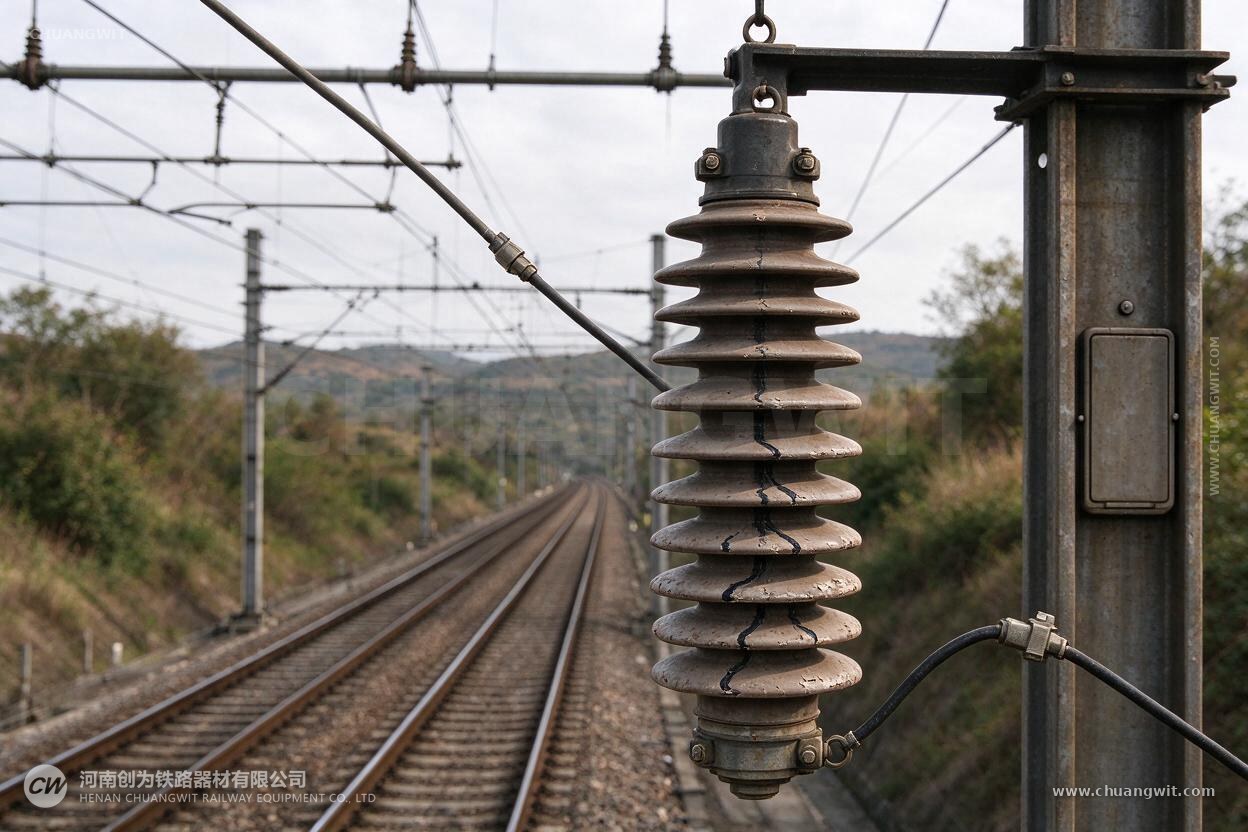
Key Takeaways
- Polymer insulator aging attacks three zones in order: the housing surface, the interfaces between housing and core, and the core itself.
- Tracking is the formation of a carbonized conducting path from dry band arcing; erosion is the non conducting loss of shed material. Both are driven by surface wetting and pollution.
- Hydrophobicity loss is the leading indicator: when silicone sheds stop repelling water, dry band activity and then tracking follow.
- Brittle fracture is a mechanical failure of the glass fiber core driven by chemical attack on stressed fibers, and it can drop a conductor without visible warning.
- Dimensioning against pollution uses unified specific creepage distance of approximately 22.0 to 53.7 mm/kV across classes a to e per IEC TS 60815-1, phase-to-earth basis.
- Railway condition monitoring is image rich: the 6C system processes up to 120 GB of data per day under TB/T 2076-2020, and published work detects geometric anomalies of insulator strings automatically.
What Actually Ages on a Polymer Insulator?
A composite insulator is three subsystems stacked on one axis: a load bearing core of resin impregnated glass fibers, a polymer housing that provides the sheds and creepage, and the interfaces plus end fittings that seal the two together. Aging is not one process but a family of processes, each with its own location, driver and time scale.
The housing faces the environment: ultraviolet radiation, pollution deposits, wetting and drying cycles, corona and surface discharges. The interfaces face water ingress and electric stress, since any gap between housing and core becomes a weak dielectric. The core, protected in theory, faces mechanical tension continuously and chemical attack if the sealing is ever defeated. A well made unit manages all three for decades; an aging assessment is a check that it still does.
Railway duty adds intensity rather than new physics. Traction corridors combine pollution from brake wear and freight, continuous energization at 25 kV AC, mechanical vibration from pantograph passage, and in tunnels, humid and fouled air. The same families serve arrester housings, where the comparison between polymer that slips and tracks and porcelain that can shatter is set out in our article on composite versus porcelain arresters for railway overhead lines.
How Do Tracking and Erosion Develop?
Tracking begins with wetting. When a polluted shed surface loses its water repellence, moisture forms a film, leakage current flows, and the film dries in bands because the current heats it unevenly. Voltage then concentrates across the dry bands, and small arcs strike across them. This dry band arcing is the engine of polymer housing aging.
Each arc deposits energy on the surface. In a tracking susceptible material, the heat carbonizes the polymer and leaves a conducting black path, which grows arc by arc until it bridges enough creepage to matter. In a tracking resistant material such as a well formulated silicone housing, the material instead erodes: shed substance is lost locally without forming a conducting path, so the damage stays non conducting until material loss is severe.
The two outcomes look similar at a glance and demand opposite interpretations, which is why inspection needs more than a glance. The precursor to both is loss of hydrophobicity, the surface property that keeps water in droplets, whose mechanism and recovery we explain in our article on why silicone rubber sheds stay clean. A housing that recovers its water repellence after rain is aging well; one that stays wettable is on the road to dry band activity.
What Is Brittle Fracture of the Core Rod?
Brittle fracture is the mechanical failure mode specific to composite cores. A small population of the glass fibers fails under the combined action of sustained mechanical tensile stress and chemical attack, classically by acidic species that reach the fiber surface through a housing breach or a defective seal. The crack grows slowly, perpendicular to the core axis, until the remaining section can no longer carry the load.

What makes the mechanism serious is its signature: a clean, flat fracture face over most of the core, with only a small final rupture zone, and little external evidence beforehand. The housing can look healthy while the core inside is progressively severed. On an OCS cantilever or suspension position, the consequence is a dropped assembly and a line blockage rather than a controlled outage.
Defense is architectural rather than heroic. It rests on the sealing system at the end fittings, on housing integrity so water and acids never reach the fiber, on correct installation so cores are not scratched during handling, and on design that keeps long term stress within the class rating, such as the 100 kN suspension rating of the FQX/FQB composite family to GB/T 11030-2008 and the TB/T 3199 series.
How Do Standards Expose Aging Before Delivery?
Standards attack aging the same way service does, only faster. Under the GB/T 11030-2008 and TB/T 3199 series framework, composite insulators face type testing that combines electrical stress, wetting and pollution proxies with mechanical loading, precisely to surface weak housings and weak interfaces before the hardware reaches a live railway. Temperature cycling from minus 40 to plus 70 degrees Celsius accompanies the electrical program, since interfaces reveal themselves under thermal expansion mismatch.
European section insulator practice makes the polymer choice explicit: the EN 50406 family for section insulators of overhead contact lines is written around insulating components that are polymer, resin or composite in modern specifications. Dimensioning of the pollution duty, meanwhile, follows IEC TS 60815-1, with reference unified specific creepage distance of approximately 22.0 to 53.7 mm/kV across site pollution severity classes a to e on a phase-to-earth basis. The table below shows the legacy values many older polymer installations were dimensioned to.
| Legacy pollution class (IEC 815:1986) | Pollution level | Minimum nominal specific creepage (mm/kV, phase-to-phase basis) |
|---|---|---|
| I | Light | 16 |
| II | Medium | 20 |
| III | Heavy | 25 |
| IV | Very heavy | 31 |
Source: legacy IEC 815:1986 tables on a phase-to-phase basis; current IEC TS 60815-1 classes a to e are referenced phase-to-earth, so the systems must not be mixed. Many 25 kV railways historically specified 25 mm/kV at polluted sites.
When auditing an aging fleet, that table is the first question: which basis, and which class, was the creepage actually bought to? Underspecified creepage ages a polymer housing faster than any intrinsic material weakness, because it multiplies dry band arcing hours.
How Is Polymer Insulator Aging Caught in Service?
Railways now inspect at data scale. The 6C monitoring system for high speed overhead contact systems, standardized in TB/T 2076-2020, processes up to 120 GB of data per day, and that imagery contains the insulators as installed. Published work has applied rotated bounding box detection to geometric anomalies of insulator strings and sectioning insulators, such as tilt and offset, and multi source data fusion has been used for condition assessment of sectioning insulators and disconnectors, an approach our article on condition assessment and fault prediction for OCS sectioning insulators and disconnectors reviews in depth.
Human inspection still anchors the call. The visible catalog of housing aging runs from loss of sheen and chalking, through hydrophobicity loss visible as wetting behavior, to erosion pits, tracking paths and shed punctures. The practical field checks, including what to photograph and how to grade severity, are collected in our OCS component inspection guide covering all 16 categories.
For brittle fracture specifically, vigilance is indirect: any housing breach, crack at an end fitting seal, or unexplained change in assembly alignment justifies removal and sectioning of the unit. Because the failure is rare, fleets manage it through seal integrity and through removal of any unit whose history includes mishandling.
What Slows Polymer Insulator Aging?
Design choices first: a housing compound formulated for tracking and erosion resistance, creepage matched to the real severity class of the corridor, corona suppression at the live end so discharges do not concentrate on the sheds nearest the fitting, and a sealing system whose durability equals the intended service life. These are precisely the properties that type testing under GB/T 11030-2008 and the TB/T 3199 series is designed to demonstrate, and the reason to demand the full test file rather than a datasheet.
Maintenance choices second: washing programs on heavily polluted corridors, prompt replacement of units with damaged housings, and disciplined handling during installation so cores and seals start undamaged. Material comparison belongs in the same conversation, since glass and porcelain trade this aging catalog for different failure signatures, a trade our article comparing porcelain, glass and composite insulator materials sets out, with the porcelain specific record in porcelain versus composite insulator choice for railway OCS cantilevers.
Frequently Asked Questions
What is a polymer insulator?
A polymer insulator carries mechanical load in a resin impregnated glass fiber core and takes its electrical duty from a polymer housing, typically silicone rubber for outdoor railway service. Composite families such as FQX/FQB rate suspension types to 100 kN tension and cantilever bending types across 8 to 20 kN classes, built to GB/T 11030-2008 and the TB/T 3199 series, and EN 50406 specifications for section insulators use polymer insulating components.
What is tracking and erosion on a polymer insulator?
Both are surface damage from dry band arcing on a wetted, polluted housing. Tracking carbonizes the material into a conducting path that grows arc by arc, while erosion removes shed material without forming a conducting path. Tracking resistant housing compounds erode rather than track, so the distinction tells an inspector whether damage is stable or progressive.
What is brittle fracture in composite insulators?
It is a slow mechanical failure of the glass fiber core driven by chemical attack on fibers under sustained tensile stress, usually after water or acidic species defeat the housing or end fitting seal. The fracture face is characteristically flat over most of the core, and external evidence is minimal, which is why seal integrity and handling discipline are the main defenses on an OCS.
How is polymer insulator aging detected in service?
Through layered inspection: image based monitoring under the 6C system standardized in TB/T 2076-2020, which processes up to 120 GB of data per day, automatic detection of geometric anomalies of insulator strings, and hands on checks of wetting behavior, chalking, tracking paths and seal condition. Hydrophobicity loss is the leading indicator that sends a unit to detailed assessment.
Practical Takeaways
Manage polymer insulators as aging assets with a leading indicator. Track hydrophobicity, protect the seals, dimension creepage to the true IEC TS 60815-1 severity class rather than the cheapest one, and remove any unit with a breached housing or an unexplained alignment change before the core inherits the problem.
For an aging assessment framework over a specific catenary route, or for replacement hardware qualified to GB/T 11030-2008 and the TB/T 3199 series, contact our engineering team and we will work the inspection results with you.