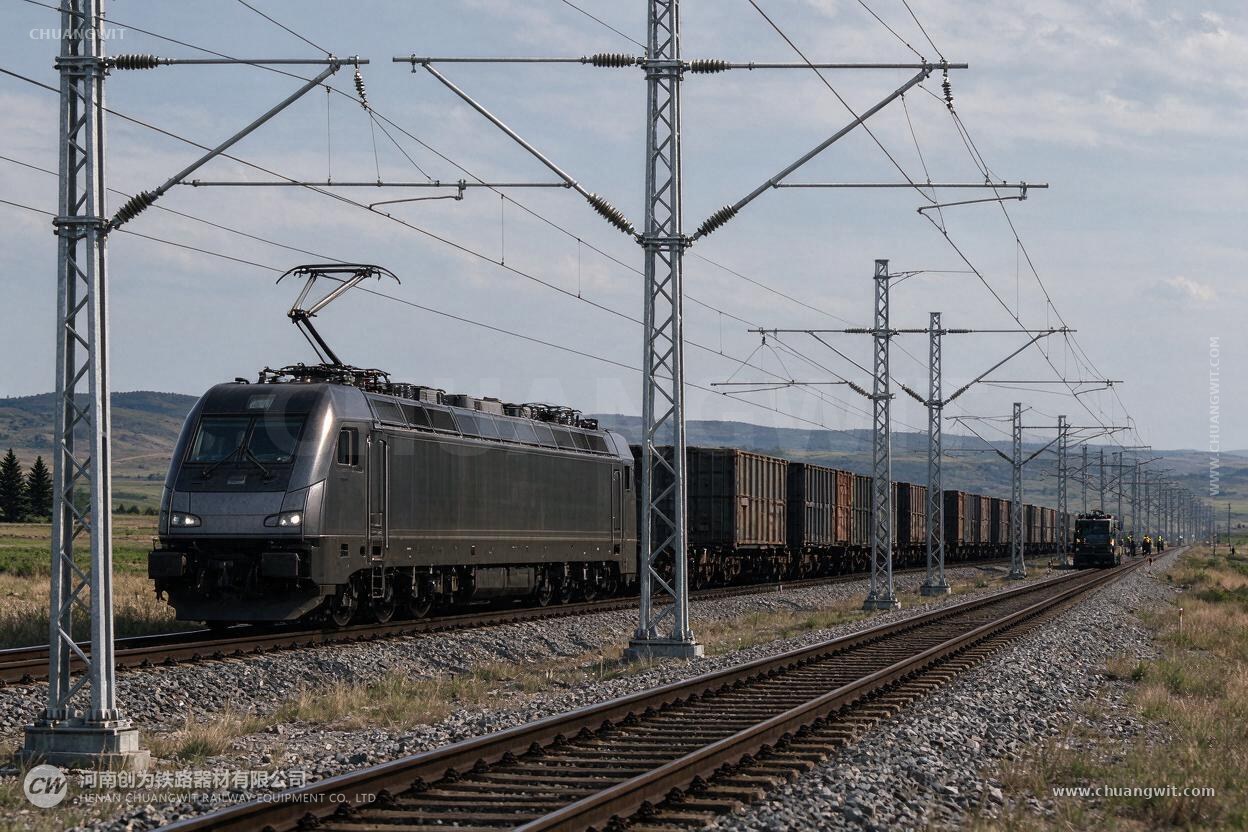
Railway electrification supplies trains with power from the grid through a trackside conductor, overhead or third rail, instead of on-board diesel generation. Railways electrify because grid-supplied electric traction converts energy into motion significantly more efficiently, feeds braking energy back into the system, removes exhaust from stations and cities, and inherits a power mix that decarbonizes without touching the fleet. Mainlines typically run 25 kV AC at 50 Hz.
Key Takeaways
- Electrification moves the power plant off the train: energy arrives from the grid through an overhead contact system or a conductor rail, so the railway buys electricity instead of burning diesel on board.
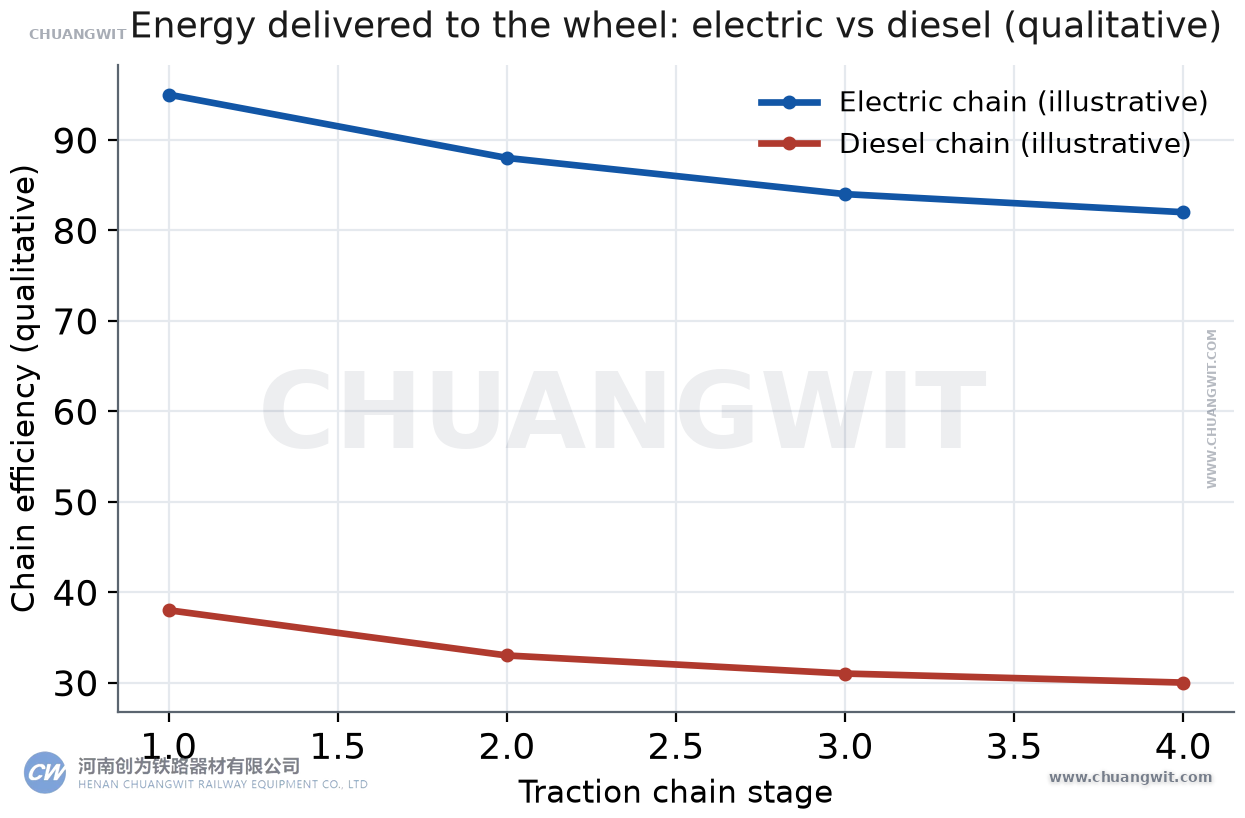
- Electric traction converts energy to motion significantly more efficiently than a diesel engine, and regenerative braking returns braking energy to the system instead of wasting it as heat.
- Mainlines typically run 25 kV AC at 50 Hz; high-capacity corridors use 2x25 kV autotransformer feeding with 50 kV between catenary and negative feeder and autotransformers roughly every 10 to 15 km.
- Urban metros usually run direct current, 1.5 kV overhead to TB/T 3252-2022 practice in Chinese urban rail, or a typical 750 V DC third rail.
- Third-rail collection is practically limited to about 160 km/h, with a world record of 175 km/h set by a British Class 442 in 1988, so speed ambitions push projects toward overhead wire.
What Is Electrification of Railways?
Electrification means converting a railway so traction energy arrives from outside the train. The utility grid feeds traction substations, which transform and feed the contact system along the track; trains collect the power through a pantograph under an overhead contact line or through shoe gear on a conductor rail, and return the current through the wheels and rails. The diesel engine, fuel tanks and much of the traction maintenance burden leave the railway entirely.
The main system families have settled over decades of practice.
| System family | Nominal voltage (kV) | Typical application | Reference point |
|---|---|---|---|
| Single-phase AC overhead | 25 AC, 50 Hz | Mainline passenger and freight | Common mainline practice |
| 2x25 kV autotransformer feeding | 50 between catenary and feeder | High-capacity and high-speed corridors | Autotransformers about every 10 to 15 km |
| DC overhead | 1.5 DC | Urban rail and metros | Urban rail components to TB/T 3252-2022 |
| DC conductor rail | 0.75 DC | Metros and commuter lines at moderate speed | Typical UK third-rail network voltage |
Source: system family values per verified traction supply references; urban rail component standard TB/T 3252-2022.
Why the families coexist, and what each trades away, is the subject of AC versus DC traction: why railways ended up using both, while the component anatomy of the overhead version is laid out in OCS fundamentals.
Why Do Railways Electrify: The Energy Case?
The core argument is thermodynamic. A diesel powertrain burns fuel in a locomotive, converting a minority of the fuel energy into traction at the rail while the rest leaves as heat, and it does so in hundreds of separate engines that each need maintenance. A power station or renewable source feeding an electric train converts energy at industrial scale, and the transmission losses along the contact system are modest by comparison.
Regenerative braking sharpens the case. An electric train braking for a station can return energy to the contact line for the next accelerating train to use, a loop impossible with diesel, where braking energy must be burned off as heat. On metros with frequent stops the effect is significant, and on heavily trafficked mainlines it compounds year after year.
Power is the second argument. An electric locomotive draws whatever the motors demand from the grid, while a diesel unit is capped by the engine it carries, which is why the strongest freight locomotives on electrified corridors out-accelerate and out-haul their diesel equivalents on gradients. The supply chain that makes this work, from substation to wheel, is traced in how electric traction works: from substation to wheel.
What Does Electrification Do for Climate and Air Quality?
Because the energy conversion happens off the train, emissions happen off the train too. Stations, tunnels and dense city corridors stop being exhaust collectors, which was part of the original case for electrification a century ago and matters again for air quality standards today. Noise falls as well, both from the removal of diesel engines and from electric drives that run more quietly at speed.
The climate case compounds over time. A diesel fleet emits the same grams per kilometer in the year it is built and the year it is retired; an electrified railway inherits every improvement in the grid behind it, so renewable additions cut railway emissions without a single change to track or fleet. Regenerative braking reduces the energy drawn in the first place. Together these effects are why electrification appears in national decarbonization plans as a quantified lever rather than a slogan.
What Does Electrification Cost, and When Does It Pay?
The honest answer is that electrification is capital-intensive and the payback is traffic-dependent. The direct costs are the contact system itself, masts, wiring, sectioning and insulation, plus substations and feeding, plus the civil works where bridges, tunnels and stations need clearance for the overhead line, plus depot and rolling stock changes where fleets must convert. Indirect costs include the possession time needed to wire a live railway.
Against that, the operating side improves steadily: energy per train-kilometer falls, locomotive maintenance falls, fleet availability rises, and regenerative braking trims the energy bill further. Payback is fastest on high-traffic, high-power corridors, heavy freight gradients and intensive commuter services, and slowest on lightly used branch lines, which is exactly the pattern seen in electrification programmes worldwide. Costs must be assessed per project; no universal figure survives contact with a specific alignment.
Overhead or Third Rail: How Far Do the Benefits Reach?
The collection technology bounds the benefits. Third-rail and conductor rail systems, such as the fully enclosed steel-aluminium composite contact rail used on light rail, are rugged and compact, ideal in tunnels and at moderate speed, but physics limits them: practical current collection tops out around 160 km/h, with a world record of 175 km/h set by a British Class 442 in 1988, and the exposed rail imposes gaps at switches and level crossings and vulnerability to ice and flooding.
Low voltage also caps train power, since a DC third-rail set draws very high currents: the LIRR M7 and M9 multiple units manage roughly 1,500 to 1,600 kW per two-car set, and such systems need more substations per route-kilometer than AC. Overhead collection at 25 kV AC escapes those limits, which is why speed and heavy traffic push electrification upward, literally. The comparison is developed in fully enclosed light rail steel-aluminium composite contact rail.
Where Does an Electrification Programme Start?
Programmes start with the parameters that drive everything downstream: line speed, traffic density, train power, structure gauge and the existing network around the route. Those inputs fix the system family and then the overhead contact system design parameters, from wire tension to insulation coordination. On strong AC corridors the feeding scheme deserves early attention: fully compensated catenary under AT feeding shows how 2x25 kV autotransformer supply and the suspended assembly are designed as one system.
The lesson of every successful programme is the same: electrification pays where traffic justifies it, and the design decisions that matter, voltage, feeding and collection technology, are made in the first study, not the last. Railways that get those right collect the energy, climate and power benefits for decades.
Frequently Asked Questions
What is electrification of railways?
Electrification is the conversion of a railway so trains take traction power from the grid instead of generating it on board. Traction substations feed a contact system along the track, typically 25 kV AC at 50 Hz overhead on mainlines, 1.5 kV DC or a typical 750 V DC conductor rail on urban lines, and trains collect it by pantograph or shoe gear.
Why electrify a railway?
Because grid-supplied electric traction converts energy into motion significantly more efficiently than on-board diesel, returns braking energy to the system through regeneration, delivers more power to the rail for heavy acceleration and gradients, removes exhaust from stations and tunnels, and inherits every future improvement in the grid. The case strengthens as traffic density rises.
How much does rail electrification cost?
Costs are project-specific, driven by the contact system, substations, civil clearance works in bridges and tunnels, depot changes and rolling stock, plus possession time to wire a live railway. Operating costs fall through cheaper energy per train-kilometer, regenerative braking and lighter locomotive maintenance, so payback is fastest on dense, high-power corridors and slowest on light branches.
How does railway electrification work?
Substations transform grid power to the traction voltage and feed the contact line in sections. Overhead systems carry the current in a contact wire collected by a pantograph, with the messenger wire and droppers holding geometry; conductor rail systems feed shoe gear instead. Current returns through wheels and rails to the substation, closing the loop under earthing rules such as EN 50122-1.
Choosing Next Steps
Electrification is a systems decision: the energy and climate benefits follow from voltage, feeding and collection choices made early. For teams shaping a programme, the companion articles on this site map the components and standards involved, from contact line fundamentals to autotransformer feeding and OCS design parameters.
Chuangwit manufactures overhead contact system components for exactly these programmes, from section insulators to disconnectors, insulators and catenary fittings, built to the TB/T and GB/T standard families cited throughout this article. To discuss component selection for an electrification project, contact our engineering team.