Every cantilever on an electrified railway needs an insulator, and the porcelain vs composite insulator decision shapes the next thirty years of maintenance on that line. The insulator holds off 25 kV between the live catenary hardware and the earthed mast, carries the static and dynamic loads of the suspension, and does so through pollution, rain, frost and temperature swings from minus 40 to plus 70 degrees Celsius. Two material technologies compete for the duty: high-strength porcelain bodies with zinc-sleeve steel pins, and composite long-rod insulators built from silicone-rubber sheds over a fibre-glass core rod.
Neither material is simply better. Porcelain offers a dense, proven, non-ageing dielectric with excellent mechanical stiffness; composite offers hydrophobic pollution performance and a fraction of the mass. The right choice depends on the pollution climate, the structures carrying the load, the handling regime of the installing crews and the inspection culture of the maintainer.
This article compares the two families across the criteria that actually decide projects: pollution behaviour and creepage, weight on the cantilever, failure modes, handling and damage detectability, and lifecycle cost.
Two materials, one duty
A railway cantilever insulator works in bending and tension at the same time. The OCS loads pull on the wire side, wind pushes the assembly sideways, and the insulator must keep its dielectric integrity while those loads cycle with every pantograph passage and every storm. Porcelain insulators, such as the QB27.5 cantilever family, use a high-strength porcelain body with a zinc-sleeve steel pin, a combination whose electromechanical behaviour has been validated across decades of mainline service and is governed by the TB/T 3199 series for insulators in electrified railway overhead contact systems.
Composite insulators replace the porcelain body with a fibre-glass core rod that carries the mechanical load, sheathed in silicone-rubber sheds that provide the creepage path. The FQX/FQB Series Composite Long-Rod Insulator decodes directly: FQ denotes the composite insulator, X the suspension type and B the long-rod form, with suspension types rated to 100 kN tension and cantilever bending types through a full range of 8 to 20 kN bending classes, all to GB/T 11030-2008 and TB/T 3199.2-2018.
Pollution performance and creepage
Creepage distance is the surface length the leakage current must travel, and both families scale it for the environment. Porcelain cantilever insulators are catalogued with 1200, 1400 and 1600 mm creepage options, and composite long-rod models span 1200 to 1600 mm as well, so the choice of material does not by itself decide the available pollution class; heavily polluted coastal sections are served by large-creepage versions in either technology.
What differs is the surface behaviour. Silicone rubber sheds are hydrophobic: pollution sticking to them stays dry-beaded rather than wetted, so leakage currents and the risk of pollution flashover drop even before creepage enters the argument. Porcelain is hydrophilic and relies on creepage plus natural rain washing, which works well on open route but less well where there is no rain, notably in tunnels, or where coastal salt is deposited faster than rain clears it. A composite insulator therefore earns its place quickest in coastal, industrial and desert pollution climates.
Weight and load behaviour on the cantilever
Composite insulators weigh a fraction of the porcelain equivalent, and on a cantilever that mass difference acts at the worst possible point: the tip. A lighter insulator reduces the static bending moment on the bracket and mast, allows lighter supporting hardware, and simplifies erection, because a two-person crew can lift and bolt the unit without mechanical assistance. Porcelain bodies, being dense ceramics, add tip mass that the structure must carry for the whole service life.
Mechanically, the porcelain families offer bending failing load classes from 8 up to 25 kN, with each individual porcelain body passing a mechanical load test before release. The composite family covers bending duties in the 8 to 20 kN range and adds high-tension suspension ratings, including the 100 kN class used where an insulator string hangs in the load path. Both families hold their ratings across the full minus 40 to plus 70 degree operating range, including stable frost and thaw resistance in cold regions.
Porcelain cantilever families: QB and QBS
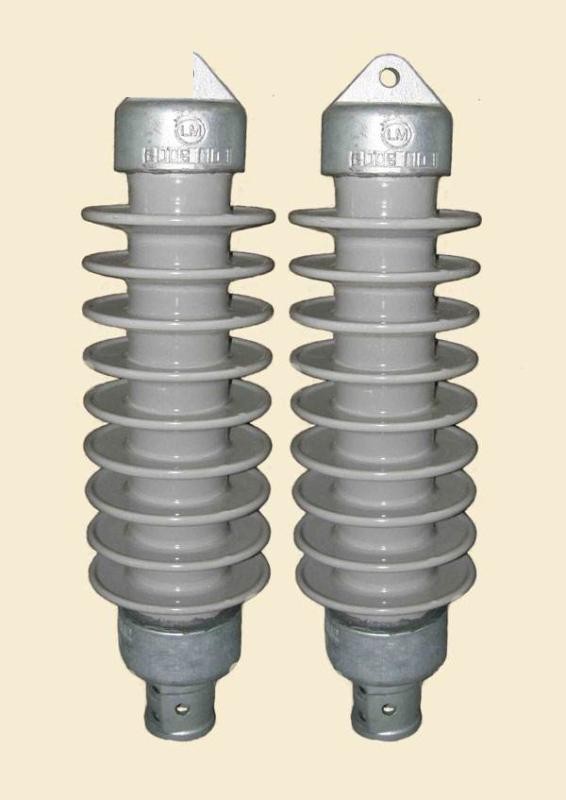
The porcelain side of the comparison is organised into single and double insulation families. The QB27.5 single-insulation porcelain cantilever insulators are described as the most common OCS insulator type: QB identifies the porcelain cantilever insulator, 27.5 the rated voltage in kilovolts, the following digits the bending failing load in kilonewtons from 8 to 25, and the trailing digits the creepage distance, 1200, 1400 or 1600 mm. Structure heights of 760 to 790 mm and arc distances of 490 to 530 mm scale with the creepage option.
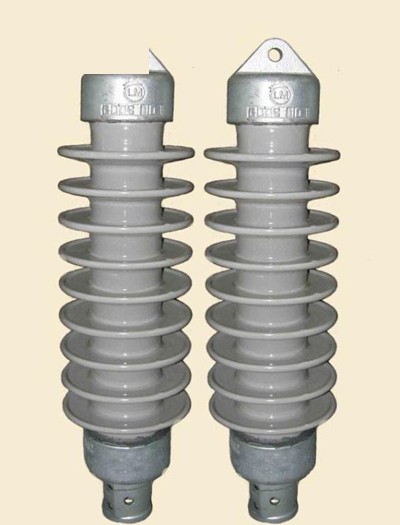
Where the design calls for higher reliability, the QBS27.5 double-insulation porcelain cantilever insulators add the second insulating layer, with the S in the model denoting double insulation. The family keeps the 8 to 25 kN cantilever load classes and offers 1200 or 1400 mm creepage with structure heights of 850 and 865 mm respectively, serving mainline cantilever suspension, tensioning insulation and polluted coastal sections in the same envelope discipline as the single-insulation parts.
Porcelain vs composite insulator failure modes
The two materials fail differently, and the difference matters for risk assessment. Porcelain can fail by puncture, a breakdown through the body wall between the cap and the pin. A punctured unit may hold its mechanical load while losing dielectric strength, and because the fault is internal it is not obvious from the ground. External flashover, by contrast, arcs along the shed profile in both materials: it is loud, it trips protection, and the insulator usually survives it, but repeated events erode the surface. Composite insulators rarely puncture through the core; their degradation mode is surface tracking and erosion of the silicone sheds, or hydrophobicity loss in heavy pollution, all of which develop gradually and are visible to a close inspection. The steel-cored composite design is also impact-proof without shattering, so a strike that would destroy a porcelain shell leaves the mechanical column intact.
Handling, damage detectability and lifecycle cost
Installation and vandalism behaviour round out the comparison. Porcelain must be handled as a brittle ceramic: edge chipping from a knock against the mast can seed a crack, so lifting, storage and bolting all follow careful procedures, and any visible chip or glaze crack condemns the unit. Composite insulators tolerate transport knocks that would scrap porcelain, but their soft sheds can be cut by vandals, tools or gunfire, and a shed perforation that exposes the core needs replacement, because the core, once wetted and polluted, loses its margin. Detectability therefore favours different regimes: porcelain rewards acoustic and close visual testing programmes, while composite rewards routine visual patrol with attention to shed integrity.
| Criterion | Porcelain | Composite |
|---|---|---|
| Mass on cantilever | Higher | Fraction of porcelain |
| Creepage options | 1200 to 1600 mm | 1200 to 1600 mm |
| Pollution surface | Hydrophilic, rain-washed | Hydrophobic silicone |
| Hidden failure mode | Puncture through body | Core exposure via shed cut |
| Handling | Brittle, careful lift | Impact-proof, light |
| Lifecycle profile | Stable, inspection-heavy | Low cleaning, patrol sheds |
Lifecycle cost follows from those rows. Porcelain buys decades of stable, maintenance-light dielectric performance wherever pollution is moderate and handling can be disciplined; composite buys pollution margin, lighter structures and easier installation wherever salt, industry or tunnel conditions dominate. Many projects now run both deliberately: composite long-rods in the polluted and coastal sections, porcelain with large creepage elsewhere, each specified where its strengths pay. For help drawing that line on a specific route, contact our engineering team.