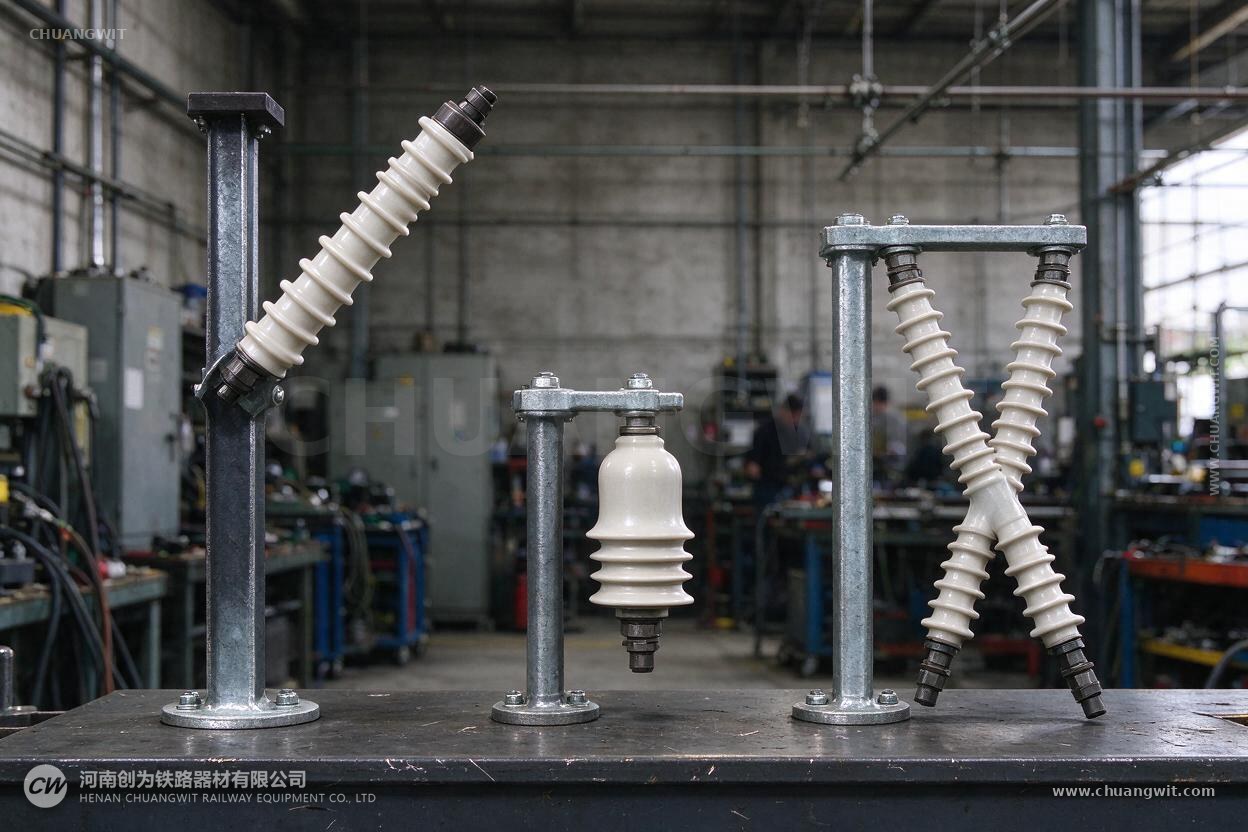
Porcelain, glass and composite are the three insulator materials of the railway overhead contact system (OCS), and each fails differently: porcelain can puncture, glass shatters visibly, composite housing ages by tracking and erosion. All three are governed for railway service by the TB/T 3199 series with GB/T 11030-2008. Composite suspension types are rated to 100 kN tension and cantilever bending types span 8 to 20 kN classes.
Key Takeaways
- The three materials share one electrical job but fail differently: porcelain punctures, glass shatters where you can see it, composite degrades gradually at the surface.
- Glass suspension discs use a 146 mm disc spacing, so string length follows directly from the number of units, with every body individually mechanical load tested to the TB/T 3199 series and GB/T 11030-2008.
- Composite long-rod types decode as FQX/FQB: FQ the composite insulator, X the suspension type, B the long-rod form, rated to 100 kN tension with 8 to 20 kN bending classes.
- All three families serve electrified railway duty from minus 40 to plus 70 degrees Celsius.
- Pollution dimensioning is material independent: approximately 22.0 to 53.7 mm/kV reference unified specific creepage across site pollution severity classes a to e per IEC TS 60815-1 on a phase-to-earth basis.
- Silicone housing adds hydrophobicity, which suppresses pollution wetting and is the main reason composites lead in polluted corridors.
What Do All Three Materials Share?
Every insulator, whatever its body is made of, must hold traction voltage continuously, survive lightning and switching surges, carry mechanical load, and do so for decades outdoors. The electrical dimensioning language is common: a withstand capability proven by test, and a creepage distance matched to the pollution severity of the corridor. The standards frame is common too, since railway service means the TB/T 3199 series together with GB/T 11030-2008 for all three materials.
Where the materials part company is in how they age and how they fail. That difference propagates into inspection regime, spare holding and even track worker training, which is why material choice is a maintenance decision as much as a design one. The two most detailed comparisons on this site, porcelain versus composite insulator choice for railway OCS cantilevers and the self-shattering advantage of glass suspension discs, examine the pairs in depth.
Porcelain: The Dense Veteran
Porcelain is a fired ceramic body whose electrical strength comes from dense, homogeneous material, traditionally finished with a glazed surface that sheds some pollution and resists wetting partially. For railway duty the bodies are high-strength porcelain, and in the classic combination the body works with a zinc-sleeve steel pin whose electromechanical behavior has been validated across decades of mainline service under the TB/T 3199 series.
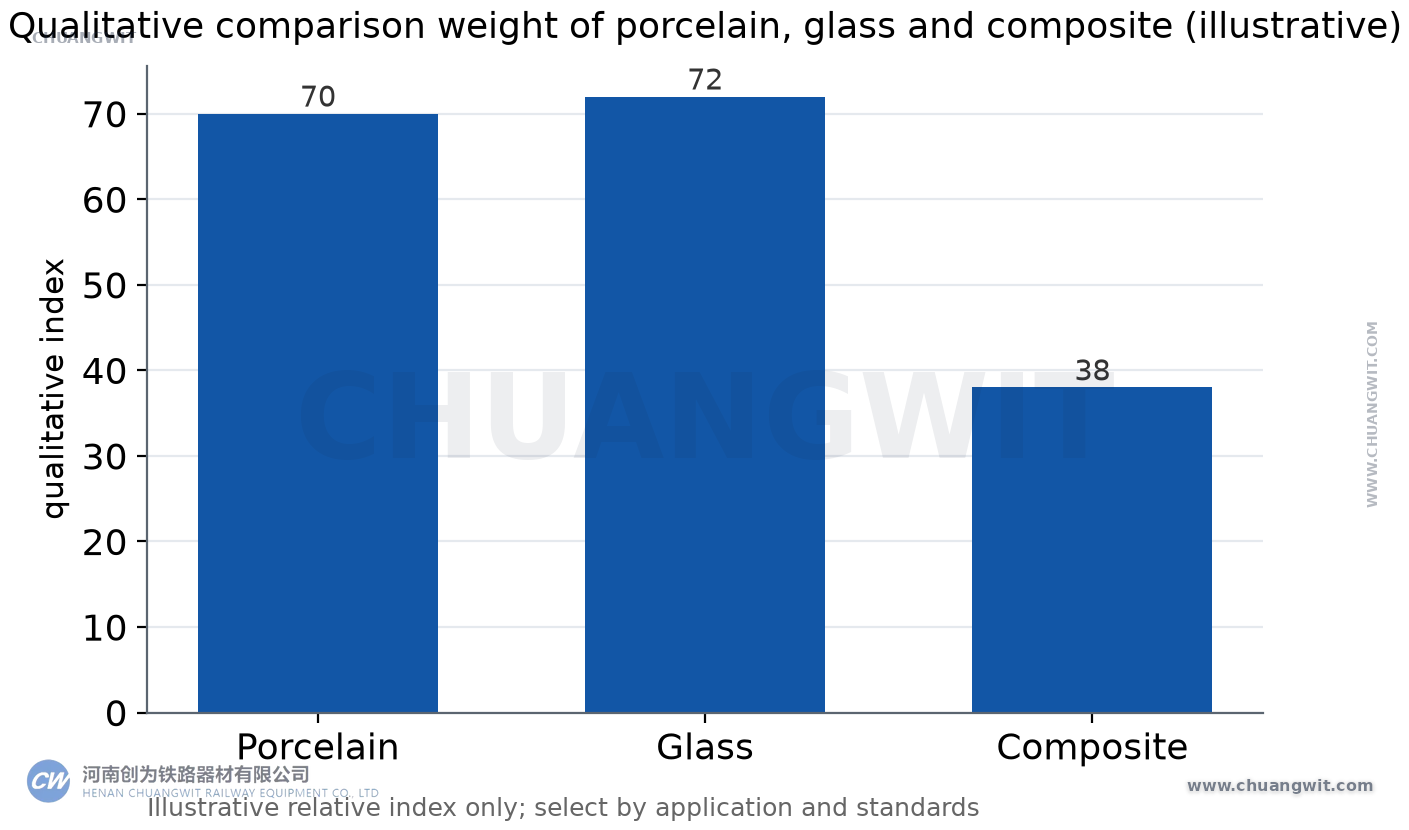
The strength of porcelain is compressive and proven; its weakness is concealment. A crack or internal void can hide inside the body and still pass a visual inspection, which is why routine electrical testing exists and why a puncture, when it finally happens, is sudden. Mass is the second cost: porcelain strings and posts are heavy, which matters for mast loading, tunnel handling and installation logistics.
Glass: Self-Shattering Honesty
Toughened glass stores compressive stress in its surface, which gives the body high mechanical strength and a distinctive failure signature. When a glass disc is overloaded or damaged, it shatters completely and visibly, leaving the cap and pin hanging on the string while the missing shed announces itself from the ground. Inspection therefore becomes a matter of counting shelled discs rather than testing blind bodies.
The railway figures are anchored: disc spacing is 146 mm across the range, so string length follows directly from the number of units, and every body passes an individual mechanical load test before release, to the TB/T 3199 series and GB/T 11030-2008 for service from minus 40 to plus 70 degrees Celsius. Electrically, glass is hydrophilic, so it wets as a film and depends on shape and washing for pollution performance rather than on surface chemistry.
Composite: Polymer Housing on a Resin Core
A composite insulator is a resin impregnated glass fiber core that carries the mechanical load, wrapped in a polymer housing, almost always silicone rubber for railway outdoor duty, whose sheds provide the creepage. The FQX/FQB family decodes directly: FQ denotes the composite insulator, X the suspension type and B the long-rod form, with suspension types rated to 100 kN tension and cantilever bending types through a full range of 8 to 20 kN bending classes, all to GB/T 11030-2008 and the TB/T 3199 series.
The advantages are weight and surface behavior. A composite long-rod weighs a fraction of the porcelain string it replaces, which eases cantilever and mast design, and silicone sheds are hydrophobic, so pollution layers wet as droplets rather than films and flashover voltage under pollution rises. The price is a different failure catalog: the housing ages by tracking and erosion, the core is vulnerable to brittle fracture if its sealing is defeated, and condition assessment is less visual than glass. Our article on polymer insulator aging works through those mechanisms.
Side by Side: What the Anchored Values Say
The table below collects the railway anchored values for the three materials under their common standards frame.
| Attribute | Unit | Porcelain | Glass | Composite |
|---|---|---|---|---|
| Suspension tension rating | kN | Proven family service | String of discs | 100 (FQX/FQB suspension types) |
| Cantilever bending classes | kN | Proven family service | Not typical duty | 8 to 20 |
| Disc spacing | mm | Body dependent | 146 | Continuous shed |
| Individual body mechanical proof test | per unit | Type based regime | Every body tested before release | Type based regime |
| Service temperature range | degrees Celsius | minus 40 to plus 70 | minus 40 to plus 70 | minus 40 to plus 70 |
Source: GB/T 11030-2008 together with the TB/T 3199 series for insulators in electrified railway overhead contact systems.
Read the table as a map of duties rather than a scoreboard. Suspension tension belongs to strings and long-rods; bending belongs to post and cantilever types; and the individual proof test row is the reason glass failures are visible while porcelain failures can hide.
How Does Pollution Performance Differ?
Pollution performance is where surface chemistry earns its money. Glass and porcelain are hydrophilic: pollution wets into a conducting film, and flashover risk tracks the film, so the countermeasures are creepage, profile and washing. Silicone housing is hydrophobic: water beads into droplets, the conducting film never fully forms, and the surface even transfers water repellence into the pollution layer itself, the mechanism explained in our article on why silicone rubber sheds stay clean.
The specification numbers are shared regardless of material. IEC TS 60815-1 sets reference unified specific creepage distance of approximately 22.0, 27.8, 34.7, 43.3 and 53.7 mm/kV for site pollution severity classes a to e on a phase-to-earth basis, which is the correct basis for a 25 kV AC traction system. The legacy IEC 815:1986 figures of 16 to 31 mm/kV for classes I to IV were phase-to-phase based and must not be mixed with the new basis, and many 25 kV railways historically specified 25 mm/kV for polluted sites.
Arrester housings repeat the same triangle. A porcelain housed arrester can shatter under failure with burst risk, while a polymer housed one tends to slip and track at the sheds, as our comparison of composite versus porcelain arresters for railway overhead lines sets out.
Which Material for Which Railway Duty?
For suspension strings where maintenance inspection is easy and mechanical tradition runs deep, glass discs and their visible failure signature remain a strong answer. For cantilever and tunnel duty where weight, bending class granularity and polluted air dominate, composite long-rods of the FQX/FQB type are the modern default, and their integration into cantilever assemblies is described in our article on rod insulators in OCS cantilevers. Porcelain holds its ground where its electromechanical track record and compressive strength are decisive, and where the inspection regime can live with a hidden failure mode.
None of the three choices changes the electrical dimensioning, so make the material decision on maintenance philosophy, corridor pollution and mechanical logistics, then hold every option to the same test file: type and routine evidence to GB/T 11030-2008 and the TB/T 3199 series, and creepage stated on the phase-to-earth basis of IEC TS 60815-1.
Frequently Asked Questions
What is a composite insulator?
A composite insulator is a mechanical load carrying core of resin impregnated glass fiber, housed in a polymer material, almost always silicone rubber for outdoor railway duty, whose molded sheds provide creepage. The FQX/FQB railway family rates suspension types to 100 kN tension and cantilever bending types across 8 to 20 kN classes, built to GB/T 11030-2008 and the TB/T 3199 series, and offers low weight plus hydrophobic pollution performance.
Are composite insulators better than porcelain?
Neither is universally better. Composites win on weight, handling and polluted corridor performance thanks to hydrophobic silicone housing, and porcelain wins on a long validated electromechanical record and compressive robustness. Both meet the same GB/T 11030-2008 and TB/T 3199 series requirements for railway service from minus 40 to plus 70 degrees Celsius, so the decision rests on inspection regime and corridor conditions.
Is porcelain stronger than glass?
In compression both are strong, and porcelain bodies carry decades of mainline service validation. Toughened glass, however, gives every disc an individual mechanical load test before release to the TB/T 3199 series and GB/T 11030-2008, and its failure mode is fully visible self-shattering, so strength is effectively proven per unit. Porcelain can hide internal cracks, which is the trade behind the question.
How much creepage distance does a porcelain insulator need?
Creepage is set by site pollution severity, not by material. Per IEC TS 60815-1 the reference unified specific creepage distance runs from approximately 22.0 to 53.7 mm/kV across classes a to e on a phase-to-earth basis, the correct basis for 25 kV traction. Legacy IEC 815:1986 values of 16 to 31 mm/kV for classes I to IV were phase-to-phase based, and many railways historically specified 25 mm/kV for polluted sites.
Practical Takeaways
Write the material decision into the maintenance plan, not only the design file. Glass rewards lines that can be patrolled and counted, composite rewards polluted corridors and weight limited structures, porcelain rewards conservative mechanical service. Whatever the mix, hold the procurement to the anchored values: 100 kN suspension and 8 to 20 kN bending classes for composites, 146 mm disc spacing for glass, and the common minus 40 to plus 70 degrees Celsius railway envelope.
To match the material map against your corridor severity and support inventory, contact our engineering team for a selection review built on the FQX/FQB composite range and the proven porcelain families.