Insulator selection on a railway overhead contact system (OCS) begins with one question: which mechanical duty must the insulator perform? A post insulator railway component stands rigid between the earthed structure and the live hardware and works as a short beam, carrying the cantilever load in bending at every gust and every pantograph passage. A suspension insulator hangs in the wire path and works as a tension link, its core loaded along its axis by wire tension. The electrical duty is identical; the mechanics are opposites, and almost every selection mistake traces back to confusing the two.
Chinese OCS hardware separates the duties cleanly in its catalogue: porcelain post-type families such as QZ and QBN for mast support and positioning insulation points, and suspension-type families such as QX for the points where an insulator string bears tensile load. Both are governed by the TB/T 3199 series for insulators in electrified railway overhead contact systems, together with GB/T 11030-2008, and both operate from minus 40 to plus 70 degrees Celsius.
This article explains where each type belongs, how their ratings differ, what single and double insulation add for 25 kV systems, and how tunnels and coastal pollution steer the specification.
Two duties: bending and tension
Consider what each insulator does with a load. The post type is bolted at its base to a mast top, base plate or switch support, and the live hardware acts on its free end. Wind pressure on the wires, the weight of the cantilever, pantograph forces transmitted down the registration chain: all arrive as a lateral force that bends the insulator about its base. Its rated quantity is therefore a bending failing load in kilonewtons, and its design problem is stiffness plus dielectric strength in a compact column.
The suspension type hangs between two wire-side fittings, for example between a termination clamp and an anchor or between a bracket and a suspended load. Every force arrives as tension along the axis, so its rated quantity is a tensile failing load. It can afford to be slender, because a column in pure tension does not buckle, but every discontinuity in the load path, every fitting and pin, shares the full wire tension. This is why the two families are never interchangeable: a post insulator installed as a suspension link loses its bending advantage and gains nothing, while a suspension unit asked to act as a rigid post has no bending rating to offer.
Post insulator applications on supports and switch bases
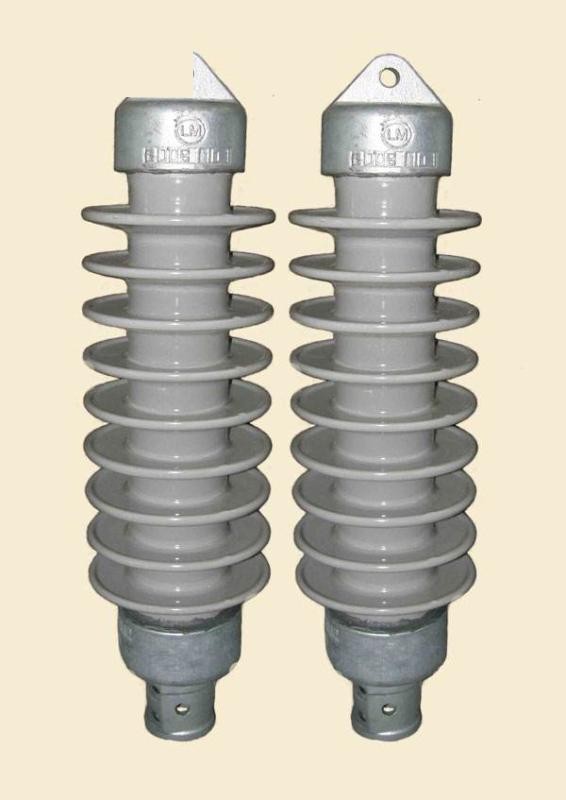
Post insulation belongs wherever the OCS meets a rigid support. The QBN/QBJ/QBG series porcelain post-type insulator covers the mainline range: single-insulation QBN and QBJ models in 1400 mm creepage and QBG models at 1600 mm, with double-insulation QBSN, QBSJ and QBSG equivalents. The model grammar is consistent: 25 denotes the rated voltage class, the following number the cantilever load in kilonewtons from 8 to 20, and the trailing number the creepage in millimetres. Each porcelain body passes an individual mechanical load test, and the zinc-sleeve steel pin guards the most corrosion-sensitive interface.
At the mast support insulation points specifically, the QZ27.5 porcelain post-type insulator is the reference family, and its model code decodes the same way: QZ27.5/16-1400 denotes a rated voltage of 27.5 kV, a cantilever load of 16 kN and a creepage distance of 1400 mm. The complete 8 to 20 kN load classes let the designer match the insulator to the calculated support load, while large-creepage versions serve coastal and heavily polluted sections. Beyond masts, the same post-type duty appears on switch bases and sectioning structures, wherever a rigid, live component must stand off an earthed frame.
Suspension insulators in the wire path
Suspension insulation belongs wherever an insulator hangs in the tension path of the wiring: at tensioning and anchor points, in the strings that carry messenger wire to structures, and in jumper and connection hangers where a conductive span must be broken. The QX27.5 porcelain suspension-type insulator represents the family, and its code reads as duty: QX27.5/70-1400 denotes a rated voltage of 27.5 kV, a tensile failing load of 70 kN and a creepage distance of 1400 mm. The large tensile rating is the point: the unit stands in the full tension of the wire it terminates, so its mechanical margin is measured against the tension length, not against wind bending.
Inspection practice differs accordingly. A post insulator is checked for bending cracks near the base and chipped sheds at working height, while a suspension unit is checked for pin corrosion, cement or interface movement, and evidence of arc flashovers along its sheds. Both families reward the individual mechanical load test that each porcelain body undergoes before delivery, because ceramic defects that matter under bending rarely announce themselves visually.
Single versus double insulation for 25 kV
For 25 kV AC systems, both post and suspension duties come in single and double insulation versions. The single-insulation insulator provides one dielectric barrier between live hardware and earthed structure, which is adequate for most mainline service. The double-insulation families, identified by the S in designations such as QBS for cantilever insulators and the QBSN series in the post range, add a second insulating stage with an intermediate metallic stage arranged toward earth. What that buys is failure tolerance: a puncture or flashover of one stage no longer bridges live parts directly to the earthed structure, and the intermediate stage gives protection and monitoring a defined path.
Double insulation is specified where the consequence of a single failure is unacceptable: above station throats and platforms, in long tunnels where a flashover closes the line for hours, and on structures carrying several tracks from one frame. The cost is a taller, heavier unit, which returns the discussion to the load rating: the double-insulation post insulator must still meet the same cantilever load class as its single-insulation counterpart on the same support.
Selection notes for tunnels and coastal pollution
Environment adjusts the specification after the duty is fixed. In tunnels, pollution is not rain-washed and humidity is constant, so creepage is chosen one class up from the equivalent open-route section and surfaces are inspected on a shorter cycle; double insulation is often worth its premium there. In coastal and industrial atmospheres, salt and conductive dust drive the same logic, and the 1600 mm creepage classes, or hydrophobic composite equivalents, prevent pollution flashover where washing access is limited. Cold regions add one further check: the porcelain families used are tested for stable frost and thaw resistance across the full minus 40 to plus 70 degree range, so the insulation choice must not be downgraded for climate reasons alone.
| Aspect | Post type | Suspension type |
|---|---|---|
| Mounting | Rigid, on supports | Hanging, in wire path |
| Load carried | Bending, 8 to 20 kN class | Tension, up to 70 kN class |
| Typical spots | Mast tops, switch bases | Tensioning and anchor points |
| Rating figure | Cantilever bending load | Tensile failing load |
| Watch item | Base cracks, chips | Pin corrosion, arc marks |
The post insulator and the suspension insulator are not rivals but specialists: one stands and bends, the other hangs and stretches, and each is catalogued, tested and rated for exactly that. For help matching load classes, creepage and insulation levels to a specific structure schedule, contact our engineering team.