Every support point of an overhead contact system (OCS) depends on a cantilever: the framed tube assembly that reaches from the mast over the track and holds the catenary suspension at a fixed height and lateral position. Choosing among catenary cantilever types is therefore one of the first hardware decisions in an electrification project, because the choice fixes the load carried by the mast, the insulation arrangement, the corrosion protection strategy and the erection method. A design institute working on a 350 km/h passenger dedicated line and a contractor rewiring a 160 km/h mixed-traffic route will specify visibly different hardware for the same functional purpose.
Chinese electrification practice has settled this decision by standardising cantilever families around line speed. Hot-dip galvanised steel assemblies serve 200 to 250 km/h passenger dedicated lines and conventional lines below 200 km/h, while aluminium assemblies dominate 300 to 350 km/h high-speed lines, where lower mass on every support reduces the demands on masts and foundations. Both families follow the flat plus inclined cantilever configuration suspended on a post-side insulator string, and both are manufactured to the TB/T 2075 series and its simplified, unified technical requirements.
This article compares the main catenary cantilever types in current production: steel against aluminium tube-and-fitting assemblies, integral against standardised construction, and the way the assembly class is matched to line speed and to tunnel or open-route conditions.
How a tube-and-fitting cantilever is assembled
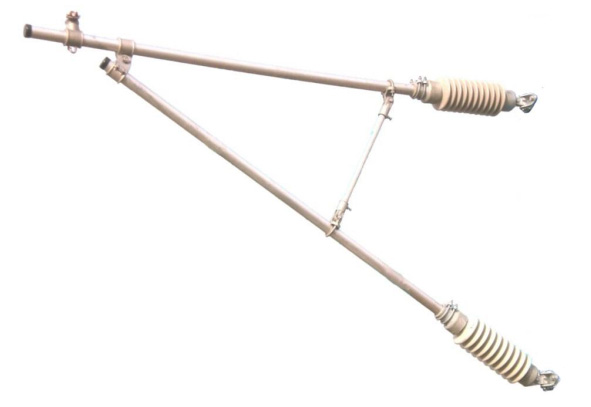
Most open-route cantilevers follow the same tube-and-fitting logic. A flat cantilever tube runs roughly horizontally from the mast side and carries the messenger wire seat, while an inclined cantilever tube rises diagonally to it and provides the mounting reference for the positioning device that registers the contact wire. A diagonal brace closes the triangle, and die-forged connectors join the tubes at their intersections. The complete assembly hangs on the post-side insulator string, so insulation to the earthed mast is provided by rod or string insulators at the mounting interface rather than by the tubes themselves.
Concentrating the insulation at the mast interface keeps the tubes and fittings at line potential, simplifies the geometry and allows the same insulator families to serve many assemblies. It also means the metalwork must never be treated as dead: any bracket, clamp or tool that bridges from a tube to the mast places a fault across the insulation. Individual parts such as clevis eyes, messenger wire seats, support pipe clips and tube caps are dimensionally standardised within each family, so forgings are interchangeable and a damaged tube can be replaced without recutting an assembly drawing.
Steel cantilever assemblies for 200 to 250 km/h lines
The Steel Cantilever Support Assembly (200–250 km/h) is the workhorse family for 200 to 250 km/h passenger dedicated lines and for electrified lines below 200 km/h. Its flat cantilever, inclined cantilever, clevis double eye, messenger wire seat, support pipe clip, cantilever support tube and tube cap are built from hot-dip galvanised steel tubes with forged connectors throughout. The result is an economical, damage-tolerant assembly that suits mixed traffic, station yards and lines where maintenance attention is periodic rather than continuous.
Galvanised steel tolerates rough handling during erection, and bolted joints can be re-torqued in service without special preparation. The zinc layer is the corrosion protection, so the two points that deserve attention are cut ends and bolt holes, where the zinc is penetrated; these are typically dressed with zinc-rich paint during installation. Steel tubes are heavier on the mast and foundations, which is acceptable at conventional speeds and often welcome as stiffness against wind load on exposed routes.
Aluminium cantilever assemblies for 300 to 350 km/h lines
The Aluminum Cantilever Support Assembly (300–350 km/h) replaces each heavy component with an aluminium equivalent: an aluminium flat cantilever, aluminium inclined cantilever, aluminium clamp seat, aluminium messenger wire seat, aluminium clevis single eye, aluminium support and tube cap. The load paths are unchanged, with the flat cantilever carrying the messenger wire seat and the inclined cantilever providing the mounting reference for the positioning device, but the assembly mass falls to a fraction of the steel equivalent.
The weight saving matters more than it first appears. Every kilogram removed from the cantilever tip reduces the static bending moment on the mast, allows slimmer structures and foundations, and lowers the inertia excited each time a pantograph passes. Aluminium also forms a stable oxide skin, so there is no coating to maintain; the engineering effort shifts to managing galvanic contact, which is why the family uses matched aluminium fittings and tube specifications such as the 70 mm 6082-T6 aluminium tube used across the high-speed series. On a 350 km/h line, where dozens of supports carry the same parts, the material choice repeats into measurable savings on structures.
Integral and standardised cantilever families
Two further catenary cantilever types refine the choice. The Integral Cantilever Support Assembly (300–350 km/h) builds the flat cantilever, inclined cantilever, messenger wire seat and cantilever support tube into an integral structure with markedly fewer bolted joints. Fewer joints mean faster erection, less long-term loosening under vibration and more consistent geometry, and the assembly strength is verified against the combined maximum ice and wind load cases. Integral construction suits long high-speed sections built from repeating spans, where factory pre-assembly pays back quickest.
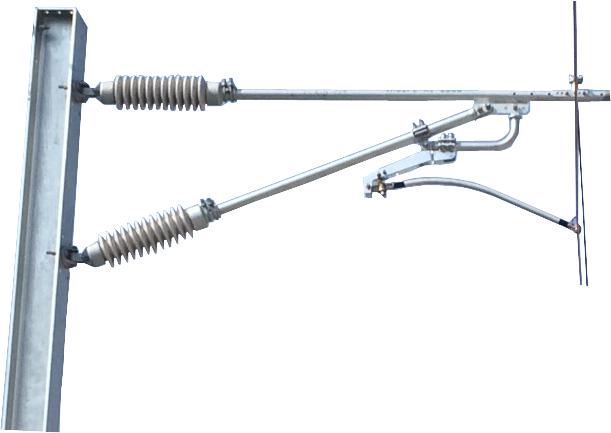
The Standardized Aluminum Cantilever Assembly (300–350 km/h) reaches the same goals from the opposite direction. It is a lightweight, unified parts set, comprising a flat cantilever, inclined cantilever, combined messenger wire seat, support connector and aluminium support, made to the simplified, unified technical requirements of the TB/T 2075 series. Standardisation shrinks the catalogue of drawings a project must manage and makes parts interchangeable between projects and stocking depots, which is valuable on long programmes with phased construction.
Matching catenary cantilever types to line speed
Speed drives the load case. Pantograph uplift forces, aerodynamic drag on the tubes and the dynamic response of the registration point all grow with speed, and the assembly must still carry the governing combined wind and ice maxima of the route climate. A practical selection sequence is to fix the design speed class first, then the environment, then the structure capacity, and only then the family.
For lines at or below 250 km/h the steel family is usually the economical answer, and its speed class brackets both 200 to 250 km/h passenger dedicated lines and conventional mixed-traffic railways. For 250 to 350 km/h service, aluminium assemblies and their integral or standardised variants carry less mass where dynamics matter most. Consistency matters within a section: the inclined cantilever is the mounting reference for the positioning tube and locator, so mixing classes between adjacent supports complicates registration settings and spares holding.
| Criterion | Steel assembly | Aluminium assembly |
|---|---|---|
| Speed class | Up to 250 km/h | 250 to 350 km/h |
| Tubes | Hot-dip galvanised steel | Aluminium alloy such as 6082-T6 |
| Mass on structure | Higher | Lower |
| Corrosion care | Zinc layer, dress cut ends and holes | Oxide skin, control galvanic contacts |
| Erection | Heavier lifts, generic tools | Light lifts, matched fittings |
| Typical duty | Mixed traffic and conventional lines | High-speed passenger dedicated lines |
Tunnel and open-route differences
Open-route cantilevers bolt to bases on mast tops, but inside tunnels the same suspension hangs from short posts anchored into the lining or from brackets fixed directly to the arch. The tubes shorten, the messenger wire seat moves closer to the wall, and the insulation placement must respect the restricted electrical and mechanical clearance of the bore. Damp tunnel air also argues for hot-dip galvanised or coated parts regardless of the speed class chosen outside. The functional families are unchanged; only the interfaces differ.
When a project drawing set is fixed and the speed class, route environment and structure schedule are known, selecting among cantilever families becomes a straight match of hardware to conditions. For help pairing an assembly class with a specific line design, contact our engineering team.