Every gapless metal-oxide surge arrester built for a 27.5 kV traction system contains the same active element: a column of zinc-oxide varistor blocks whose job is to clamp surge voltage and absorb discharge energy. What separates one arrester family from another in daily service is usually the housing around that column. The housing seals the blocks against moisture, provides the external insulation and creepage distance, and carries the mechanical loads of lead-wire tension and wind on a mast-top installation. Choose it badly, and a composite arrester and its porcelain counterpart that look identical on paper diverge sharply after a few years outdoors.
Railway electrification lives with two housing traditions. Porcelain-housed arresters, designated Y5WT and Y10WT in the Chinese traction families, carry decades of service record and exceptional mechanical robustness. Composite-housed arresters, the YH types, wrap the varistor column in silicone rubber and have become the default choice on modern lines for reasons of weight, pollution behaviour and failure mode. Neither is universally superior; the decision depends on the environment, the installation method and the failure consequences the operator can accept.
This comparison works through both housings as they apply to overhead contact system (OCS) duty: how each material behaves under pollution and wetting, what happens when an arrester fails, how each handles in transport and erection, and where each belongs on a modern electrified route.
Why a composite arrester suits polluted and coastal lines
The silicone rubber of a composite housing is hydrophobic: it beads water into discrete droplets instead of allowing a continuous wet film, so leakage current across a polluted shed stays low even when deposition is heavy. Recoverable hydrophobicity strengthens the effect, because low-molecular-weight silicone species migrate into the pollution layer and make the layer itself water-repellent. The practical consequence is that a composite arrester with a given creepage distance commonly outperforms a porcelain arrester with the same distance in coastal salt-fog, cement dust, coal corridor and industrial pollution environments, and requires less cleaning intervention to stay there.
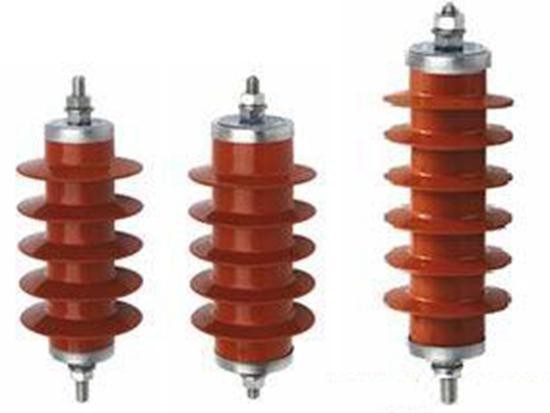
Weight is the second advantage. A silicone housing over a fibreglass or resin core weighs a fraction of the equivalent porcelain shell, which changes the ergonomics of mast-top installation: shorter possessions, smaller crews, and less load on cantilever fittings not originally designed for arrester service. For elevated urban viaduct OCS and retrofit programmes where arresters are added to existing structures, the composite YH5W-42/110 gapless metal-oxide surge arrester represents the common solution, pairing the lightweight housing with a 42 kV rating, a 31.5 kV continuous operating voltage and a lightning impulse residual voltage of no more than 110 kV.
Where porcelain arresters still win
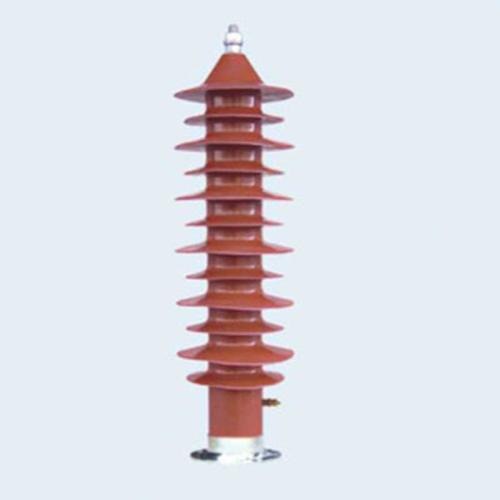
Porcelain brings its own list of virtues. The fired ceramic shell is extraordinarily resistant to abrasion, sand-laden wind and direct mechanical abuse, which matters on corridors where maintenance access is rough and handling discipline is imperfect. Its dimensional stability and long service record give many asset owners the confidence that comes from decades of installed base, and its stiffness suits installations where the arrester also carries sustained lead-wire tension. The Y5WT-42/120 porcelain-housing metal-oxide surge arrester exemplifies the class for traction duty: 5 kA nominal discharge class, a 600 A 2 ms square-wave withstand, 1600 mm of creepage and operation from -40 °C to +70 °C, all sealed for long-term energised outdoor service to GB/T 11032.
The honest counterweight is mass and failure behaviour. Porcelain shells are heavy, demanding mechanical lifting at every installation and replacement. Should an internal arc occur, a porcelain housing can shatter, scattering fragments over track and personnel; composite housings split, vent and generally stay attached. Modern porcelain arresters mitigate the consequence through external disconnectors that detach the faulty unit from the circuit, and disconnector-equipped versions are standard across both housing families in the traction range.
Reading the YH family on residual voltage steps
Within the composite family the housing is constant while the varistor column changes, and the designation records the result. The YH5W series for 27.5 kV traction arrives in three residual voltage steps, and the figure after the slash is the lightning impulse residual ceiling in kilovolts. The YH5W-42/120 gapless metal-oxide surge arrester occupies the middle step, and the family data make the progression explicit: the 110 kV variant limits lightning impulse residual to 110 kV with a steep-wave ceiling of 127 kV and a switching impulse ceiling of 94 kV, while the YH5W-42/140 gapless metal-oxide surge arrester allows up to 140 kV lightning impulse, 157 kV steep-wave and 119 kV switching impulse residual, with a DC 1 mA reference voltage of at least 65 kV and a 400 A square-wave withstand.
The direction of choice is protective margin: the lower residual step of a 110 kV unit leaves more withstand margin on tightly coordinated insulation, while the 140 kV step reflects a column built for heavier thermal duty. All three share the same composite housing, continuous operating voltage of 31.5 kV and the sealed, gapless construction the OCS environment requires, so the housing decision and the electrical decision can be taken independently.
Pollution, wetting and long-term behaviour
Housing material interacts with the environment through the surface layer. On porcelain, pollution combined with mist or light rain forms a conductive film; leakage current heats the film unevenly, dry bands form, and local arcing can graduate to tracking and eventually flashover unless the surface is cleaned. The traditional defences are creepage distance and washing schedules, both of which cost money on a route of hundreds of kilometres. Silicone surfaces suppress the wet-film mechanism itself, and shed profiles on composite arresters exploit this with shapes that would be impractical to cast in ceramic. On heavily polluted corridors the maintenance ledger usually decides the question in favour of composite, while in clean inland environments, where pollution rarely wets into a continuous film, porcelain performs indefinitely and the choice can follow mechanical considerations alone.
Handling, transport and installation
Logistics differences are easy to underestimate. Composite arresters travel well on simple pallets, tolerate stacking and can be manhandled into position by a two-person crew; porcelain units demand individual packing, cushioned transport and crane or gin-wheel erection, with each lift over live track planned as a formal operation. On the other side of the ledger, porcelain tolerates the rough contact of tools, ladders and neighbouring materials without cosmetic damage, while composite sheds can be cut or scored by sharp contact, and any deep cut into a shed becomes a track-management concern that inspection must catch. Neither habit is difficult; each requires the site culture to match the material.
Choosing between the two housings
The decision factors compress into a short comparison, with the caveat that both families meet the same GB/T 11032 electrical requirements for traction service.
| Aspect | Composite housing | Porcelain housing |
|---|---|---|
| Weight | Low | High |
| Pollution behaviour | Hydrophobic, low leakage | Needs creepage and cleaning |
| Failure mode | Splits and vents | Can shatter |
| Mechanical abuse | Sheds can be cut | Abrasion and impact resistant |
| Erection effort | Manual, short possession | Lifting plan required |
In practice the composite types now dominate new electrification and polluted-corridor retrofits, and porcelain retains a solid role where mechanical severity, abrasion or established practice favours it. Both are supplied with disconnectors and counters where the maintenance regime wants visible fault isolation and discharge records. For a corridor-specific recommendation, our engineering team reviews the pollution class, exposure and installation method and returns a housing and residual-step schedule for the section.