Among the insulators available to a traction electrification engineer, the glass suspension insulator has one property no other dielectric offers: it announces its own failure. A toughened glass disc that loses its dielectric strength shatters on the spot, sheds its shell, and stands out from hundreds of intact units as an empty cap and pin that a patrol can see from the track. In a railway environment where inspection time is scarce and possessions are short, failure you can see at line speed is not a small convenience. It changes the economics of the whole insulator maintenance programme.
Tempered glass discs have served overhead contact systems (OCS) for decades, in strings that carry messenger wires to structures, in the tensioning and anchor points of every tension length, and in jumper and connection hangers. Their mechanical ratings, creepage options and standard compliance place them alongside porcelain and composite alternatives; their self-shattering behaviour is what sets the inspection regime apart.
This article explains how toughened glass discs are built, why self-shattering works, how their mechanical and puncture behaviour compares with porcelain, where they fit in catenary anchoring, and what a sensible inspection workflow looks like.
How a toughened glass disc is built
A tempered glass insulator starts as a molten glass shell pressed around its metal parts, then cooled rapidly so the outer skin freezes in compression while the interior settles in tension. That residual stress profile is the engineering: compression in the skin suppresses surface crack growth, giving the disc high bending and impact strength for its mass, and it stores enough strain energy that an internal flaw large enough to matter cannot grow slowly. It releases all at once, and the shell shatters into small blunt granules.
The LXP/LXWP series glass suspension insulator catalogues the family in 70 and 80 kN failing-load classes. The LXP models are the standard profiles with 320 mm creepage per unit, LXWP models are the antipollution profiles with 400 mm creepage, and LXWP1 units reach 450 mm creepage on a 280 mm diameter shell, with corresponding lightning impulse withstand ratings of 100, 110 and 125 kV per unit. Disc spacing is 146 mm across the range, so string length follows directly from the number of units, and every body passes an individual mechanical load test before release, to the TB/T 3199 series and GB/T 11030-2008 for electrified railway service from minus 40 to plus 70 degrees Celsius.
Self-shattering: failure you can see
The self-shattering behaviour of toughened glass is usually summarised as shattering at zero value. A disc is a zero-value unit when it has lost its dielectric function, and in glass this state is self-declared: the shell goes, the granules fall away, and what remains is the steel cap and pin with the string still mechanically continuous. The electrical fault is total, but it is also unmistakable at a glance, which is the exact opposite of the failure a porcelain disc prefers, an internal puncture that leaves the shell intact and the defect invisible until close testing finds it.
The maintenance consequence is profound. A patrol on foot, on a road-rail vehicle or from a passing train can count shattered discs along a whole line without touching anything, and the count is the condition assessment. There is no need for live-line dielectric testing to find dead units, no ultrasonic survey to find hidden punctures, and no judgement call about whether a surface mark matters. Insulation faults in glass strings announce themselves; the engineering task reduces to replacing the announced units in the next planned possession.
Glass suspension insulator strength and puncture behaviour
The tempered skin does double duty. In service, the compression layer gives the disc resistance to the surface damage that would grow into fracture in annealed glass: glaze scuffs, small impacts and thermal shock cycles. Even after a shell shatters, the cap-and-pin core of the unit continues to carry the string load, so a zero-value disc does not drop the wire it hangs from; the fault is electrical, not mechanical, and the string holds until the scheduled replacement.
Puncture behaviour against porcelain follows from the same physics. Porcelain can puncture through its wall between cap and pin, leaving a conductive channel hidden inside an intact-looking body. In toughened glass, a flaw that reaches critical size releases the stored stress and shatters the shell instead of quietly conducting, so the dielectric failure mode and the visible failure mode are the same event. For a maintenance engineer weighing hidden-failure risk, that difference is the whole argument, and it is why glass strings dominate where long, patrol-only inspection intervals are the reality.
Where glass strings fit in catenary anchoring
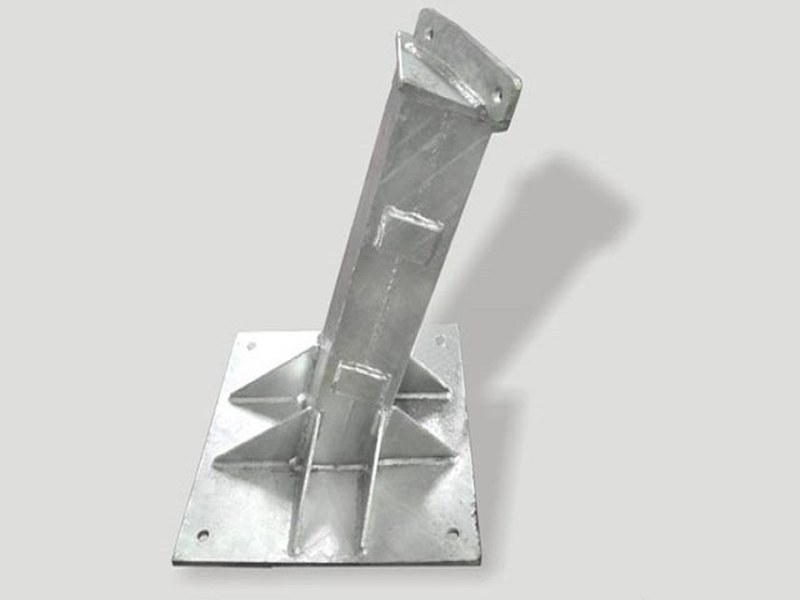
Anchoring is the natural home of glass in a contact system, because an anchor point needs both full mechanical load capacity and reliable insulation in one string. At a tunnel anchoring compensation point, the load path starts at the structure: the 23-1 Heavy-Duty Anchor Arm is the load-bearing fixed point that carries the full anchoring tension of the contact wire and messenger wire and provides the rigid support on which pulley blocks and limit frames operate, bolted to the tunnel wall or foundation and hot-dip galvanised for the damp atmosphere.
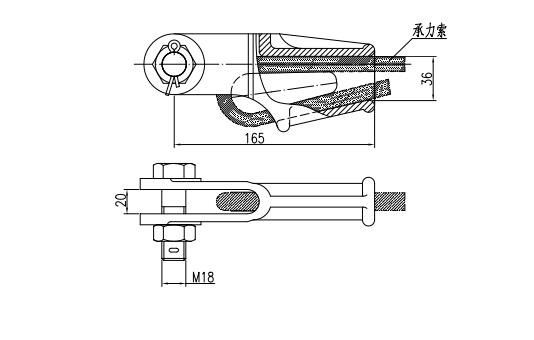
At the wire end of the same load path sits the termination hardware. The JL27-2010 terminal anchor clamp grips the outgoing contact or messenger wire with a wedge self-locking forged copper alloy body, at a grip strength not lower than 95 percent of the rated breaking load of the wire, and its other end connects to the insulator and tensioning assembly that completes the OCS tensioning fixation. The glass string between them insulates the full tension path; the same arrangement serves station terminations, urban rail anchors and emergency repair work at speeds of 350 km/h and below, and shorter glass units hang in jumper connections where a conductive span must be broken.
An inspection workflow built on visibility
The inspection workflow for glass strings follows three steps. First, patrol: walk or ride the line at the specified interval and count shattered discs per string, recording structure numbers. Second, triage: a single shattered unit in an otherwise sound string is a planned-possession replacement; clusters in one span suggest a local cause, such as a lightning strike or vandalism, and deserve a closer look at the whole string. Third, replace and record: swap the failed units, check the fittings for the arc damage that sometimes accompanies a flashover, and reset the count. Because the shells of neighbouring units are unaffected by one unit shattering, replacements are single-disc interventions.
Pollution adds one routine task. On coastal and industrial sections, the antipollution LXWP profiles with 400 or 450 mm creepage buy margin against surface flashover, and periodic washing keeps that margin; the shell surfaces are smooth and non-tracking, so washing restores them fully. In cold regions the bodies resist freeze-thaw cycles stably, and the tempered skin tolerates the thermal gradients of rapid temperature changes better than most ceramics.
| Type | Creepage | Impulse | Duty |
|---|---|---|---|
| LXP-70/80 | 320 mm | 100 kV | Standard strings |
| LXWP-70/80 | 400 mm | 110 kV | Polluted sections |
| LXWP1-70/80 | 450 mm | 125 kV | Heavy pollution |
Tempered glass does not eliminate insulator failures; it converts them from hidden defects into visible inventory. For a line owner, that conversion is worth as much as any rating on the datasheet, and it is why glass suspension strings remain a default choice for catenary anchoring worldwide. For help sizing glass strings for anchor, tensioning or jumper duty on a specific route, contact our engineering team.