An overhead line maintenance window — a possession or a line block — is a planned period in which traction power is switched off, the overhead contact system (OCS) is earthed and trains are excluded so crews can work safely. Productive planning means staged work packs, clear checkpoints and materials waiting at the access point before the block starts. EN 50122-1 frames the safety case with permissible prospective touch voltage limits of 60 V rms on AC and 120 V on DC in normal operation.
Key Takeaways
- A maintenance window combines three conditions: power off and proven dead, protective earths applied, and train movements blocked — anything less is not a safe possession.
- EN 50122-1 permits prospective touch voltage of 60 V rms on AC and 120 V on DC in normal operation; fault-time limits follow voltage-time curves in the same standard.
- The 6C monitoring system specified in TB/T 2076-2020 processes up to 120 GB of inspection data per day, so crews can arrive with defects already located instead of searching on site.
- Per GB/T 1985-2023, a position signal may be issued only when the moving contacts of all poles of a disconnector have reached the open or closed position — interlock verification belongs in every isolation checklist.
- Window output is won before power comes off: materials staged, permits issued, access lighting rigged and the work sequence rehearsed on paper.
What Is a Maintenance Window in Railway Overhead Line Work?
Railways earn revenue when trains run, so electrification maintenance is compressed into planned pauses. A maintenance window — termed a possession when the line is handed over entirely, or a line block when a defined section is closed — gives crews exclusive access with the overhead line dead and earthed. Windows are short, repeated and expensive per minute, which makes planning discipline the main productivity lever available.
Each window follows the same arc: application and granting of the block, isolation and earthing at agreed points, execution of work in pre-defined packs, withdrawal of earths, proving the line, and handback. Skipping the paperwork stage is how productive windows turn into incident reports, because every later step depends on knowing exactly what was touched and what was left.
The vocabulary differs between railways — possession, line block, work window — but the engineering content is the same: exclusive access, proven isolation and a bounded handback time. International projects should agree the term and the checklist behind it before the first mobilization, because the safety case, not the word, is what crews inherit.
Is the Railway Overhead Line AC or DC — and Why Does It Change the Plan?
Main line railways generally run 25 kV AC traction supply, while metros commonly run DC at 1500 V with rigid or flexible overhead construction. The distinction changes switching practice, earthing arrangements and the test instruments crews carry. The touch voltage reference points that frame safe working come from EN 50122-1.
| System | Permissible prospective touch voltage, normal operation (V) | Source |
|---|---|---|
| AC traction | 60 rms | EN 50122-1 |
| DC traction | 120 | EN 50122-1 |
Source: EN 50122-1 permissible prospective touch voltage in normal operation; short-term fault limits follow the voltage-time curves in the standard.
Construction also shapes the task list. Rigid busbar lines built to TB/T 3252-2022 concentrate work on joints, supports and section devices; flexible catenary adds dropper, stitch wire and tensioning checks from the TB/T 2075 families. The construction decision itself is compared in rigid overhead conductor rail versus flexible catenary.
How Do You Structure a Productive Possession?
Structure the window in three phases. Before: freeze the work pack list well ahead, stage materials at the access point, pre-assemble whatever can be pre-assembled, and confirm permits, staffing and tool calibration. During: run parallel crews where isolation allows, sequence walking and travel time realistically, and hold a mid-window checkpoint against the pack list. After: account for every person and tool, withdraw earths in reverse order of application, and record deferred items while memory is fresh.
Two habits separate strong performers. They classify candidate work in advance into line-blocking, adjacent-track and no-access categories, so the window request matches true needs. And they feed deferred items straight into the next window request instead of losing them in reports.
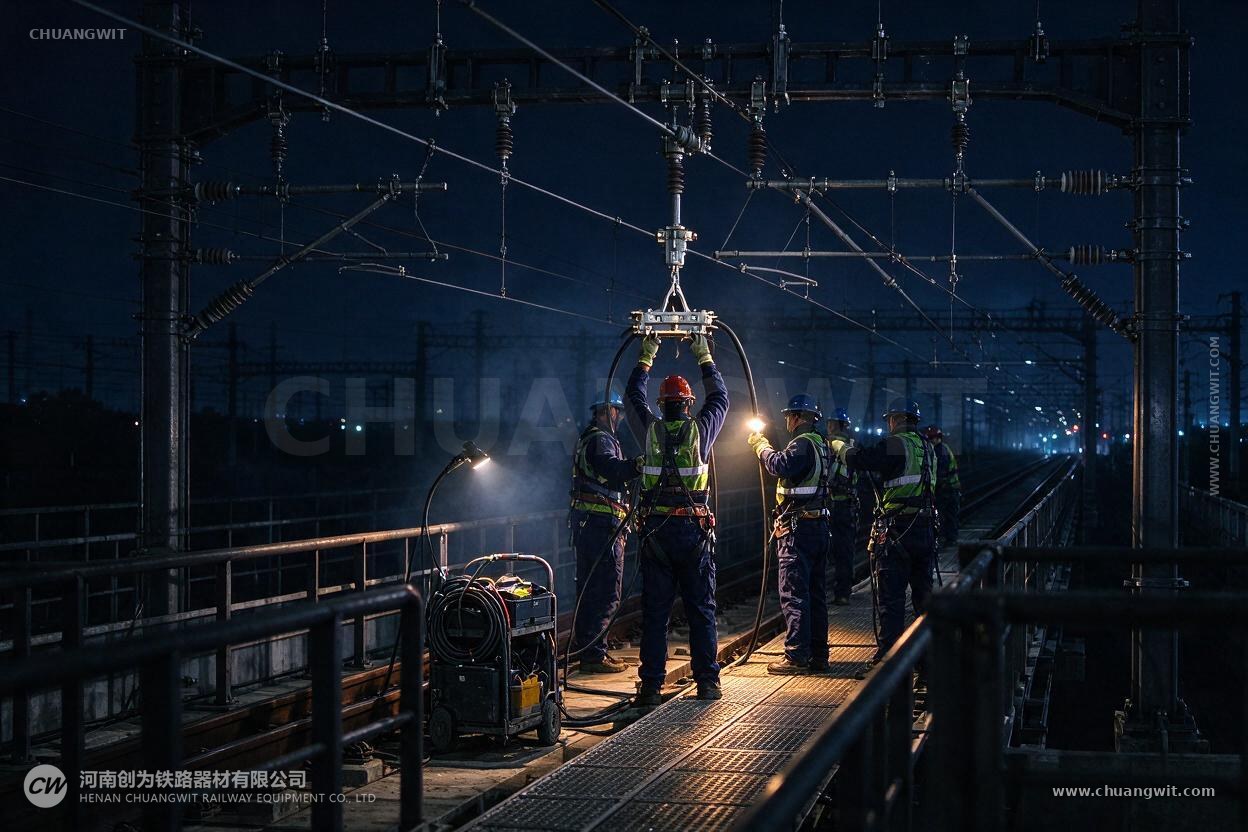
Night work adds its own overhead. Lighting must be rigged before anything else can start, communications need a plan where radios struggle in tunnels or deep cuttings, and fatigue management limits how long a crew can safely hold tools at height. Experienced planners budget these fixed costs first and only then fit the technical tasks into the time that remains.

The workflow from block application through isolation, work packs and handback, with the checkpoints that matter at each stage, is summarized in the figure above.
What Can Be Monitored Between Windows Instead?
Not every defect needs a ladder. The 6C system — the operation, inspection and monitoring infrastructure specified in TB/T 2076-2020 for high-speed overhead contact systems — collects up to 120 GB of data per day from inspection vehicles and fixed cameras. That stream converts window work from searching to fixing: the crew walks to a located defect with the right part in hand.
Disconnector status is the leading example. Image recognition applied to route imagery verifies whether moving contacts of all poles truly reached open or closed positions, echoing the position-signal rule of GB/T 1985-2023. The method is described in remote monitoring of disconnector status by image recognition, and the broader fusion approach in condition assessment and fault prediction from multi-source data.
The division of labor is straightforward: measurements that cameras and vehicles can make belong to the monitoring layer, and the window is reserved for hands-on work — torquing, replacing, adjusting — that no sensor can perform. Networks that blur this division spend their windows re-measuring instead of repairing.
Which Defects Deserve Window Time?
Prioritize by failure consequence and detection confidence. The recurring window consumers on electrified lines are section insulator arc damage, overheated electrical connection clamps, disconnector contact degradation and crossing wear. Each has a documented inspection angle and a standard to judge against.
| Component | Typical window task | Governing reference |
|---|---|---|
| Section insulators | Runner and arc damage inspection, replacement | TB/T 2073-2020 technical conditions for OCS components |
| Electrical connection clamps | Resistance and temperature-rise checks, re-clamping | TB/T 2075.11-2024 slip and temperature-rise requirements |
| Disconnectors | Contact wear and loop resistance measurement | GB/T 1985-2023 and TB/T 2803-2003 |
| Crossings | Wear measurement and workmanship correction | OCS crossing maintenance workmanship standard |
Source: TB/T 2073-2020, TB/T 2075.11-2024, GB/T 1985-2023 and TB/T 2803-2003 as published in the Chinese railway standards corpus.
Deeper procedures per family: section insulator installation, adjustment and maintenance, the 27.5 kV disconnector maintenance guide and avoiding overheated electrical connection clamps.
Seasonal timing matters as much as priority. Winter windows carry icing checks on disconnectors, summer windows carry thermal checks on clamps at peak load, and every window carries a walk-through of whatever the monitoring layer flagged since the last possession. A rolling seasonal template keeps the work list from drifting toward whatever failed most recently.
Frequently Asked Questions
What is a line block on the railway?
A line block is a planned closure of a defined track section to normal traffic so that engineering work can proceed safely. For overhead line work the block comes with electrical isolation and protective earthing of the contact system. Trains are excluded, access is controlled, and the block ends only when people, tools and earths are accounted for and the line is proven fit for traffic.
Is the railway overhead line AC or DC?
Both exist. Main line railways commonly use 25 kV AC traction supply, while many metros use DC at 1500 V with rigid or flexible overhead construction. The choice affects feeding, earthing practice and maintenance procedures. EN 50122-1 gives the touch voltage reference points — 60 V rms on AC and 120 V on DC in normal operation — that frame safe working on each system.
What is live line work?
Live line work is maintenance performed on equipment that remains energized, using insulated tools, protective clothing and minimum approach distances instead of isolation. On overhead contact systems it is used selectively, for example inspection or cleaning where a window cannot be obtained. Most OCS hardware replacement still happens in isolated and earthed possessions, because dead-line conditions remove the electrical hazard entirely.
What are the main components of overhead lines?
An overhead contact system consists of the messenger wire, the contact wire and the droppers between them; supports such as masts, cantilevers and steady arms; insulators; sectioning devices including section insulators and neutral sections; disconnectors and earthing switches; and tensioning equipment. Each family follows its own standard group, such as the TB/T 2075 series for fittings, and each appears on the window work list with its own inspection method.
Pack the Window, Not the Hope
A maintenance window is bought time; productivity is engineered before it starts. Combine 6C data specified by TB/T 2076-2020 with staged work packs, and treat isolation, earthing and interlock verification per GB/T 1985-2023 as the fixed cost of every possession. The strategic layer — how monitoring reshapes the whole maintenance calendar — continues in OCS maintenance strategy: moving from reactive to condition-based.
For hardware that survives short windows — pre-matched fittings and section insulators supplied with test evidence — our engineering team supports specification and delivery planning.