Railway catenary corrosion concentrates where dissimilar metals meet in a wet electrolyte: copper alloy contact and messenger wires against steel masts, galvanised fittings and aluminium conductors, with coastal salt or tunnel humidity supplying the moisture. The defence is systematic material pairing — aluminium-clad steel strands, hot-dip galvanising of steelwork to a minimum of 610 g/m² on guy masts per TB/T 2286 practice, stainless steel fasteners in humid DC tunnels — together with insulating or sacrificial interfaces at every bimetallic joint.
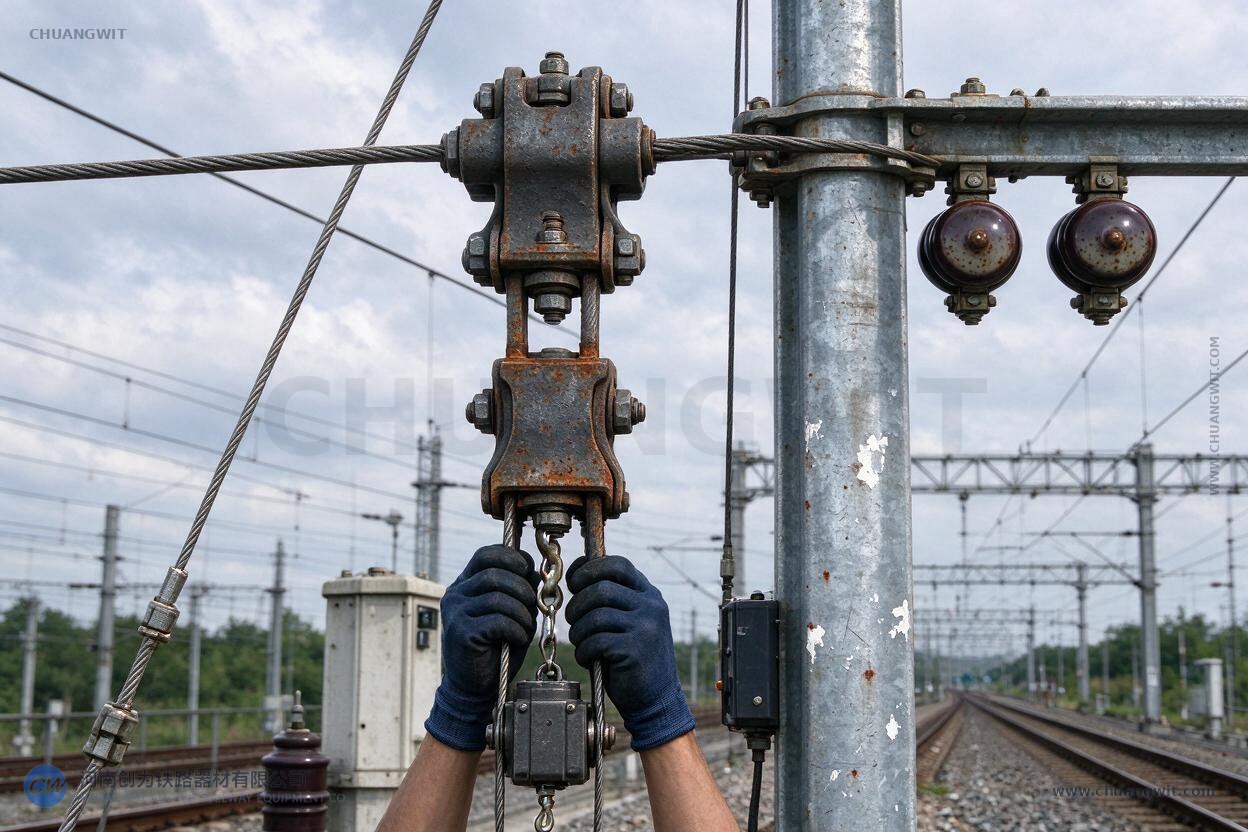
Key Takeaways
- Galvanic attack lands on the less noble metal of any pair; copper alloy wire against plain steel hardware is the classic catenary couple.
- Steel masts and guy sets for tension length joints use Q235B or Q345 steel with a minimum of 610 g/m² hot-dip galvanising, type-tested to the TB/T 2286 class series.
- Messenger strands can use aluminium-clad steel cores — the LBGLJ layout, equivalent to the JL/LB1A type of GB/T 1179 — so the steel core never sits bare against copper hardware.
- Humid DC tunnel practice calls for aluminium alloy runners and stainless steel fasteners, as built into the metro families to TB/T 3252-2022.
- Corrosion products also pollute insulator surfaces, so corrosion control and pollution classification under IEC TS 60815 belong in the same corridor plan.
Where does corrosion attack a catenary system?
The attack map follows the materials and the water. Copper alloy wires are electrochemically noble and rarely corrode structurally, but their surfaces darken and their fittings do not share that protection. The messenger wire corrodes where moisture sits longest — at clamp interfaces, inside dropper barrels, and wherever two strands cross and hold a film. Fittings, pins and bolts corrode at crevices; masts corrode at ground level, at the base flange and anchor bolts, and wherever galvanising has been cut or burned during fabrication or repair.
Location weighting matters more than any average. A single tunnel portal, a windward sea crossing or a drainage failure at one foundation can account for most of the corrosion found on an otherwise healthy line. Corrosion surveys therefore work location by location, and the results drive washing, coating and hardware replacement programs aimed at the wet few hundred metres rather than the dry many kilometres.
Why does galvanic corrosion hit steel-and-copper joints?
Galvanic corrosion needs three things simultaneously: two metals at different electrochemical potential, an electrical connection between them, and a shared electrolyte. A catenary supplies all three every time it rains. The copper side of the pair sits noble and survives; the steel side becomes the anode and dissolves, and the joint that was designed for mechanical duty becomes a battery whose anode is a load-bearing part.
The area ratio decides the speed. A small anode feeding a large cathode — a steel pin in a copper-rich assembly, a scratch through zinc on a big galvanised fitting — concentrates the whole galvanic current onto little metal and drives fast local loss, which is why pitting at scratches and crevices does the real damage long before uniform thinning is measurable. Crevice corrosion piles on: inside a joint gap the oxygen is depleted, the local chemistry turns aggressive, and the hidden surface wastes away while the outside still looks sound.
How are masts and steel structures protected?
Hot-dip galvanising is the backbone. The guyed masts used at tension length joints are built from Q235B or Q345 steel with a minimum of 610 g/m² of galvanising and TB/T 2286 class testing, and the same galvanising discipline extends across the mast families — from lattice masts to H-section columns hot-rolled to GB/T 34199 in Q235B or Q355B, with the GH series consolidating requirements under GB/T 25020.1, as profiled in our OCS mast types guide. Zinc protects twice: as a barrier, and sacrificially at every scratch where it corrodes in place of the steel beneath.
Where the environment outruns galvanising, the structural answer is to change material rather than fight harder. Prestressed concrete poles produced to TB/T 2286 in at least C50 concrete, such as the Φ300/Φ350 equal-diameter families, remove the metallic corrosion question from most of the column — the trade-offs against steel are worked through in our concrete versus steel pole comparison. Inspection then shifts to the steel that remains: base plates, anchor bolts and the fittings themselves.

What about the wires — copper, aluminium and composite cores?
Copper and copper alloy strands are the noble end of nearly every couple they join, which protects the wire and endangers its neighbours — the reason bimetallic discipline is organised around the interfaces, not the copper. Messenger selection makes this explicit: the TB/T 3111 series governs stranded conductors for overhead contact systems, and within it the LBGLJ aluminium conductor with aluminium-clad steel core wraps aluminium strands for conductivity around a bearing core that is already sheathed in aluminium — a layout equivalent to the JL/LB1A type of GB/T 1179, and the anatomy is detailed in our messenger wire materials guide. The cladding means the steel core is never exposed as a bare anode, and the aluminium surface presents a more compatible partner to the alloy fittings around it.
Composite cores change the couple entirely by removing metal from the middle of the span, and they trade the galvanic question for interface and hardware questions of their own. Whatever the conductor, the practical rule survives: control the joints, because the wire body is rarely where corrosion wins.
Which fittings and joints deserve the closest attention?
Electrical joints come first, because corrosion there does electrical damage as well as mechanical. A corroded contact face in an electrical connection clamp raises resistance, the joint heats under load, and heating accelerates corrosion — the runaway loop behind most overheated connections, analysed in our electrical connection clamp guide with the requirements of TB/T 2075.11-2024. Mechanical joints come next: anchor clamps, pulley and pin interfaces, and anywhere a zinc layer is pierced during assembly.
Environment-specific practice is standardised where the worst environments are. Metro tunnels combine humidity, condensation and leakage currents, and the DC families built to TB/T 3252-2022 answer with aluminium alloy runners and stainless steel fasteners for humid tunnel air — the same philosophy of choosing the pair before it is assembled. Winter adds icing and thaw moisture to the electrolyte supply, and the failure modes that follow for line switchgear are catalogued in our winter disconnector failure guide. The table condenses the working rules.
| Material pair in contact | Dominant mechanism | First line of defence | Anchor or protection level (g/m² where zinc) |
|---|---|---|---|
| copper alloy wire on galvanised steel fitting | galvanic attack consuming zinc, then steel | matched fittings, coatings, drained joint design | TB/T 2075 series practice |
| steel mast at ground level and base hardware | uniform loss and pitting in wet zones | hot-dip galvanising, drainage and detailing | minimum 610 g/m², TB/T 2286 class testing |
| aluminium strands on steel core | galvanic attack at cut ends and damage points | aluminium cladding over the core | LBGLJ layout, JL/LB1A equivalent of GB/T 1179 |
| aluminium runners with fasteners in humid DC tunnels | crevice and galvanic attack | stainless steel fasteners | TB/T 3252-2022 metro families |
Source: TB/T 2075 series fittings practice; TB/T 2286 mast classes and galvanising levels; GB/T 1179 equivalent conductor layouts; TB/T 3252-2022 metro section insulator families.
How do coastal and polluted environments change the plan?
Coastal salt is the ideal electrolyte and industrial pollution adds conductive films, so both shorten every corrosion timeline and both demand the corridor-level response. Washing programs serve double duty: they remove the salt film that drives both galvanic corrosion and insulator surface pollution, and the pollution severity assessment under IEC TS 60815 — which our coastal and polluted corridor insulator guide develops — informs the same corridor map. One survey, two programs, one maintenance budget.
The survey discipline stays material-led. Walk the line where the water goes: drainage failures, splash zones, tunnel portals, windward faces and every bimetallic joint on the inventory. Rank findings by remaining section and by consequence of failure — an anchor fitting outranks a decorative bracket — and let the ranking drive the intervention sequence, from washing and coating through fastener replacement to component renewal.
Frequently Asked Questions
What are catenary wires made of?
The contact wire is a hard-drawn copper alloy — typically copper with silver or magnesium under EN 50149 — while the messenger above it is a stranded conductor governed by the TB/T 3111 series: copper alloy strands, or aluminium around an aluminium-clad steel core in the LBGLJ layout. Droppers, clamps and fittings are copper alloy, aluminium alloy or galvanised steel, and the material pairings are chosen with galvanic corrosion in mind.
What is messenger wire, and why does its material matter for corrosion?
The messenger wire is the suspended structural conductor that carries the mechanical load of the catenary assembly and holds the contact wire at its height through droppers. Its material matters because it combines stranded steel, aluminium and copper interfaces at every clamp and dropper connection — the exact conditions galvanic corrosion needs. Aluminium-clad cores and matched fittings exist to break up those couples.
Does silicone rubber absorb water?
Water absorption in the bulk is very low — silicone rubber is widely used as a housing material precisely because it resists taking up water — but its surface behavior is what earns it the job: it is hydrophobic, so water beads and rolls off rather than forming the continuous film pollution flashover needs. For corrosion engineers the relevance is simple: composite silicone housings neither rust, nor hold the wet film that drives galvanic couples on adjacent metalwork.
What is a composite conductor?
A composite conductor combines two materials to divide duties that one cannot serve alone: in catenary service, aluminium strands carry current around a steel or composite core that carries load. The aluminium-clad steel core layout of the LBGLJ type, equivalent to the JL/LB1A conductor of GB/T 1179, is the classic railway example — conductivity from the aluminium, strength from the core, and corrosion compatibility from the cladding that keeps the core from becoming a bare anode.
Keeping Steel and Copper Apart, Systematically
Catenary corrosion control is not a coating campaign; it is a pairing discipline applied from the specification stage onward. Choose the material pair before the joint exists, galvanise the steelwork to the levels the mast standards require — a minimum of 610 g/m² on the guy mast families to TB/T 2286 — favour clad cores in the strands, insist on stainless fasteners where tunnels stay wet, and survey by where the water actually goes. The hardware families that make this achievable are standardised across the TB/T 2075 series and the mast and conductor standards, so nothing in the program requires bespoke parts.
For corridors where salt or pollution has already shortened timelines, the material review and the insulation review belong in the same project. Contact our engineering team to review fitting, conductor and hardware selections for corrosive service across the ranges manufactured to the TB/T 2075, TB/T 2286 and TB/T 3111 series.