The pole material chosen for an electrified route commits the operator to a cost and maintenance profile for the life of the installation. On conventional-speed lines the candidates narrow quickly to prestressed concrete and hot-rolled steel, and the comparison between them is genuinely close: both are mature, both are standardised, and both have decades of installed base on 25 kV and 1.5 kV systems. What separates them is not whether they work, but how each one ages, how it is handled and inspected, and where its costs land over a full lifecycle.
In the concrete vs steel pole comparison, concrete wins on material cost and chemical inertness while steel wins on weight, ductility and ease of modification. Around those two facts sit the practical questions that decide most projects: transport economics, foundation type, earthing arrangements, the corrosion environment of the corridor, and the inspection regime the operator can actually sustain across hundreds of kilometres.
This article compares the two catenary pole materials on those terms, using the standard families supplied for overhead contact system (OCS) duty as reference points throughout.
What each material brings to catenary support
Prestressed concrete is a compression material with its tension problem solved in advance. High-strength tendons are tensioned before the concrete cures, so the finished member carries a permanent compressive reserve that keeps the section uncracked under service bending. The H-series cross-arm prestressed concrete pole illustrates the family for railway use: H denotes the cross-arm form, and the designation gives moment capacity, height above ground and embedment depth, with basic models such as H60/8.7+3.0 at 60 kN·m, 8.7 m above ground and 3.0 m of embedment, rising through H78/8.7+3.0 to large-capacity types such as H170-250/12+3.5. Concrete strength class is at least C50, bending behaviour is type-tested against the TB/T 2286 class series, and crack resistance is verified in testing.
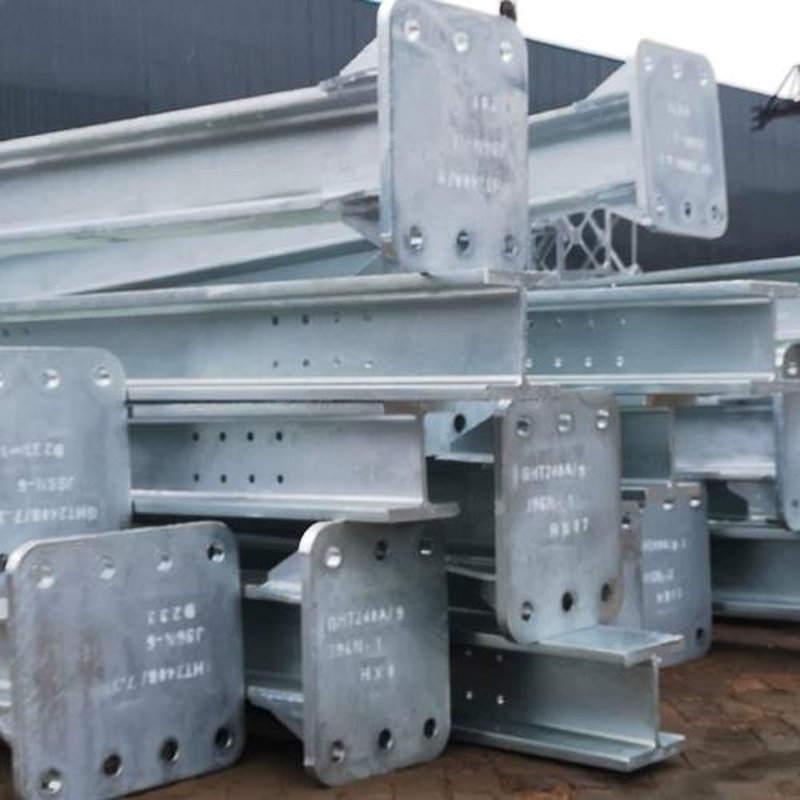
Steel answers with ductility. A hot-rolled H-section column in Q235B or Q355B yields progressively rather than cracking, tolerates overload excursions from wind or ice beyond design assumptions, and accepts drilled, bolted and welded modifications without structural penalty. The trade is a surface that must be protected against corrosion, which in practice means hot-dip galvanising of the complete pole. Both families carry an earthing terminal for mast earthing and stray-current protection, and both install either by direct burial or onto a flange foundation, erected as whole poles.
Initial cost, weight and handling
Concrete usually wins the first-cost comparison on material alone, and the constant-diameter spun pole is the economy end of that family. The Φ300/Φ350 ring-shaped equal-diameter prestressed concrete pole is specified by its 300 or 350 mm diameter, produced to TB/T 2286 in at least C50 concrete, and is noted by the manufacturer for lower cost and good insulation characteristics. The offset is mass: a prestressed pole of useful catenary height is far heavier than its steel equivalent, so transport tonnage, crane capacity at every hole and the practicalities of handling a brittle member near live track all scale with the choice.
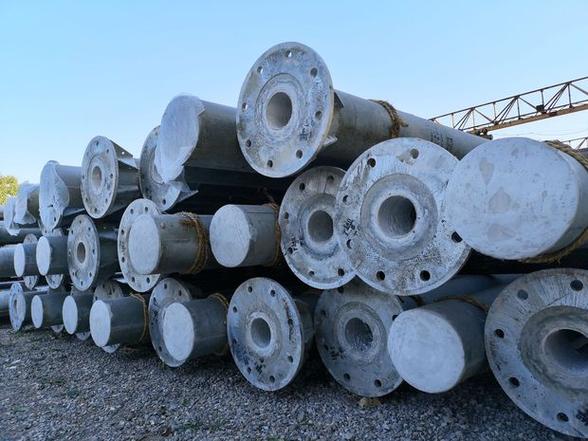
Steel reverses the logistics. The GH-series H-section steel mast arrives as a column of 240 to 300 mm section height and 7.5 to 11 m length, light enough for routine two-point lifting, and erects onto anchor bolts: set the base, level with adjusting nuts, torque the fasteners. Steel unit cost per pole is higher, but lighter poles mean smaller cranes, shorter possessions and cheaper haulage, and on remote or access-restricted sections those savings frequently close the gap.
Durability: corrosion, carbonation and cover spalling
The two materials age differently, and inspection programmes must follow the difference. Concrete degradation is quiet: carbonation front advances from the surface, and in coastal or de-icing salt environments chloride ions migrate inward; either mechanism eventually depassivates the prestressing steel, corrosion products expand, and the concrete cover spalls in visible chunks. The defence is quality at manufacture, adequate cover and controlled cracking, verified by the crack-resistance type testing the standard families undergo, plus periodic visual survey for longitudinal cracks, rust staining and spall marks.
Steel degradation is a surface phenomenon managed by coating. Hot-dip galvanising to the traction standards, with zinc coatings of at least 610 g/m² on members 5 mm and thicker in the heavier families, is quoted at 30 years or more of coating life, and thickened coatings are specified for coastal corridors. Inspection is correspondingly simpler: zinc condition near ground level and at joints, mechanical integrity after any impact, and the bolted connections. Where damage does occur, steel accepts local repair or partial replacement readily; a spalled prestressed pole is usually a whole-pole replacement, because the tendons themselves are the structure.
Earthing and stray-current behaviour
Electrical behaviour is where the materials diverge hardest. A steel pole is a conductor from head to base: the earthing terminal bolts on, the pole itself provides the down-conductor, and bonding to the rail-side earthing system or a buried strip is straightforward and inspectable. This matters doubly on DC metros, where stray-current management depends on deliberate, low-resistance paths and on avoiding accidental ones.
Concrete is a semiconductor whose resistance depends on moisture and salt content. The pole still carries a fitted earthing terminal, but a dedicated conductor must complete the path, and the embedding concrete must not be relied upon to bond the reinforcement into the earthing scheme unless the design says so. On AC lines the practical consequence is modest; on DC systems with aggressive stray-current regimes, the engineered earthing of steel often tips the decision on its own.
Insulation mounting and cantilever interfaces
How the wiring hangs from the pole also differs. Steel masts are earthed structures by definition, so every cantilever insulates: rod or string insulators between mast and cantilever, and insulated registration between structure and wiring, are designed as part of the assembly. Concrete offers a measure of inherent insulation, and the ring-section family is promoted for exactly that characteristic, but modern practice on traction systems still mounts fully insulated cantilever assemblies on both materials, so the difference shows up less in component count than in creepage margins near the pole surface and in the behaviour of polluted or wet surfaces close to earthed fittings.
Concrete vs steel pole at a glance
Inspection effort should be costed alongside the poles themselves. A concrete-pole route invites a periodic walking survey focused on crack width, rust staining at the ground line and spalling around fittings, with suspected carbonation depth checked on a sampling basis; findings escalate slowly, which suits long maintenance intervals. A steel-pole route shifts the same effort onto coating condition, fastener torque after early service years and post-incident checks, tasks that are quicker per pole but must not be skipped near corrosion sources. Either regime is inexpensive when it is routine and expensive when it is deferred.
| Aspect | Prestressed concrete | H-section steel |
|---|---|---|
| First cost per pole | Lower material cost | Higher, offset by logistics |
| Weight and handling | Heavy, crane erection | Light, quick bolt-down |
| Degradation mode | Carbonation, chloride, spalling | Zinc wear, surface corrosion |
| Earthing path | Dedicated conductor needed | Pole is the conductor |
| Damage response | Usually whole-pole change | Local repair possible |
Conventional-speed mainlines with stable alignments and cheap local casting remain natural concrete territory; high-speed sections, station yards, retrofit sites and DC metros increasingly specify steel for weight and earthing reasons. Both materials, correctly specified and inspected, serve for decades. For a corridor-specific recommendation weighing transport, corrosion environment and earthing regime, our engineering team can review the section data and propose the pole schedule.