The messenger wire, also called the catenary wire, is the structural spine of an overhead contact system (OCS). It hangs in a true catenary curve between support points, carries the contact wire beneath it through droppers, transmits the suspension loads into the cantilevers and registration assemblies, and usually conducts a share of the traction current in parallel with the contact wire. Because it does structural and electrical work at the same time, the material it is stranded from decides span capability, tensioning behaviour and corrosion margin for the next thirty years.
Messenger wire materials are chosen against three questions: how much breaking force the span arrangement needs, how much current the messenger is expected to carry, and what atmosphere it will spend its life in. This guide works through the stranded conductor families used in railway catenary, hard copper and copper-magnesium strand plus aluminium-clad steel core composite conductors, explains how strength class pairs with tension and span length, and closes with the corrosion considerations that dominate tunnel and coastal projects.
What the messenger wire actually does
In a catenary suspension the messenger is tensioned between supports and sags under its own weight plus the weight it carries. Droppers connect it to the contact wire at calculated points, and their lengths are what pull the contact wire into a level running surface despite the curve above. Tighten the messenger and the whole assembly stiffens, the sag flattens and the elasticity of the suspension becomes more uniform along the span, which is exactly what high-speed current collection requires.
The conductor also belongs to the electrical circuit. A copper or copper-alloy messenger runs in parallel with the contact wire, lowering the combined resistance of the current path and reducing conductor temperature rise. That dual structural-electrical duty is why railway messenger conductor is a dedicated product family with its own standard, the TB/T 3111 series for stranded conductors of the overhead contact system, rather than a generic overhead line conductor pressed into service.
Messenger wire materials: the three stranded families
JT hard copper stranded wire
Hard-drawn copper strand is the reference option: maximum conductivity, straightforward jointing, proven behaviour. JT series hard copper stranded wire runs from JT70 to JT150 in 1×19 and 1×37 constructions, holds a minimum of 97% IACS conductivity, and delivers, for example, at least 48.01 kN breaking load at the 120 mm² size with a mass of 1065 kg/km. It suits conventional and heavy-haul messenger duty and urban rail, where currents are significant and spans moderate. Its limitation is the same as for hard copper contact wire: under the highest tension regimes that high-speed lines apply, hard copper does not offer the strength margin the loading case demands, so the standard guidance reserves it for conventional duty and points faster projects to the magnesium-alloyed series.
JTM and JTMH copper-magnesium stranded wire
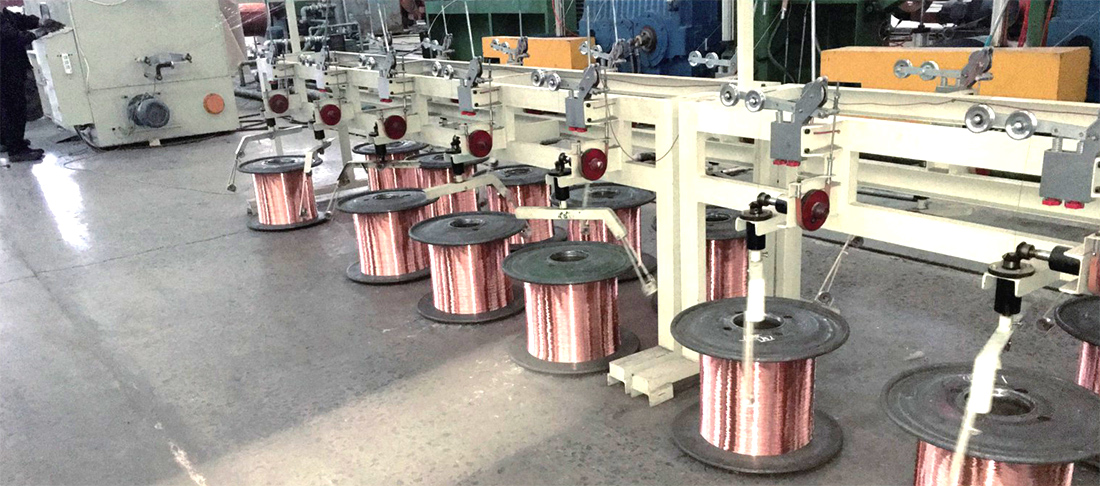
Alloying copper with magnesium before stranding lifts breaking force sharply while keeping serviceable conductivity. JTM/JTMH copper-magnesium alloy stranded wire spans sizes from 10 to 150 mm² in 1×7, 1×19 and 1×37 constructions: JTM carries a minimum of 80% IACS and JTMH 75% IACS, and at the 120 mm² 1×19 size the minimum ultimate tensile forces are 57.79 kN and 68.91 kN respectively, rising to 72.67 kN and 86.65 kN at 150 mm². The high-strength grade is the established partner of CTMH contact wire in fully compensated high-speed suspensions rated to 350 km/h, where both wires of the system are tensioned hard and must hold their geometry together as temperatures move.
LBGLJ aluminium-clad steel core conductor
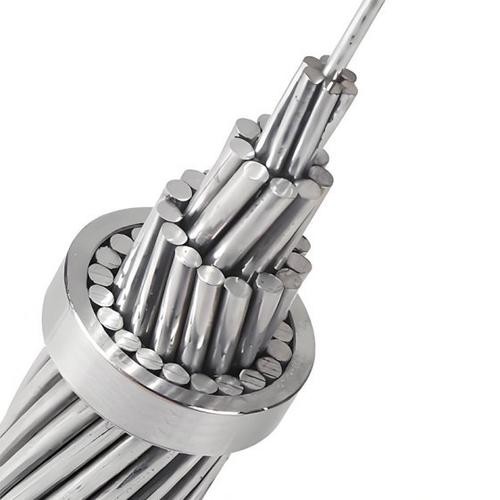
Where spans get long or loads get structural, a composite conductor takes over. LBGLJ aluminium conductor with aluminium-clad steel core wraps aluminium strands for conductivity around an aluminium-clad steel bearing core that does the mechanical work, a layout equivalent to the JL/LB1A type of GB/T 1179. Fifteen sizes from 50/8 to 300/40 give the designer a wide ladder: the 120/20 size, for instance, combines 134.13 mm² total section, 40.59 kN minimum tensile force and 0.2382 Ω/km DC resistance at 445.52 kg/km, while the 300/40 tops the range at 94.69 kN. That strength-to-weight freedom is what large-span suspensions, river and valley crossings and heavy feeder duty call for, and the aluminium-clad layer protects the steel core against the salt-fog atmospheres such crossings often expose it to.
Pairing strength class with tension and span length
The messenger is selected inside a triangle of tension, span and sag. Higher working tension flattens sag, stiffens the suspension and raises the natural quality of the pantograph interface, but every kilonewton of tension must be carried by the strand, by the splices and by the compensation devices at the anchors. Longer spans sag more for the same tension, so the conductor breaking force requirement climbs with span length independently of speed. The families divide the work naturally:
| Series | Conductor | Conductivity | Breaking force | Typical duty |
|---|---|---|---|---|
| JT | Hard copper strand | 97% IACS | 48.01 kN (120) | Conventional, metro messenger |
| JTM | Copper-magnesium strand | 80% IACS | 57.79 kN (120) | High-tension mainline messenger |
| JTMH | High-strength Cu-Mg strand | 75% IACS | 68.91 kN (120) | High-speed, 350 km/h systems |
| LBGLJ | Aluminium-clad steel core | 0.2382 Ω/km (120/20) | 40.59 to 94.69 kN | Large spans, feeder duty |
Two practical consequences follow. First, the messenger and contact wire are chosen as a pair, because their temperature elongation and tension behaviour must stay matched or the dropper lengths and stagger drift apart across the temperature range; the JTMH-with-CTMH pairing exists precisely because both conductors share alloying behaviour. Second, tensioning hardware, compensation devices and anchor fittings must be rated for the conductor, not merely for the tension, and a strength upgrade often cascades into heavier fittings at the supports.
Corrosion in tunnels and coastal environments
Atmosphere shapes material life as strongly as load does. In tunnels the conductor faces humidity, condensation and, on DC railways, stray-current and leakage paths that drive electrochemical attack at every small defect. Coastal alignments add salt fog, which is aggressive to bare steel and punishing to uncoated bimetallic interfaces. The copper families hold their own well: copper, copper-magnesium and copper-silver alloys form stable patinas and are the standard answer in corrosive railway atmospheres. The composite conductor answers differently, encapsulating its steel core in an aluminium cladding so the load-bearing steel never sees the electrolyte directly, which is why aluminium-clad designs are routine on coastal and estuary crossings.
Galvanic discipline matters at the connections. Fittings, splices and electrical connections should be matched to the conductor material to avoid dissimilar-metal couples, and any cut end of a clad-core conductor is a point to protect, because there the steel core is exposed. In badly polluted tunnels, maintainers also watch for grease and dust films that retain moisture against the strand surface, cleaning and re-greasing at electrical joints during scheduled works.
A selection checklist for catenary wire
- Fix the mechanical case first: span length, working tension and the required sag behaviour under the full temperature range.
- Choose the strength class that meets breaking force with margin, remembering the high-strength grades trade conductivity for force.
- Check the electrical case: how much current the messenger must share, and what ampacity that implies alongside the contact wire.
- Match the contact wire pairing so both conductors move together with temperature.
- Rate the atmosphere: tunnel humidity, salt fog and pollution push selection toward corrosion-resistant families or clad cores.
- Confirm the fittings chain, splices, anchors, messenger seats and compensation, is rated for the conductor chosen.
Selection is always a project-specific calculation, but the families and the numbers above frame the decision honestly. For a second opinion on a specific span arrangement, or for conductor data against a particular tension and climate case, our engineering team reviews messenger selection with designers and maintains full product data for all three families.