Inside a tunnel, the rules of overhead contact system (OCS) suspension change. There are no masts to cantilever from, so every load resolves into the tunnel lining through anchored steelwork; the height envelope is fixed by the bore long before the wiring design starts; and the air is damp, vibration is constant, and access exists only inside carefully planned possessions. Tunnel catenary support design therefore concentrates on three things: a short, strong load path into the lining, hardware compact enough to live inside the clearance envelope, and adjustability that lets crews set registration precisely and correct it years later without redrilling.
The Chinese hardware standard for this environment is TB/T 2075.22-2024, the tunnel support and positioning devices part of the TB/T 2075 series. Its numbered families, such as the 22-series drawings, define hanging posts, registration brackets and adjusting bases that are dimensionally matched to each other and to the positioning tubes and locators used on open route. A designer who stays inside one family inherits interfaces that already fit.
This article walks through how tunnel suspension is arranged, what each support component does, and where vibration, drainage and maintenance access shape the details.
Why tunnel catenary support differs from open route
On open route, a mast foundation carries bending moments from wind, ice and the catenary itself, and the cantilever reaches freely over the track. In a tunnel the structure is already there: the lining, or an invert-filled arch, accepts the loads through embedded parts or post-installed anchors. The support hardware becomes a set of short brackets and posts rather than long cantilevers, because the wall is close to the wire and every extension costs clearance.
Clearance governs everything. The contact wire height, the pantograph working range, the structure gauge of the rolling stock and the electrical clearances to earthed lining all compete for the same vertical and lateral space, so components are deliberately compact. Low-clearance sections, single-track bores and urban metro tunnels push this further, which is why the tunnel families use die-forged, high-strength parts in small envelopes instead of larger fabricated ones.
Tunnel hanging posts as anchored supports
The central member of most tunnel wiring is the hanging post. The Tunnel Hanging Post 22-5 (Types Y / F) is a short post fixed to the tunnel wall, to embedded parts or a mounting base, and it suspends the OCS support devices: cantilever-type supports, suspension insulators and, at anchor points, the anchoring and tensioning equipment. The Y and F designations denote post forms and mounting orientations, selected to match the tunnel cross-section and the direction from which the suspension is hung, so the same product family covers single-track bores, double-track tunnels and open-cut covered sections.
Because the post is the interface between dynamic railway loads and a concrete lining, its base connections allow precise installation and adjustment during erection, and the structural steelwork is hot-dip galvanised or anti-corrosion coated for the damp tunnel atmosphere. Load capacity is a matter of the anchor group and the lining condition rather than the post alone, which is why anchor design and pull-out verification belong in the support design package, not in site improvisation.
Registration in restricted gauge
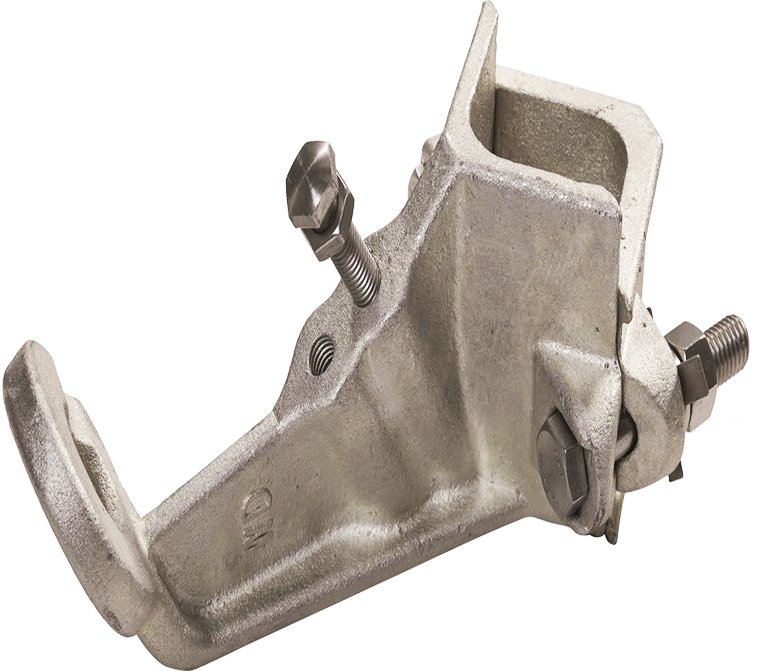
Holding the contact wire at its designed stagger inside a confined bore is the job of the tunnel registration bracket. The 22-4A Tunnel Registration Bracket is the positioning connection seat of the tunnel family: it mounts on the tunnel wall support structure or on a 22-5 hanging post and joins the positioning tube and locator that grip the wire. Its face carries multi-directional adjustment holes, which adapt the bracket to different tunnel cross-sections and assembly directions and allow the stagger to be set precisely, then re-aligned later without drilling new anchors.
The bracket is designed to pair with 22-5 posts and bow cantilevers, and its interfaces match the standard positioning tube and locator family, so the same locator hardware works inside and outside tunnels. Connection stiffness is the performance criterion: the bracket must hold the registration point steady under pantograph-induced dynamics, because in a tunnel there is no span length in which registration errors can quietly average out.
Adjusting bases and fine alignment
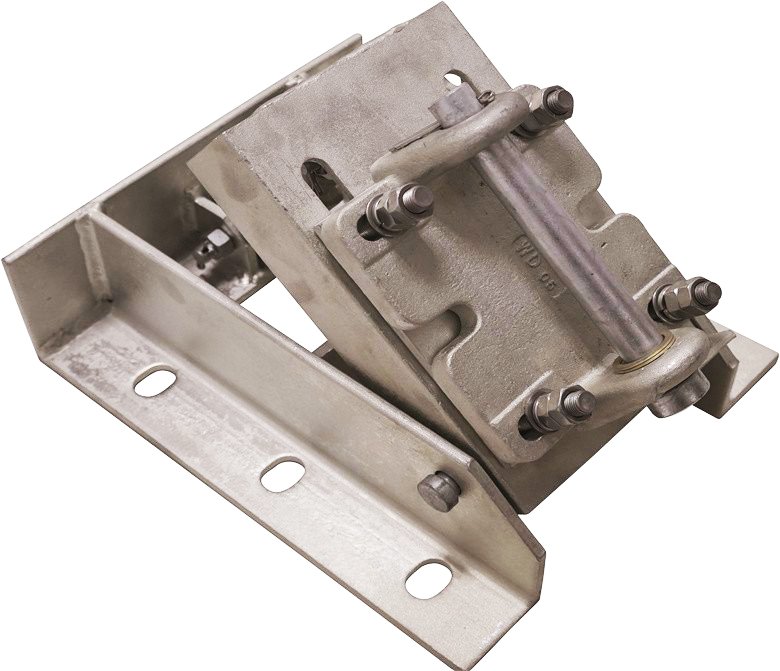
Between the lining anchor and the supported component sits the adjusting base, the part that turns millimetres of construction tolerance into a correct OCS geometry. The Adjusting Base 22-1A (Die-Forged) is a die-forged steel base plate carrying hanging posts or insulator fittings, with a multi-hole adjustment face for stepped positioning of OCS support components. Die forging gives the base a continuous grain flow and a dense structure, hence high load capacity in a compact envelope, exactly the trade a low-clearance tunnel demands.
In practice the base absorbs two layers of error: the as-built position of the embedded parts or anchors, and later settlement or realignment of the suspension. Slotted and multi-hole connections let crews shift a hanging post or insulator seat by small increments during maintenance realignment without touching the anchors. Specifying a base with enough adjustment range at the outset is far cheaper than adding drilled-and-tapped corrections under traffic pressure.
Vibration, drainage and corrosion
A tunnel amplifies three environmental effects that open route softens. First, vibration: every pantograph passage transmits dynamic load through the registration point, the brackets and the post into the anchors, so bolted joints are torque-checked and locking features are specified at erection and at periodic inspection. Second, moisture: tunnel air, seepage and wash-water make the atmosphere humid, and hardware is hot-dip galvanised or anti-corrosion coated accordingly; drainage channels and cable troughs must stay clear so that water never routes across insulator surfaces or collects at a post base. Third, confined flashover consequences: any pollution film on tunnel insulators is not rain-washed, so creepage and cleaning intervals deserve explicit attention in the wiring design.
Corrosion control is mostly detail work. Cut ends on galvanised parts are dressed, stainless or coated fasteners are used where dissimilar metals meet, and anchor recesses are pointed or capped so that water cannot sit against the anchor group. These details decide whether a twenty-year tunnel installation stays serviceable between major overhauls.
Access planning and maintenance possessions
Everything inside a tunnel is maintained inside possessions, usually at night, in poor light and under an isolation and earthing regime. Hardware choices can shorten or lengthen that work. Multi-hole brackets and adjusting bases allow re-registration with hand tools; pre-assembled post-and-bracket units shorten time under the arch; and matched families mean a crew carries one set of spares for a whole tunnel section rather than several. Designers who plan the access pattern, working positions and lifting method for each support type during the design stage consistently hand over tunnels that are quicker to commission and cheaper to maintain.
Tunnel catenary support succeeds when the load path, the adjustment range and the environment are treated as one problem. The 22-series hanging posts, registration brackets and adjusting bases are built as a matched answer to it, and our engineering team can help map them to a specific bore cross-section and wiring diagram.