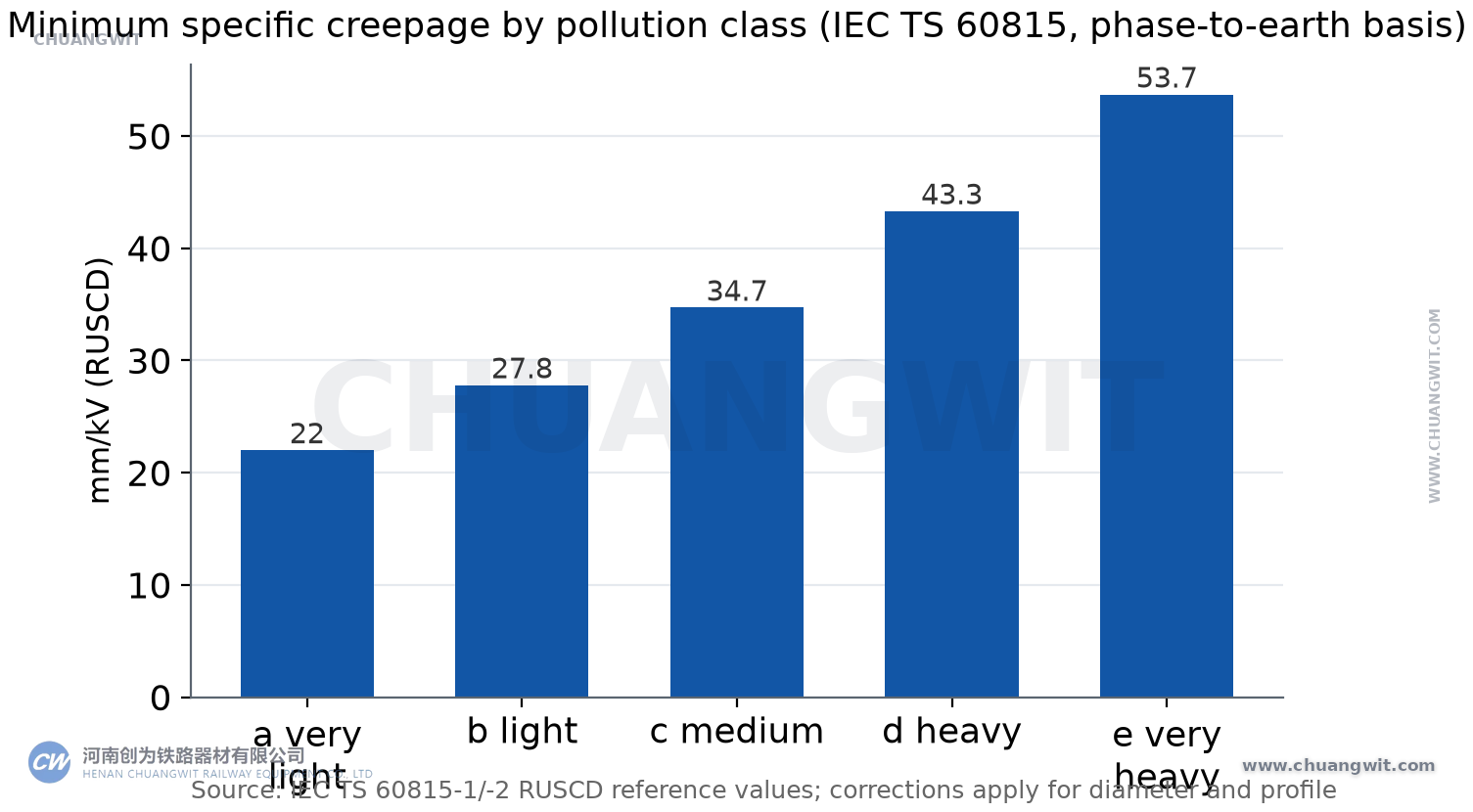
Specific creepage distance is creepage distance divided by the voltage it must withstand, expressed in mm/kV, and IEC TS 60815-2 is the current source of the working values. It defines site pollution severity classes a to e with reference unified specific creepage distance (RUSCD) from 22.0 mm/kV in class a to 53.7 mm/kV in class e, referenced to phase-to-earth voltage.
Key Takeaways
- Current IEC TS 60815-2 tabulates RUSCD values of 22.0, 27.8, 34.7, 43.3 and 53.7 mm/kV for site pollution severity classes a to e, referenced to phase-to-earth voltage.
- Legacy IEC 815:1986 tabulated minimum nominal specific creepage of 16, 20, 25 and 31 mm/kV for pollution classes I to IV, referenced to phase-to-phase voltage.
- The two tables use different voltage bases, so their mm/kV values must never be mixed in one specification; state the basis whenever a value is quoted.
- A 25 kV traction line is a phase-to-earth system, catenary to rail, so the IEC TS 60815 phase-to-earth basis applies directly.
- Historically many railways specified 25 mm/kV for polluted 25 kV traction sites, the legacy class III value, and the figure still circulates in older documents.
- IEC TS 60815 adds a diameter correction of roughly 10 to 20 percent for insulators above 500 mm diameter, plus profile corrections, before a final value is fixed.
What is specific creepage distance?
Specific creepage distance is the total creepage distance of an insulator divided by its reference voltage, in mm/kV. The reference unified specific creepage distance, abbreviated RUSCD, is the tabulated value in IEC TS 60815 for a reference geometry, from which real insulators are then assessed with corrections. The physical meaning of the number is simple: how many millimeters of insulating surface the design buys for every kilovolt the insulation must hold.
The concept, the vocabulary and the basis rules are unpacked in plain language in our companion article on what creepage distance means. This page is the reference table itself: the current values, the legacy values, and the conversion trap between them.
The current table: IEC TS 60815 classes a to e
IEC TS 60815-1, first published in 2008 with 2025 editions current, defines site pollution severity (SPS) classes a to e, from very light to very heavy. IEC TS 60815-2 assigns each class a reference unified specific creepage distance (RUSCD), the value for a reference geometry from which real insulators are assessed. The values are:
| SPS class | Site pollution severity | RUSCD (mm/kV, phase-to-earth) |
|---|---|---|
| a | Very light | 22.0 |
| b | Light | 27.8 |
| c | Medium | 34.7 |
| d | Heavy | 43.3 |
| e | Very heavy | 53.7 |
Source: IEC TS 60815-2, reference unified specific creepage distance referenced to phase-to-earth voltage, editions 2008 and 2025.
Reading the table is a two-step act. First the site earns a severity class, judged from measurements of deposits on the insulation surface as described in our guide to pollution classes and site severity assessment. Then the class selects the RUSCD, corrections are applied, and the result is carried into the insulator specification and its test evidence.
The legacy table: IEC 815:1986 classes I to IV
Before IEC TS 60815, insulator pollution was specified with IEC 815:1986, which used four classes and minimum nominal specific creepage distances referenced to phase-to-phase voltage:
| Legacy class | Pollution level | Minimum nominal specific creepage (mm/kV, phase-to-phase) |
|---|---|---|
| I | Light | 16 |
| II | Medium | 20 |
| III | Heavy | 25 |
| IV | Very heavy | 31 |
Source: legacy IEC 815:1986 pollution class table, referenced to phase-to-phase voltage.
The legacy table has not vanished. It lives on in tender documents, in old network design manuals and in the institutional memory of maintenance departments, which is precisely why it is reproduced here: an engineer comparing a 1990s specification with a current datasheet needs both tables side by side, each with its basis stated.
Why the voltage basis matters: the phase-to-earth versus phase-to-phase trap
The two tables divide by different voltages. The legacy IEC 815:1986 values are referenced to phase-to-phase, or line-to-line, voltage, as used in three-phase power systems. The current IEC TS 60815 RUSCD values are referenced to phase-to-earth voltage, which for a three-phase system is lower than phase-to-phase, and that is why the current-basis mm/kV figures are larger for comparable severity. The numbers are not contradicting each other; they are counting the same physical requirement against different divisors.
The rule that follows is absolute: state the basis whenever a specific creepage value is quoted, and never compare, mix or convert values between the two tables informally. An old class III figure of 25 mm/kV phase-to-phase cannot be dropped into a current specification as if it were an RUSCD on the phase-to-earth basis, and vice versa. Any correct conversion belongs to the standards methodology, not to a rule of thumb on site.
A quick check protects a tender. When comparing offers, list for each supplier the quoted creepage in mm, the reference voltage and its basis, and the class letter claimed. Two lines in a table will expose any figure quoted on the wrong basis, and a supplier who cannot state the basis has not done the calculation at all. The review costs minutes and prevents an insulation coordinate error that would otherwise surface years later as pollution flashovers in service.
Applying the table to 25 kV railway insulation
Traction simplifies the basis question. A 25 kV AC railway is a single-phase system in which the voltage that matters, catenary to rail, is already the phase-to-earth voltage of the feeding arrangement. Specifying creepage for 25 kV traction therefore uses the phase-to-earth basis of IEC TS 60815 directly, with no translation step.
Historically, many railways specified 25 mm/kV for polluted traction sites, the legacy class III figure of IEC 815:1986, and the number still appears in regional practice. When such a specification is modernized, the class should be reassessed as an SPS class a to e and the RUSCD taken from the current table, rather than carrying the legacy number forward with an implied basis change.
Hardware datasheets show the finished arithmetic. A 27.5 kV catenary arrester of the Y5WT-42/120 class lists 1600 mm of creepage to GB/T 11032, a figure consistent with polluted-site traction duty; selection practice for that family is covered in our guide to railway surge arrester selection. For cantilever and post insulation, the choice between porcelain and composite bodies interacts with pollution class, and is compared in our article on porcelain versus composite insulators.
Corrections before you finalize a number
The tabulated RUSCD is a starting point, not the final specification. IEC TS 60815 applies corrections for insulator diameter: above 500 mm, the required creepage increases by roughly 10 to 20 percent, because large-diameter bodies collect pollution differently and dry unevenly after wetting. Profile corrections adjust for shed geometry, spacing and alternate shed patterns, and the standard expects them to be applied by the designer, not absorbed silently by the supplier.
Write the corrections into the purchase document: class letter, basis, diameter correction if any, and the resulting minimum creepage in mm. Then demand test evidence that reports the actual creepage distance of the delivered item, in the same terms. How that evidence is produced, from routine checks to type tests, is explained in our overview of insulator testing programs.
Frequently Asked Questions
What is specific creepage distance?
Specific creepage distance is the total creepage distance of an insulator divided by its reference voltage, expressed in mm/kV. IEC TS 60815-2 tabulates reference unified specific creepage distance by site pollution severity class: 22.0 mm/kV in class a rising to 53.7 mm/kV in class e, referenced to phase-to-earth voltage. Legacy IEC 815:1986 values of 16 to 31 mm/kV used a phase-to-phase basis.
What does reference unified specific creepage distance mean?
Reference unified specific creepage distance, or RUSCD, is the tabulated mm/kV value in IEC TS 60815 for each site pollution severity class a to e, defined for a reference insulator geometry and referenced to phase-to-earth voltage. Real insulators are assessed against it with diameter and profile corrections. It replaced the minimum nominal specific creepage figures of IEC 815:1986.
How is insulator creepage distance calculated?
Physically, creepage distance is measured along the insulator surface between conductive parts, following the shed profile. For specification, the required specific creepage is selected from the pollution class table, 22.0 to 53.7 mm/kV per IEC TS 60815-2 on the phase-to-earth basis, corrected for diameter and profile, and then applied against the system reference voltage to obtain the minimum total creepage.
Why do the old and new creepage tables not match?
Because they use different voltage bases. Legacy IEC 815:1986 referenced minimum nominal specific creepage of 16 to 31 mm/kV to phase-to-phase voltage, while IEC TS 60815 references RUSCD values of 22.0 to 53.7 mm/kV to phase-to-earth voltage. Same physics, different divisors; always state the basis when quoting either set, and never mix them in one specification.
Practical takeaways for using the table
Anchor every creepage number to three things: the class, the basis and the corrections. Assess the site honestly, prefer the current IEC TS 60815 classes a to e on the phase-to-earth basis, and treat legacy figures like the familiar 25 mm/kV as historical context rather than live specification. Then close the loop with procurement by requiring the delivered creepage distance in the test certificate.
For a check of creepage requirements against OCS hardware families, from post insulators to arresters, our engineering team can review the specification and its standards anchors with you.