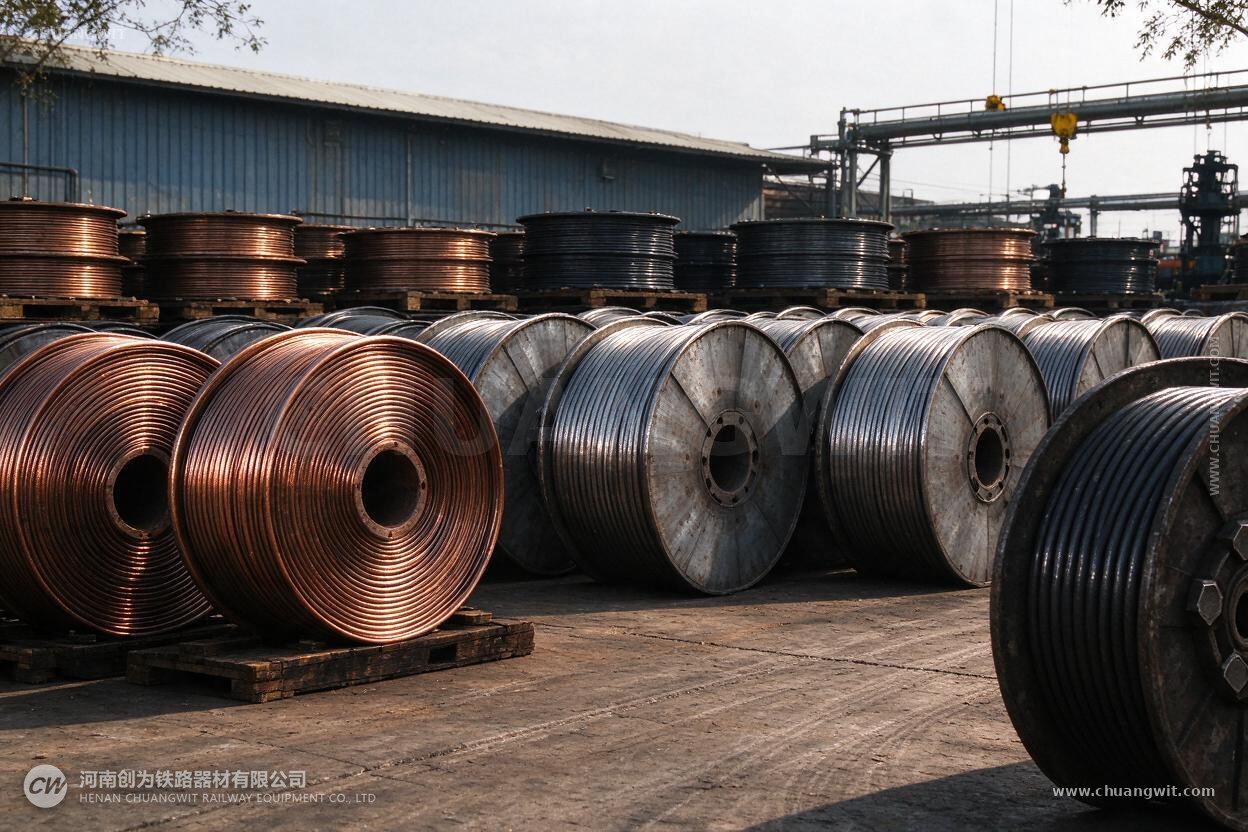
Messenger wire materials fall into three families: copper and copper alloy strands — the JTM and JTMH types — higher-strength bronze grades within the copper alloy group, and aluminium-clad steel core conductors such as LBGLJ. All are dedicated railway products under the TB/T 3111 series: Part 1 covers copper and copper alloy strands, Part 2 covers aluminium-clad steel core aluminium stranded conductors. Size then follows duty — tension, span and current — rather than catalog habit.
Key Takeaways
- The messenger does double duty — structural carrier and parallel conductor — which is why the TB/T 3111 series exists as a dedicated standard rather than borrowing generic overhead line conductor rules.
- TB/T 3111.1-2026 governs copper and copper alloy strands, including the JTM and JTMH families; TB/T 3111.2-2026 governs aluminium-clad steel core aluminium stranded conductors.
- LBGLJ wraps aluminium strands around an aluminium-clad steel bearing core, a layout equivalent to the JL/LB1A type of GB/T 1179.
- Alloying raises strength at some cost in conductivity: selection balances sag, tension and current duty across the family table.
- Sizes are chosen mechanically first — tension, span, wind and ice — with the material grade then tuned for conductivity and corrosion environment.
What Is Messenger Wire and Why Does It Have Its Own Standard?
A messenger wire that only hung wire could be any strong strand; a messenger that also carries traction current cannot. That dual structural-electrical duty is why railway messenger conductor is a dedicated product family under the TB/T 3111 series for stranded conductors of the overhead contact system, with its own materials, tests and tolerances rather than rules borrowed from generic transmission conductor standards.
The series is also young and actively maintained, which matters for procurement documents:
| Standard | Scope | First issued (year) | Current edition (year) |
|---|---|---|---|
| TB/T 3111 series | Strands for the overhead contact system | 2005 | 2026, split into two parts |
| TB/T 3111.1-2026 | Copper and copper alloy strands | 2005 (series) | 2026 |
| TB/T 3111.2-2026 | Aluminium-clad steel core aluminium stranded conductors | 2026 | 2026 |
| GB/T 1179 reference | JL/LB1A layout equivalence for LBGLJ | Referenced | Referenced |
Source: TB/T 3111 lineage as published in the standards corpus — first edition 2005, first revision 2017, second revision 2026 split into two parts.
Procurement should cite the part, not just the series: a reel certified against TB/T 3111.1-2026 and one delivered against a withdrawn edition are different goods even at the same cross-section. The 2026 split into parts exists precisely because copper strands and aluminium-clad steel core conductors deserve separate technical requirements.
The working relationship with the contact wire — and why two wires exist at all — is outlined in why overhead lines use two wires.
Copper and Copper Alloy Strands: JTM, JTMH and Bronze
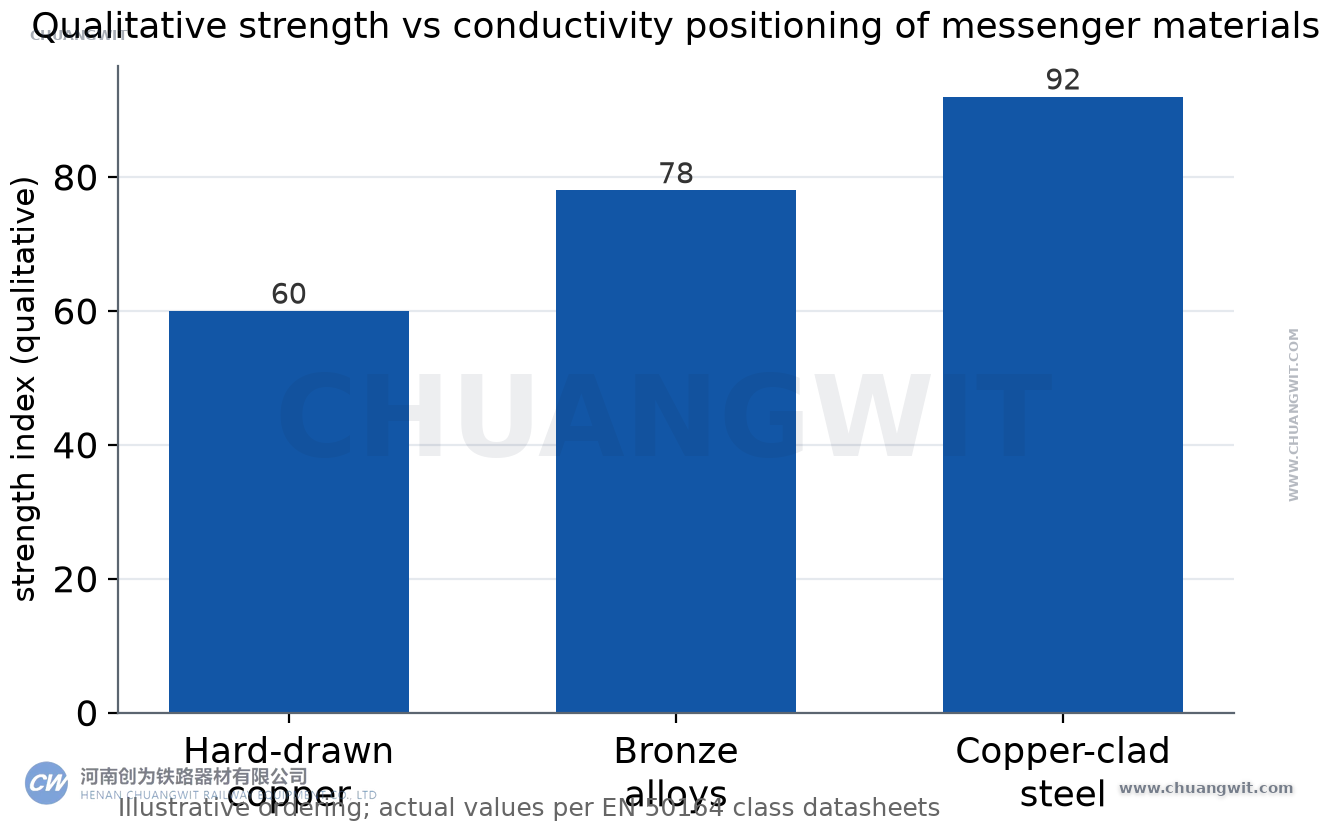
The JTM family covers copper strands, and JTMH the higher-strength copper alloy grades, both within TB/T 3111.1-2026. Copper gives the best conductivity of the group; the alloyed grades trade part of that conductivity for tensile strength, letting a span carry more tension or reach further between anchors at the same sag. Bronze — copper with tin-family alloying — sits in the same strength-first direction, with hard, wear-resistant surfaces that suit aggressive industrial and tunnel environments.
Selection follows the same alloy logic that governs contact wire, where EN 50149 assigns CuAg 0.1 to long-distance duty up to about 250 km/h and reserves CuMg 0.5 and CuMg 0.7 for high-speed, high-tension service. The comparison method transfers directly to messenger grades and is developed in CuMg versus CuAg selection logic.
Environment finishes the choice inside the family. Tunnel and coastal lines push toward grades and claddings that resist damp, industrial air favors surfaces that tolerate deposits, and clean open route lets the highest-conductivity grades run at their best economics.
Aluminium-Clad Steel Core Conductors: LBGLJ
Where weight and ampacity matter more than ultimate conductivity, the LBGLJ family wraps aluminium strands for conductivity around an aluminium-clad steel core that does the mechanical work — a layout equivalent to the JL/LB1A type of GB/T 1179, standardized for railway use under TB/T 3111.2-2026. The steel core carries tension, the aluminium carries current, and the cladding protects the interface between them against corrosion.
The split-duty concept — strength member plus conductor — extends into composite cores in modern practice, where a non-metallic core replaces steel for weight and corrosion reasons. Those families, and how they sit beside JTM and JTMH, are covered in messenger wire materials and selection: JTM, JTMH and composite cores.
How Messenger Wire Sizes Are Selected
Size selection is mechanical-first. The design tension for the speed class and span family sets the required strength; wind and ice loads add their cases to the same calculation; the resulting candidate cross-sections are then checked for current duty, because the messenger shares traction current with the contact wire. Corrosion environment — tunnel, coastal or industrial air — finally biases the material choice within the shortlist.
The practical sequence is therefore specification, not catalog browsing: define tension and duty, shortlist the material family, then let the standards file — TB/T 3111.1-2026 or TB/T 3111.2-2026 — fix tolerances and tests for the chosen size. There is no universal size chart, and any supplier offering one without asking for the load cases is guessing.
Two checks close the selection. The electrical check confirms the messenger can share traction current without exceeding its thermal limits alongside the contact wire. The interface check confirms the chosen diameter class matches the clamp and anchor families available to the project — a conductor with no matching hardware is not a selection, it is a delay.
Material Families at a Glance
| Family | Character (qualitative) | Governing standard |
|---|---|---|
| JTM copper strands | Highest conductivity of the group | TB/T 3111.1-2026 |
| JTMH copper alloy strands | Higher strength at moderate conductivity | TB/T 3111.1-2026 |
| Bronze grades | Strength plus a hard, wear-resistant surface | Copper alloy scope of TB/T 3111.1 |
| LBGLJ aluminium-clad steel core | Aluminium conductivity on a steel bearing core, JL/LB1A equivalent | TB/T 3111.2-2026, GB/T 1179 |
Source: TB/T 3111 series scopes as published in the Chinese railway standards corpus; LBGLJ equivalence to the JL/LB1A type of GB/T 1179 as stated in the messenger materials corpus. The table compares qualitative character; specific cross-sections follow project tension and current duty.
Read the two tables together: the standards table fixes which document a reel must satisfy, the family table fixes what the material inside it does, and the load cases fix the size.
Installation Interface and Specification Discipline
Material choice ripples into installation: alloy messengers need matching clamp bodies and anchor codes, and every fitting family expects a defined diameter class at the interface. Pins, bores and eyes that do not match turn a good conductor choice into a bad installation. Diameter class is part of the fitting code system, so a change of conductor family is a change of hardware bill, not just of wire. The staging sequence and its error modes are covered in messenger wire installation: stages and mistakes to avoid.
On the documentation side, the 2026 revision round refreshed the strand standards alongside the contact wire and fittings documents; what changed in each is summarized in the four new OCS standards.
Frequently Asked Questions
What is messenger wire made of?
Railway messenger wire is made of copper, copper alloy or aluminium-clad steel core strands. The JTM family covers copper strand and JTMH higher-strength copper alloy grades under TB/T 3111.1-2026; LBGLJ wraps aluminium around an aluminium-clad steel core under TB/T 3111.2-2026, matching the JL/LB1A layout of GB/T 1179. The choice follows tension, current duty and the corrosion environment of the line.
What are common messenger wire sizes?
There is no single universal size chart: messenger cross-sections are set project by project from the design tension, span family, wind and ice cases, and the current the messenger must share with the contact wire. The standards file then fixes tolerances and tests for the chosen size under TB/T 3111.1-2026 or TB/T 3111.2-2026. Specifying by duty rather than by habit is the reliable route to a defensible bill of materials.
What is messenger wire?
Messenger wire is the structural upper conductor of a catenary: tensioned between anchors, it sags in a curve and carries the contact wire through droppers while acting as a parallel electrical path. Its dual mechanical-electrical duty is why it follows the dedicated TB/T 3111 stranded conductor series. Materials span copper, copper alloy and aluminium-clad steel core families.
Does the material affect messenger wire price?
Material is a primary cost driver, expressed here qualitatively: copper content, alloying additions and steel core construction each move the cost structure, and metal market movement adds volatility on top. Between families the ranking follows metal volume and processing, not marketing. Fix the specification first — family, duty, standard edition — and quotations become comparable on structure rather than guesswork.
Specify the Family, Then the Size
Material family and size are one decision made in the right order: duty first, material second, cross-section third, standards file throughout. The TB/T 3111 series carries the whole chain for strands, and GB/T 1179 anchors the LBGLJ equivalence where aluminium-clad steel core conductors fit the duty. When duty sits between families, the honest answer is a shortlist, not a default.
For family shortlists matched to your tension and current duty, our engineering team maps JTM, JTMH and LBGLJ options against project specifications and confirms standards editions before anything ships.