Messenger wire installation creates the catenary: the stranded messenger runs along the supports on stringing blocks, is tensioned and sagged to the design curve, then receives droppers, anchors and registration so it can carry the contact wire. The conductor belongs to the TB/T 3111 stranded conductor series and the fittings to the numbered families of TB/T 2075. Most installation failures trace to three causes — sag errors, twisted lay and mismatched fittings — all avoidable with staged checks.
Key Takeaways
- The messenger does double duty — mechanical carrier of the contact wire and parallel electrical conductor — which is why it follows the dedicated TB/T 3111 series rather than generic overhead line conductor rules.
- Stage order: reel and fittings check, stringing with blocks, tensioning and sagging, dropper clipping, anchoring including the mid-point anchor to TB/T 2075.6-2024.
- Terminal anchor clamps to TB/T 2075.5-2024 encode speed class, construction and body material in the type code — order by code, not by habit.
- Droppers to JL02(7A)-2010 and the TB/T 2075 series set contact wire height; stitch wire assemblies to TB/T 2075.8-2024 smooth the support zone.
- Tension is held by compensation devices such as the 12-1G pulley type at a 1:3 ratio or the 13-1G ratchet type, both to the TB/T 2075 series.
What Is Messenger Wire and What Does It Carry?
The messenger — also called the catenary wire — is the upper conductor of the overhead contact system. Tensioned between anchor points, it sags into a curve and carries the weight of the contact wire through droppers, while also serving as a parallel electrical path for traction current. Its material families and their selection logic are covered in messenger wire materials and sizes, and the working relationship with the contact wire in why overhead lines use two wires.
Because it carries mechanical load and current at once, the messenger is ordered as a dedicated product: strands to the TB/T 3111 series, terminations and anchors to the TB/T 2075 families, with the two documents agreeing on the interfaces. Installation is where that agreement is either preserved or destroyed. On lines with automatic tensioning, the messenger also carries the stack loads that keep the system stable across seasons.
Before Stringing: Reels, Fittings and the Standards File
Check three things before the first block hangs. Conductor: reels matched to the design tension and material family — TB/T 3111.1-2026 covers copper and copper alloy strands, TB/T 3111.2-2026 covers aluminium-clad steel core aluminium stranded conductors. Fittings: clamp and anchor codes read against the TB/T 2075.5-2024 naming rules. Paperwork: mill certificates and type test evidence in the file, because messenger hardware is load-bearing and its pedigree is part of the installation.
The 2026 standards round changed the strand documents — the TB/T 3111 series was revised and split into two parts — so confirm which edition a delivery claims before accepting it. What changed and why is summarized in the four new OCS standards of 2026.
Stage the site itself. Reel stands need level ground and room to brake, platforms need access along the whole tension length, and a communication plan — who calls the tension step, who verifies sag — prevents the improvisation behind most stringing incidents. On tunnel sections, confirm clearance for the work train before the night it arrives.
Stringing and Sagging: The Core Steps
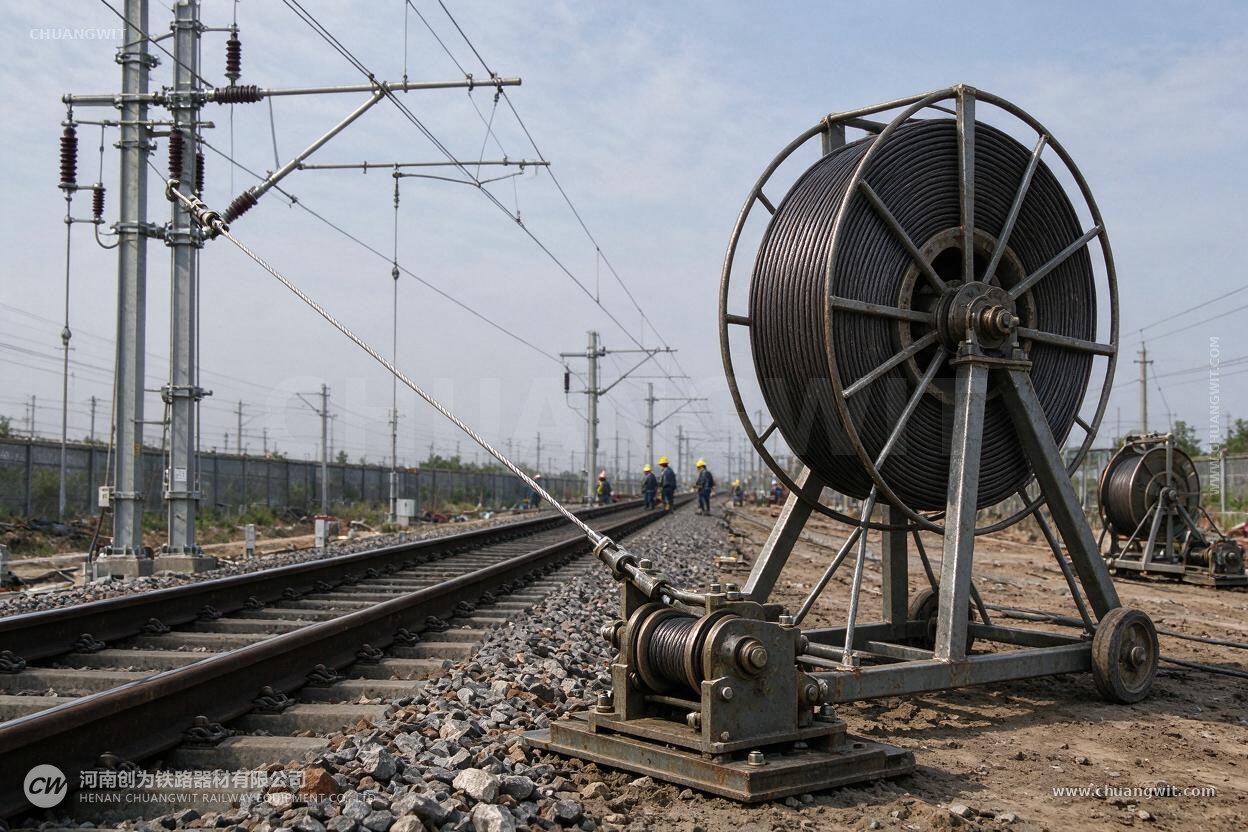
Stringing follows a fixed rhythm. Brake-equipped reel stands sit at the anchor; blocks hang on the supports; the messenger pays out under light tension to avoid ground contact and twist. Once anchored at both ends, tension rises in verified steps toward the design value, and sag is checked span by span against the temperature-adjusted sag table — sag is the geometry that makes the whole system work, and it is the first thing an inspector re-verifies.

Never lift a reel over a standing coil, never let the conductor rotate as it pays out, and never drag it across structure or ballast: a twisted lay or scuffed strand is a hidden defect that full tension will find later, usually at the least convenient anchor point.
Sag measurement deserves its own discipline. The survey crew records conductor temperature in shade, not air temperature in sun, and notes the time of each reading against the sag observed. A sag record without temperature and time is a number without meaning at the next audit.
Clipping Up: Droppers, Stitch Wires and Registration
With the messenger sagged, droppers convert the design geometry into hardware. Integral droppers of the 7-1A and 7-1B families, stamped or die-forged to JL02(7A)-2010 and the TB/T 2075 series, set the contact wire height at each support interval; placement practice is detailed in catenary droppers: types, spacing and installation practice.
Stitch wire assemblies to TB/T 2075.8-2024 then tie the support zone together, smoothing the elasticity variation where the pantograph passes the cantilever — once installed, the contact wire runs smoothly through the support zone with reduced contact loss. Tuning practice is covered in stitch wires in elastic catenary systems.
Order matters when clipping up: droppers close to supports go in first to fix the geometry, then intermediate droppers take up their calculated lengths. Cut dropper wire to the schedule rather than to eye, and record any deviation beyond tolerance for the designer instead of absorbing it silently.
Anchoring and Tensioning: Where Installations Go Wrong
Every tension length ends in hardware that must match the wire, the load and the tools. Terminal anchor clamps to TB/T 2075.5-2024 terminate the conductors; the mid-point anchor to TB/T 2075.6-2024 locks the length against unilateral wire breaks — its mechanics are explained in why every tension length needs a mid-point anchor. Compensation then holds tension across temperature swings:
| Device | Compensation ratio | Governing standard |
|---|---|---|
| 12-1G pulley compensation device | 1:3 | TB/T 2075, Part 12 |
| 12-1H compensation pulley block | 1:2, 1:3, 1:4 | TB/T 2075, Part 12 |
| 13-1G ratchet compensation device | Per design assembly | TB/T 2075, Part 13 |
Source: 12-1G, 12-1H and 13-1G device families as published with their TB/T 2075 series designations in the Chinese railway standards corpus.
Match the device to the wire load and the stack travel, not to warehouse convenience: a ratio that suits one tension length may starve or overrun another. The 12-1H block exists in multiple ratios precisely for this reason.
Ropes, anchors and safety margins around these devices carry their own rules, collected in catenary compensation device installation.
Common Mistakes and How to Avoid Them
- Sag set on the wrong temperature basis. Sag tables are temperature-dependent; interpolate for the site temperature rather than assuming the nearest tabulated value.
- Twisted or kinked conductor. Pay out under control, keep the reel axis horizontal, and reject lengths with visible lay disturbance before they reach the anchor.
- Over- or under-tension. Raise tension in verified steps with calibrated devices; an uncalibrated stack simply hides the error until the first cold night.
- Mismatched fittings. Pins, bores and eyes from different families do not pair; order matched sets within the TB/T 2075 families so interfaces arrive together.
- Skipped mid-point anchor. Without it, one wire break unloads the whole tension length and turns a repair into a rebuild.
Frequently Asked Questions
What is messenger wire?
Messenger wire is the upper, structural conductor of a railway catenary. Tensioned between anchors, it sags in a curve and carries the contact wire through droppers, and it also serves as a parallel electrical conductor. Because it carries mechanical load and current at once, it is a dedicated product family under the TB/T 3111 stranded conductor series rather than a generic overhead line conductor pressed into service.
How is messenger wire installed?
Installation runs through staged steps: verify reels and fittings against design, string the messenger on blocks under light tension, anchor and tension it in verified steps, sag it span by span against the temperature-adjusted table, clip droppers and stitch wires, then install terminal and mid-point anchors with compensation devices. Each stage has acceptance checks, and the most common failures — wrong sag, twisted lay, mismatched fittings — are caught by those checks.
What is messenger supported wiring?
Messenger supported wiring is any cabling system hung from a tensioned messenger by clamps or rings instead of supported at each end. The railway catenary is the principle at engineering scale: the messenger carries the assembly while the suspended element — a contact wire rather than a cable — performs its specific duty. The same mechanics of sag, tension and anchor points govern both applications.
Install for the Tension It Will Live Under
A messenger installed clean — undamaged lay, correct sag, matched fittings, anchors and compensation in place — holds its geometry through the long service life the design assumes. The standards provide the checklist; the discipline lives in the staging, and every mistake in the list above costs more to find later than to prevent on the day. When the stages run in order — sag verified against temperature, lay protected, fittings matched by code, anchors complete — the mistakes list stays theoretical, and the job closes without reopening the same anchor point next quarter.
For matched sets — messenger hardware to the TB/T 2075 families with conductor to the TB/T 3111 series — our engineering team supports specification, staging plans and delivery sequencing.