Abstract
On 27 February 2026 the National Railway Administration approved and issued nine railway industry standards under Announcement No. 7 of 2026, four of which relate directly to the overhead contact system: Copper alloy contact wires for electrified railway overhead contact systems (TB/T 2809-2026), Strands for electrified railway overhead contact systems - Part 1: Copper and copper alloy strands (TB/T 3111.1-2026), Strands for electrified railway overhead contact systems - Part 2: Aluminium-clad steel core aluminium stranded conductors (TB/T 3111.2-2026) and Parts and components for electrified railway overhead contact systems - Part 24: Preformed fittings (TB/T 2075.24-2026). All four took effect on 1 September 2026. This article lines up the two drafts for comment (the August 2024 versions), the announcement of the National Railway Administration, the catalogue records of the National Standards Information Public Service Platform and the publication information of China Railway Publishing House item by item, and verifies ten key technical changes in this revision round: withdrawal of the plain copper contact wire, introduction of strength grades into the model designation system, first inclusion of copper-chromium-zirconium alloy in the contact wire and strand standards, splitting of the strand standard into two, retirement of TB/T 2937-1998 after 28 years of service, loss of a railway industry product standard for aluminium-clad steel stranded conductors, and two adjustments to the English designation of preformed fittings. The article closes with an impact checklist and recommended actions for the four stages of design, procurement, manufacturing and operations.
Keywords: OCS standards; TB/T 2809-2026; copper alloy contact wire; copper-chromium-zirconium; stranded conductor; aluminium-clad steel core aluminium stranded conductor; preformed fittings; messenger wire; contact wire; railway industry standard
One point first: these four standards were not published today. The approval date was 27 February 2026, the announcement number is No. 7 of 2026, and they belong to the second batch of equipment technology standards for 2026; the same batch also contains five further standards covering bridge anti-vessel-collision devices and the locomotive and rolling stock maintenance series. The real milestone is the effective date - 1 September 2026, that is, today. From today the four old standards TB/T 2809-2017, TB/T 3111-2017, TB/T 2937-1998 and TB/T 2075.24-2020 are withdrawn simultaneously, and the product standard system for OCS wires and fittings has a new foundation. We gave an overview of how the whole batch of 33 standards landed in today's news release; that article answered "what happened". This one answers "what exactly changed, why it changed, and what each stage should do". The two do not overlap and can be read side by side.
One more sentence belongs at the very front: the official published texts of the four standards are issued by China Railway Publishing House, and the full text is not available through any public channel at present. Wherever this article marks a parameter as coming from a "draft for comment", it is taken from the two drafts for comment completed on 31 August 2024 (archived on creeb.net, the power and electrical information network; the contact wire draft runs to 19 pages and the strand draft to 24 pages, plus 4 pages of drafting notes). Results already verified from the announcement and the standard catalogue platform are sourced separately. Points where the final published version differs from the drafts for comment are listed in section 6. There is only one writing principle: do not write what cannot be pinned down, and write only what has a source.
1. Version History: Where the Old Standards Came From
To appreciate the weight of this revision round, one must first look at how old the standards being replaced actually are.
TB/T 2809 has the most complicated lineage. In 1997 the contact wire products were published as three separate standards divided by material (TB/T 2809-1997, TB/T 2810-1997 and TB/T 2821-1997); the 2005 revision merged the three into a single standard, Copper and copper alloy contact wires for electrified railways; the second revision in 2017 adjusted the title slightly to Copper and copper alloy contact wires for electrified railway use; and by this 2026 edition it is already the fourth renaming and re-issuing in twenty-nine years, with the title narrowed further to Copper alloy contact wires for electrified railway overhead contact systems. Catalogue records on the National Standards Information Public Service Platform show that the withdrawal date of TB/T 2809-2017 is precisely 1 September 2026, so old and new dovetail cleanly.
TB/T 3111 is a much newer series, appearing only in 2005, with a first edition titled Copper and copper alloy stranded conductors for electrified railway use, a first revision in 2017, and a second revision in 2026 that split it into two halves - the details come later. Note the change in the English title: the 2017 edition was recorded as "Copper and copper alloy stranded conductors for electric railway", whereas Part 1 of the 2026 edition is recorded as "Electrified railway catenary - Strands - Part 1: Copper and copper alloy strands". The standard has moved from the "for electrified railway use" family into the "electrified railway overhead contact system" family, aligning its scope with the contact wire standard.
The real antiques are TB/T 2937 and TB/T 2938. Both were issued in 1998: Aluminium-clad steel core aluminium stranded conductors for electrified railways and Aluminium-clad steel stranded conductors for electrified railways. The former applies to aluminium-clad steel core aluminium stranded conductors for power-frequency single-phase AC 25kV electrified railway overhead contact systems; the latter covers plain aluminium-clad steel stranded conductors. Neither standard was revised for 28 years - longer than the working lives of many frontline OCS technicians. In this revision round 2937 is superseded by TB/T 3111.2-2026, while 2938 was brought into the merged scope at the draft-for-comment stage and then disappeared entirely at publication; that episode is dealt with separately in section 4.
TB/T 2075.24 is the youngest: issued on 30 October 2020, effective on 1 May 2021, reviewed on 12 September 2024, with revision started immediately afterwards and re-issued in 2026. Preformed fittings are the fastest-growing category of fitting in recent years, and their standards clearly iterate faster than the older series.
| Superseded standard | Previous editions | Destination in 2026 |
|---|---|---|
| TB/T 2809 | 1997 first edition in three parts (2809/2810/2821) → merged in 2005 → second revision in 2017 | TB/T 2809-2026 Copper alloy contact wires for electrified railway overhead contact systems |
| TB/T 3111 | 2005 first edition → first revision in 2017 | Split into TB/T 3111.1-2026 (copper and copper alloy strands) |
| TB/T 2937-1998 | 1998 first edition, not revised for 28 years | TB/T 3111.2-2026 Strands - Part 2: Aluminium-clad steel core aluminium stranded conductors |
| TB/T 2938-1998 | 1998 first edition (aluminium-clad steel strands), not revised for 28 years | Included in the merged scope at the draft stage; no replacement standard arranged at publication |
| TB/T 2075.24-2020 | Issued 2020-10-30, effective 2021-05-01, reviewed 2024-09-12 | TB/T 2075.24-2026 |
The administrative home of the four new standards is unchanged: they all belong to the Traction Power Supply Subcommittee of the Railway Industry Technical Committee for Standardisation of Electrical Equipment and Systems, with the ICS classification number 29.280 (electric traction equipment). The drafting team is led by the Standards and Metrology Research Institute of the China Academy of Railway Sciences: the contact wire standard was drafted by that institute together with China Railway Electrification Engineering Group, China Railway First Survey and Design Institute Group, China Railway Eryuan Engineering Group, China Railway Beisai Electrical and Kangyuan New Materials of the China Railway Construction Electrification Bureau Group (registration number 108095-2026); the copper and copper alloy strand part drew in wire manufacturers such as Xinchengrui, Jiangyin Electrical Alloy, Yantai Jinhui and Hengtong Power Smart Grid (registration number 108096-2026); and the aluminium-clad steel core aluminium stranded conductor part involved China Railway Design Corporation, China Railway Engineering Consulting Group, Hebei Jinghui, Xingtai Cable, Henan Tongda Cable and the China Railway Test and Certification Centre (registration number 108097-2026). The fact that manufacturers and certification bodies sit deep in the drafting list is itself a signal: what this revision round has to solve is not only technical indices, but also the workability of product inspection and certification in practice.
As for why these standards were re-issued together in the same year, there is a systemic reason. Under the general rules for managing industry standards, standards shall be reviewed periodically, normally at intervals of no more than five years, and the conclusion of the review is either to remain in force, to be revised, or to be withdrawn. TB/T 2075.24-2020 was reviewed and taken into revision four years after issue, which follows exactly that rhythm; the two 1998 standards dragged on for 28 years, far beyond any reasonable review interval, and were dealt with this time in the window opened by the strand standard revision - settling an old debt. For a field with a relatively stable product line, a slower pace of standard updating is not necessarily a bad thing: OCS equipment has long supply cycles and a heavy certification system, and frequent changes leave the supply chain at a loss; but when the debt runs too long the standard drifts away from technical reality. This revision round is essentially a search for balance between settling the debt and keeping things stable.
2. TB/T 2809-2026: The Ten Changes to Contact Wire, One by One
2.1 The ten technical changes listed in the foreword of the draft for comment
The foreword of the contact wire draft for comment sets out the technical changes very clearly, ten in all. They are reproduced here one by one with a little background added:
Item one, the plain copper contact wire variety is deleted. This is the item that drew the most industry discussion. Plain copper (Cu-ETP) contact wire was once the starting point of China's electrified railways - the CT-type copper contact wire used on early lines had a tensile strength of only around 350MPa, although its conductivity was close to 100%IACS. The problem was that once traffic volumes and train frequencies rose, plain copper could not hold high tension, and it also fared badly in creep and wear; later new main lines turned to copper alloys long ago, and plain copper in practice survives only as installed stock on older lines and in some urban rail applications. Removing it from the industry standard amounts to writing the full stop at the end of the service life of plain copper contact wire on new railway lines. It should be made clear that removal is not the same as mandatory replacement: existing plain copper contact wire is replaced naturally according to the overhaul cycle, the technical conditions for the replacement are declared under the new standard system, and the transitional period is managed by the overhaul plan itself. This is consistent with the "no retroactive effect on equipment in service" principle on the operations side described later.
Item two, the requirements for the range of chemical composition are changed; item three, the copper-tin and copper-magnesium alloy contact wire varieties are changed - these two are companion moves, with the composition range following the variety grading, see section 2.2. Item four, copper-chromium-zirconium alloy contact wire varieties are added (CTCZ, CTCZM), the biggest technical highlight of this revision, expanded on in section 2.3. Item five, a reference mass per unit length requirement for contact wire is added: previously only the cross-section dimensions were controlled, now the mass per kilometre is also bounded, which is good for tensioning section length calculations, cantilever load checks and construction drum matching. Item six, the vibration and fatigue test requirements are changed, with recommended test tensions specified: tests are no longer "self-defined", and the standard simply tabulates which test tension goes with which model. This item deserves a little more comment. Once strung, a contact wire spends its life under tension, and every pantograph passage is one excitation; at several dozen train pairs a day that is tens of thousands of cycles a year, on top of which aeolian vibration adds high-frequency, small-amplitude oscillation. In the past, how the test tension was chosen and how many cycles were applied varied from one laboratory to another, and it was not rare for the same wire to pass at laboratory A and fail at laboratory B. Once the tension grades are written into the standard, the loading conditions of the laboratories are unified, type test reports become comparable with one another, and historical data used when renewing CRCC certification finally share a common scale. Item seven, the requirements for the rod blank manufacturing process are changed: the rod blank is the source of contact wire quality, and updated wording on the process route means changed acceptance criteria for different routes such as continuous casting and rolling and upward casting. Item eight, the indoor current-carrying capacity technical requirements are changed. Item nine, the vibration test method is changed. Item ten, the inspection rules are changed.
Six of the ten items carry the word "changed". They look trivial one by one, but together they point in a very consistent direction: the parts of the 2017 edition that read like a "product description" are reshaped into wording closer to manufacturing and inspection practice. The drafting notes also state the starting point of the revision - contact wire is an important item of OCS equipment whose performance and quality bear directly on traffic safety, the 2017 edition played an important role in regulating design, production and inspection since it took effect, and the revision is there to keep up with the current technical and industrial state.
2.2 Rebuilding the model designation: material code plus strength grade
More thought-provoking than the list of ten changes is the rebuilding of the model designation system. The draft for comment establishes a three-part rule of "material code + strength grade + nominal cross-section": the material code says which alloy, the strength grade says which strength band, and the cross-section figure says which size. Copper-silver alloy is not graded; copper-tin, copper-magnesium and copper-chromium-zirconium alloys are each divided into low, medium and high grades, with the low grade omitting the letter, the medium grade carrying M and the high grade carrying H. For example, CTCZM150 reads: copper-chromium-zirconium alloy, medium strength grade, 150mm² cross-section.
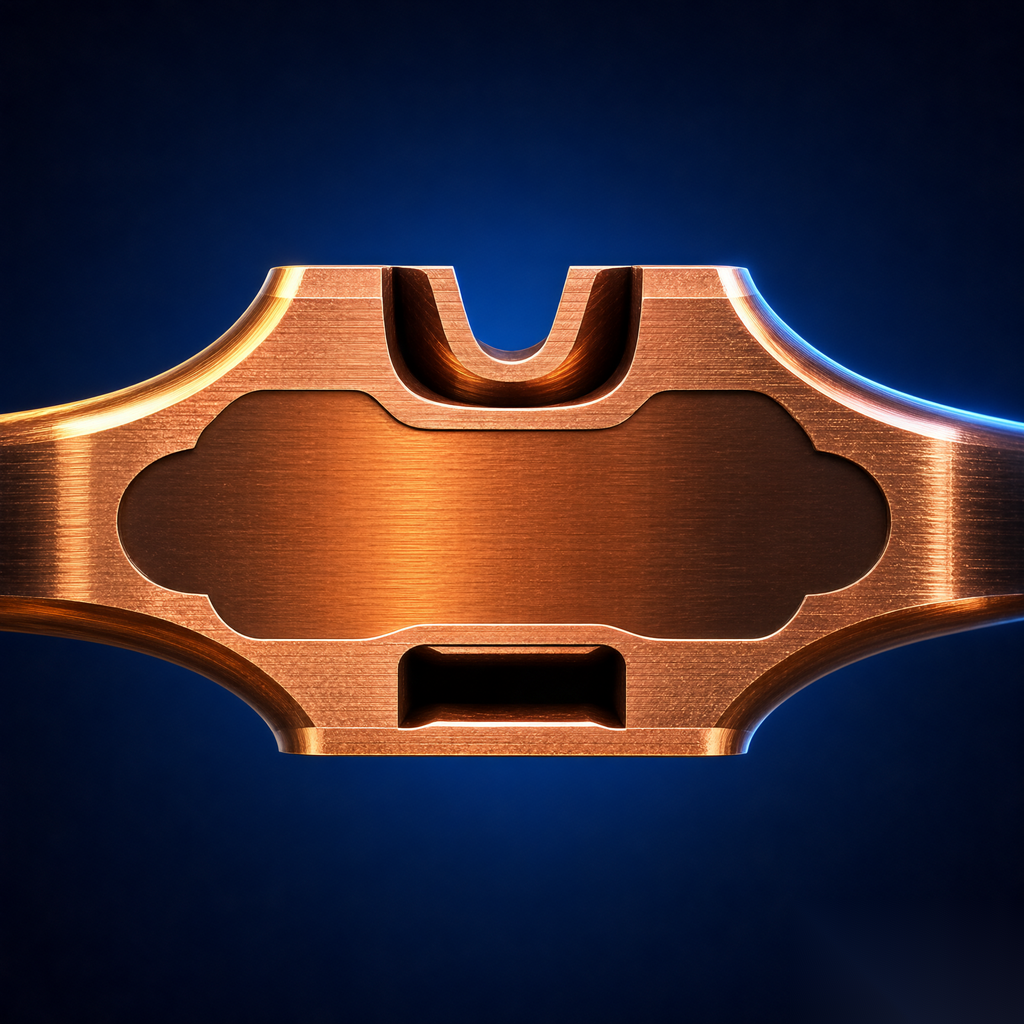
On sizes, the draft for comment retains only two nominal cross-sections, 120mm² and 150mm², a noticeable narrowing compared with the 2017 edition. Narrowing the cross-sections and grading the strength together push the product line from "customised on demand" towards "consolidated and optimised": with fewer varieties, both the supply volume and the quality consistency of each variety are easier to raise. The table below gives the full picture of the alloy system as set out in Tables 3 and 4 of the draft for comment (strength and conductivity are the values for the 120 size):
| Alloy class | Model (120/150) | Key composition range | Tensile strength (120 size) | Conductivity at 20°C |
|---|---|---|---|---|
| Copper-silver | CTA120 / CTA150 | Ag 0.08%~0.12% | ≥377 MPa | ≥97 %IACS |
| Copper-tin (low / medium) | CTS / CTSM | Sn 0.02%~0.20% / 0.15%~0.40% | ≥388 / ≥439 MPa | ≥93 / ≥80 %IACS |
| Copper-magnesium (medium / high) | CTMM / CTMH | Mg 0.20%~0.60% / 0.30%~0.70% | ≥510 / ≥541 MPa | ≥68 / ≥65 %IACS |
| Copper-chromium-zirconium (low / medium, new) | CTCZ / CTCZM | Cr 0.10%~0.80%, Zr 0.02%~0.10% / Cr 0.20%~1.00%, Zr 0.02%~0.20% | ≥469 MPa / CTCZM150 ≥560 MPa | ≥90 / ≥75 %IACS |
Note: the data in this table are taken from Tables 3 and 4 of the draft for comment. Where the final published version differs from the draft for comment, the text published by China Railway Publishing House prevails. According to the draft for comment, CTCZM150 has the highest tensile strength of all models, ≥560MPa, corresponding to a breaking force of ≥82.87kN.
Comparing this table with the 2017 edition shows that the composition bands of copper-tin and copper-magnesium have been re-cut: the old edition had one composition band per alloy, while the new edition splits them into low and medium grades (copper-magnesium into medium and high), leaving a composition gap between grades so that the same batch of material cannot fall on the boundary between two grades with no clear owner. This approach of "cutting composition bands plus matching strength" means that ordering one model number simultaneously locks the composition range and the strength floor, leaving far less room for argument at acceptance.
For procurement, strength grading has another practical meaning: previously, when discussing a copper-magnesium contact wire, the manufacturer's strength figure was the four words "meets the standard", and how much margin there was and against which grade it was assessed was left to each side to interpret; after grading, the model code of the medium or high strength grade is itself written into the contract and the technical specification, and incoming material is re-tested against that code, so the comparability of supplied quality becomes immediately clear. In tendering and comparison, the price difference between grades of the same alloy also has a clear anchor - what is being bought is a strength grade, not a verbal promise.
A note on naming, by the way. The double-M form "CTMM" (medium-strength copper-magnesium) in the new models is not a typo: the first M stands for the element magnesium and the second M stands for the medium strength grade. Likewise CTMH is high-strength copper-magnesium, CTS is low-strength copper-tin and CTSM is medium-strength copper-tin. Given a new model number, read it in three segments - material code, grade letter, cross-section - and you will not get lost. We previously compiled the older coding rules for OCS parts in the detailed guide to parts codes, which can be read in parallel. One further reminder: the old model numbers of the old standard system are no longer used for new orders now that the old editions are withdrawn, but they still exist in large numbers in existing line drawings and spare parts stores, so the materials department would do well to post a new-to-old model comparison table in the warehouse, to avoid ordering by old model and accepting by new model.
2.3 Copper-chromium-zirconium: a new post for a well-established alloy
Copper-chromium-zirconium (CuCrZr) is nothing new; it has been used for decades in the power and mould industries, and with its high softening resistance, wear resistance and weldability it is the textbook precipitation-hardening alloy. Writing it into a contact wire product standard, however, is a first for China's railway industry standard series.
The logic of its inclusion becomes clear from the table above. The core contradiction in contact wire selection is the see-saw between strength and conductivity: in solid-solution strengthened alloys (copper-silver, copper-tin, copper-magnesium) the solute atoms sit in the copper lattice, so as strength goes up conductivity necessarily comes down - the high-strength copper-magnesium grade reaches 541MPa but conductivity falls to 65%IACS; conversely copper-silver reaches 97%IACS conductivity with a strength of only 377MPa. Copper-chromium-zirconium takes another route: Cr and Zr are first dissolved into the copper at high temperature, and after quenching an ageing treatment precipitates fine Cr-rich and Zr-rich phases, which strengthen the lattice while interfering little with electron scattering, so that a strength range of 469 to 560MPa can be combined with a conductivity of 75% to 90%IACS - exactly filling the gap between copper-silver (high conductivity, low strength) and copper-magnesium (high strength, low to medium conductivity). For a new generation of OCS pursuing high tension and low energy loss, this is precisely the "intermediate solution" the design side has been asking for.
On process route, the draft for comment states: upward casting or horizontal continuous casting plus continuous extrusion, or hot continuous rolling plus precipitation strengthening. The transverse grain size requirement is deliberately set apart from the solid-solution strengthened alloys as well - copper-chromium-zirconium is relaxed to ≤0.200mm, while copper-silver, copper-tin and copper-magnesium remain at ≤0.030mm. This is not a relaxation of the requirement but a differentiated index dictated by the alloy mechanism: precipitation strengthening relies on nanometre-scale precipitates, so a slightly coarser grain does not affect the main performance line; only solid-solution strengthening needs fine grains to help carry the strength. Measuring copper-chromium-zirconium with the grain size gauge meant for copper-magnesium will produce a completely wrong conclusion - a point worth flagging to the quality department in advance. Copper-chromium-zirconium also has a property that is easily underestimated: softening resistance. In solid-solution strengthened copper alloys the solute atoms re-diffuse and the precipitates coarsen at high temperature, so strength falls away fairly quickly as temperature rises, which is one reason why the maximum permissible working temperature of copper-magnesium contact wire is controlled so strictly. The precipitates of a precipitation-hardening alloy coarsen at a higher temperature and the strength retention at high temperature is clearly better, which matches exactly the basis on which the new strand standard assesses current-carrying capacity at a maximum permissible working temperature of 150°C - the higher the wire temperature, the more obvious the advantage of the precipitation-hardening route. The demands of the new generation of OCS, higher current ratings and high tension, point in essence to the same alloy direction.
The recommended test tensions (Clause 6.3 of the draft for comment) are given in great detail by model: 15kN for CTA120 and CTS120; 20kN for CTA150, CTSM120, CTS150 and CTCZ120; 25kN for CTMM120, CTMH120, CTSM150 and CTCZ150; 30kN for CTCZM120 and CTMM150; 35kN for CTMH150 and CTCZM150. After the vibration fatigue test the breaking force shall be not less than 95% of the minimum breaking force. This set of figures effectively writes down "at what tension a wire of which strength shall be fatigue-tested", leaving the laboratories no room for discretionary choice.
The reference mass per unit length also has a clear basis: 1082kg/km for 120mm² and 1350kg/km for 150mm², with density taken as 8.94g/cm³. In the past, designers doing load calculations had to estimate cross-section times density themselves; from now on they can simply read the table, and both sides of the supply relationship are working from the same set of figures.
3. TB/T 3111.1-2026: Variety Adjustments for Copper and Copper Alloy Strands
Part 1 supersedes TB/T 3111-2017 and covers the copper and copper alloy strands used for OCS suspension - messenger wires, dropper wire, electrical connections and compensation ropes are all supplied under it. At the draft-for-comment level there are six core changes; each is taken in turn.
First, a copper-chromium-zirconium alloy strand JTCZ is added (Cr 0.20%~1.00%, Zr 0.02%~0.20%), bringing the composition system in step with the contact wire standard. The technical positioning of JTCZ is a single-wire tensile strength of ≥520MPa and a conductivity of ≥87%IACS; the strand breaking force is ≥59.16kN for JTCZ120 (1×37/2.03 construction) and ≥72.68kN for JTCZ150 (1×37/2.25 construction). Compared with the current workhorse JTMH (high-strength copper-magnesium strand, 620MPa, 75%IACS), the strength is about a tenth lower while conductivity is 12 percentage points higher. Messenger wires have a large cross-section and a long length, so DC losses and current-carrying margin have always been sensitive items in power supply calculations, and trading a little strength for conductivity pays off under many line conditions - JTCZ leaves the designer one more knob to turn.
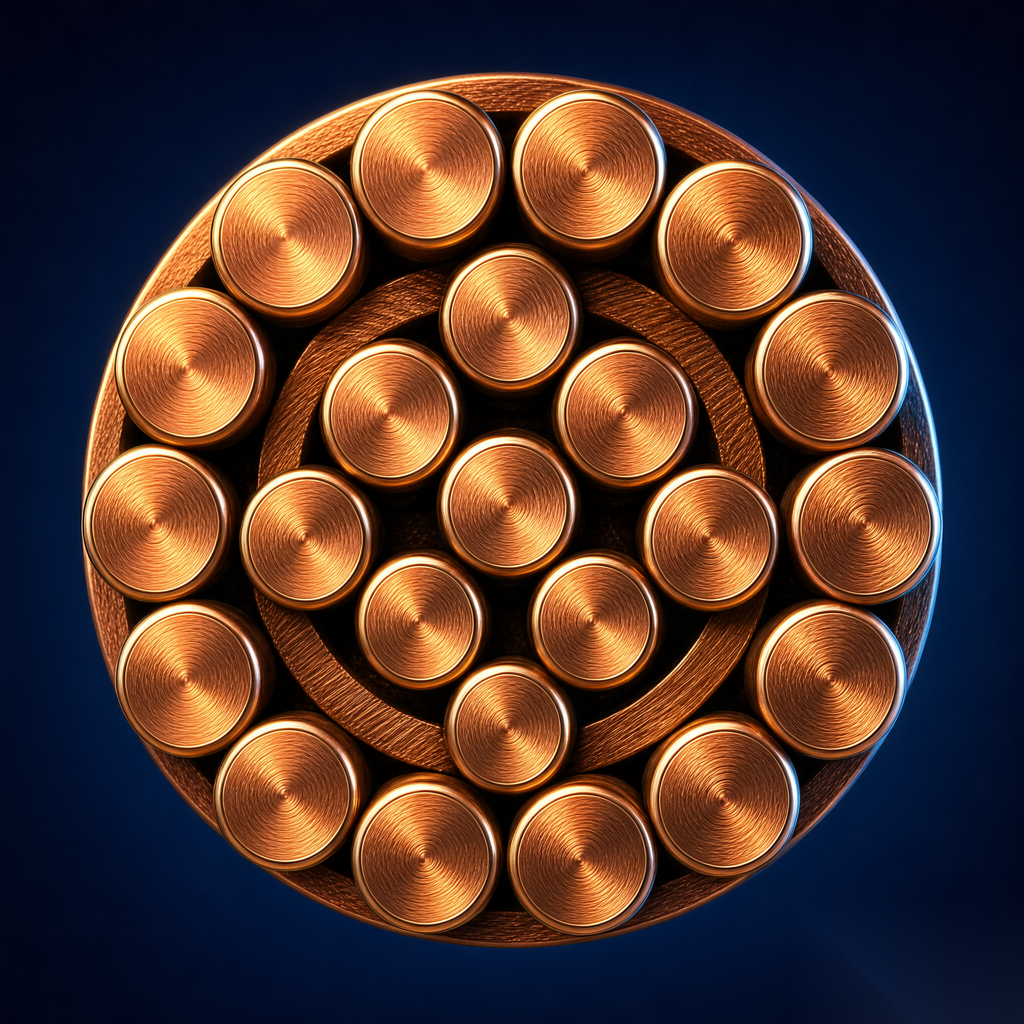
Second, the copper-magnesium strand varieties are graded into two: adjusted to JTM (Mg 0.05%~0.20%, corresponding to 520MPa and 80%IACS) and JTMH (Mg 0.15%~0.50%, corresponding to 620MPa and 75%IACS), on the same grading logic as the contact wire standard, so that the awkward situation of the same designation meaning different things in the two standards no longer arises.
Third, the strand size series is changed: 11 constructions from 10 to 150mm², among which dropper wire uses the re-stranded constructions 1×7×(1+6) and 1×7×(3+9). The advantage of re-stranding is flexibility; a dropper has to endure the vibration of every pantograph passage together with the contact wire, and wire that is too stiff readily suffers fatigue and broken strands at the clamp, a detail that bears directly on dropper life.
Fourth, the indoor current-carrying capacity requirement is changed: indoor and outdoor current-carrying capacities are now given separately for the two maximum permissible working temperatures of 95°C and 150°C. Heat dissipation conditions and the effect of solar radiation differ greatly indoors and outdoors, so using one ruler for both environments was unreasonable in the first place; this time they are separated.
Fifth, recommended test tensions are added to the vibration and fatigue tests, in seven grades from dropper wire up to large cross-section messenger wire: 1.5kN for JTM/JTMH 10 and 16 dropper wire; 2.8kN for the 25 size; 3.5kN for the 35 size; 10kN for JT/JTM/JTMH 50; 15kN for JT95 and JTMH70; 20kN for JT120 and JTM95; 25kN for JT150, JTM120/150, JTMH95/120/150 and JTCZ120/150. Small dropper wires are fatigue-tested at kilonewton-level tension, while large messenger wires go straight to 25kN - close to half or more of the actual suspension tension, a clear rise in test severity.
Sixth, the joint requirements are changed, with adjustments to the clause corresponding to Clause 6.6 of the 2017 edition. Joints are the location with the highest accident rate in strand applications, and the 2026 edition has reworked the joint provisions; the specific clauses follow the published text.
A word on the current-carrying capacity topic. For a long time the current-carrying capacity of strands was given as a single set of figures; the new edition gives indoor and outdoor values separately for the two maximum permissible working temperatures of 95°C and 150°C. On the surface there are simply more numbers, but in practice it leaves the design side room for finer work: normal operating conditions are checked against the 95°C band, and only short-time conditions such as short circuits and overloads draw on the 150°C band, the difference between the two being a quantifiable overload capability. Together with the indoor current-carrying capacity requirements changed in step in the contact wire standard, the rough-and-ready practice in power supply calculations of "discounting indoor runs by outdoor heat dissipation conditions" can now be retired. It should be noted that short-time overload capability is not an index for routine use; the time basis of the overload assessment (the draft for comment gives a 20min overload current-carrying capacity) and the recovery requirements must be read together, and the specific clauses follow the published text.
While on the subject, a note on where the JT series stands. The plain copper strand JT has not been deleted: sizes 10, 50, 95, 120 and 150 still appear in the recommended test tension grades. Outside the messenger wire role, applications such as electrical connections and earthing jumpers are extremely sensitive to conductivity and only moderately demanding on strength, and plain copper strand remains a reasonable option in those positions. What was deleted was the plain copper variety among contact wires; plain copper among strands is retained. The choices made in the two standards are not symmetrical, so do not assume that what holds for one holds for the other when reading them.
One further point for existing lines: model numbers such as JTMH120 and JTMH95 from the 2017 era continue under the new designation system; the names have not changed, what has changed is the composition band, the test basis and the inspection rules behind them. Replacing wire during maintenance on existing lines therefore raises no "model does not match" problem, but the inspection clauses in the technical conditions documents must be updated to the new edition.
4. TB/T 3111.2-2026: Aluminium-Clad Steel Core Aluminium Stranded Conductors, the First Replacement in 28 Years
4.1 Naming aligned with the national standard overhead conductor system
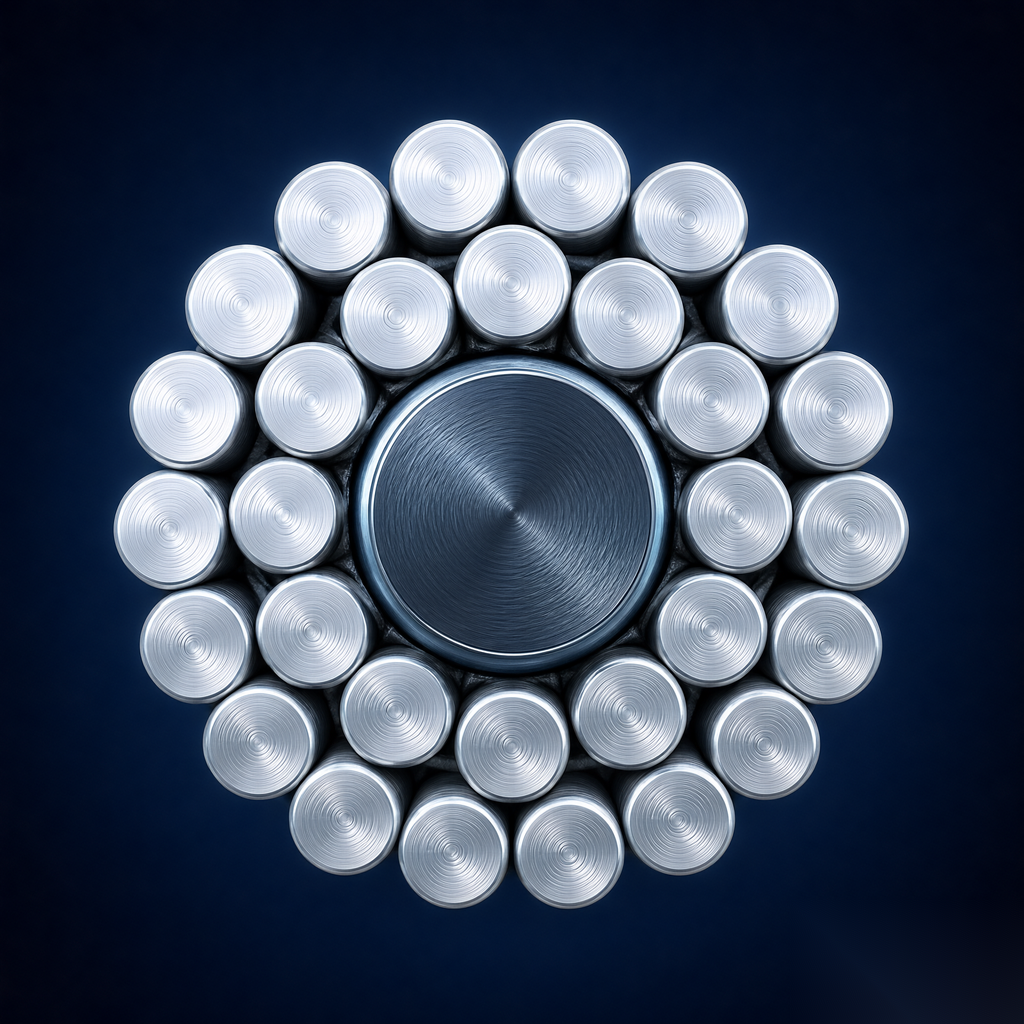
Part 2 replaces TB/T 2937 of 1998. Under the old standard the designations were a law unto themselves; the new edition aligns directly with the naming rules for national standard overhead conductors: JL/LB20A-□-□, for example JL/LB20A-120/20-26/7, where JL denotes hard-drawn aluminium wire, LB20A denotes type A aluminium-clad steel wire with 20.3%IACS conductivity, 120/20 is the aluminium cross-section over the aluminium-clad steel cross-section, and 26/7 is the number of aluminium strands over steel strands. Once the naming rules are aligned with the national standard, the railway designer looking up the current-carrying capacity and sag tables for a national standard conductor, and the manufacturer's factory inspection report, finally speak the same language on all three sides.
The material basis has also been renewed wholesale: hard-drawn aluminium wire follows GB/T 17048-2017 Hard-drawn aluminium wires for overhead stranded conductors, and aluminium-clad steel wire follows GB/T 17937-2024 Aluminium-clad steel wires for electrical purposes. When the 1998 edition was written it still cited the previous generation of material standards; renewing the references in this way brings in all the progress of 25 years of material technology, especially in the cladding process and performance grading of aluminium-clad steel wire. On electrical parameters, hard-drawn aluminium wire corresponds to 61%IACS and aluminium-clad steel wire to 20.3%IACS; DC resistance and current-carrying calculations take these two as the baseline.
Reading the model apart makes the rule obvious: in JL/LB20A-120/20-26/7, JL is the code for hard-drawn aluminium wire, LB20A is the code for aluminium-clad steel wire (type A with 20.3%IACS conductivity), 120/20 are the nominal cross-sections of the aluminium and the aluminium-clad steel respectively, and 26/7 is the stranding construction of 26 aluminium strands over a 7-strand steel core. Under the old standard, the designation of railway aluminium-clad steel core aluminium stranded conductors and that of national standard overhead conductors each went their own way: designers turned to railway handbooks for current-carrying capacity, manufacturers inspected to their own enterprise standards, and one conductor was described in three languages across three stages. With naming unified, the mature current-carrying capacity tables, sag tables and mechanical calculation parameters of the GB/T overhead conductor system can all be cited directly, and railway designers and transmission and distribution designers speak the same language. The gain in design and drawing review efficiency is no smaller than the parameter updates themselves.
4.2 Key parameters of the six sizes
The draft for comment gives six sizes, covering 70 to 310 square millimetres, so that everything from station power supply lines to strengthened messenger wires on heavy-haul lines has a counterpart. The parameters are as follows (all values from the draft for comment):
| Size (aluminium / aluminium-clad steel) | Construction (aluminium / aluminium-clad steel) | Outer diameter mm | Breaking force kN | DC resistance at 20°C Ω/km | Continuous current rating at 80°C, indoor / outdoor |
|---|---|---|---|---|---|
| 70/10 | 6/1 | 11.4 | ≥23.35 | ≤0.3992 | 175 / 254 A |
| 120/20 | 26/7 | 15.4 | ≥44.67 | ≤0.2269 | 265 / 366 A |
| 185/25 | 24/7 | 18.9 | ≥59.96 | ≤0.1478 | 350 / 480 A |
| 250/40 | 26/7 | 21.7 | ≥86.67 | ≤0.1139 | 430 / 569 A |
| 300/50 | 26/7 | 24.3 | ≥106.50 | ≤0.0913 | 505 / 660 A |
| 310/20 | 45/7 | 23.7 | ≥78.25 | ≤0.0912 | 500 / 654 A |
A few numbers in this table deserve a second look. The 300/50 size, with a breaking force of ≥106.5kN and an outdoor continuous current rating of 660A, takes both titles among the six and is the workhorse for heavy-haul and long-span applications; 310/20 is an interesting "high-conductivity special" - with the same 23mm-class outer diameter, the aluminium cross-section is raised to 310mm² while the steel core is only 20mm², so the aluminium-to-steel ratio is far higher than in the other sizes and the DC resistance is pressed down to 0.0912Ω/km, evidently intended for loss reduction on long feeding sections, at the cost of a breaking force of only 78.25kN, so where it is used depends on the mechanical conditions of the line.
4.3 Test methods from nothing, and physical parameters in full
The 1998 edition had a gap that looks incredible today: there was no current-carrying capacity test method, no method for measuring outer diameter and stranding lay ratio, and not even a provision for measuring single-wire diameter - in those days such details were held up by industry convention and manufacturers' experience. The new edition fills in clauses on appearance quality, measurement of strand outer diameter and stranding lay ratio, single-wire diameter and current-carrying capacity tests, and rewrites the test methods for breaking force, torsion and winding at the same time. The accompanying physical parameters are given in full in one go: steel ratio of each construction 6.9%~16.7%, modulus of elasticity 61.9~70.3GPa, and the coefficient of linear expansion and other parameters are listed construction by construction, so mechanical calculations can take them directly without consulting conductor handbooks from other industries.
4.4 The absence of TB/T 2938: a substantial change that is easily overlooked
The original plan in the strand draft for comment was for a single standard to replace three at once: TB/T 3111-2017, TB/T 2937-1998 and, in addition, TB/T 2938-1998 (aluminium-clad steel stranded conductors), with the foreword stating explicitly that "the requirements for aluminium-clad steel stranded conductors are deleted". The arrangement at final publication changed: it was issued in two parts, and according to the announcement Part 2 replaces only TB/T 2937-1998, with no replacement standard arranged for TB/T 2938-1998.
In plain terms: plain aluminium-clad steel stranded conductors for OCS use (products of the JLB20A family) no longer have a railway industry product standard. Aluminium-clad steel stranded conductors are used in OCS mainly for auxiliary conductors, return conductors and some messenger wire applications; aluminium-clad steel messenger wire is corrosion resistant and mechanically strong, and has been used extensively in coastal and heavily polluted areas. If new projects still want to select such products, the basis for selection will have to move to the GB/T standard system (for example the conductor product standards corresponding to GB/T 17937), and all clauses in tender documents that cite TB/T 2938 must be cleared out. This change is buried in the announcement table and is very easy to miss on a quick read, yet it is a real constraint on the selection of messenger wires and auxiliary conductors.
A little more on the position of aluminium-clad steel messenger wire. Its structural characteristic is that the steel carries almost all the mechanical strength while the aluminium layer provides conduction and corrosion protection; it has a natural advantage in long spans and under heavy ice loading, and its high-temperature sag behaviour is more stable than that of aluminium stranded conductors, which is why it was long one of the options for strengthened messenger wires and power supply lines. But it must also be admitted that, as the strength and corrosion resistance of copper alloy strands such as JTMH and JTCZ have improved, the share of plain aluminium-clad steel messenger wire in new lines has been steadily shrinking - copper alloy messenger wire is more electrochemically compatible with copper contact wire, and the choice of joint clamp is simpler. The "cold treatment" of 2938 at standard level is less a technical rejection than a ratification of the market's current state. Aluminium-clad steel messenger wire already in service on existing lines is unaffected, and spare wire for maintenance can be procured under the original design technical conditions; it is only when the number TB/T 2938 appears in the technical documents of a new project that a question mark should be raised.
5. TB/T 2075.24-2026: Adjustments to the Name and Drafting Team for Preformed Fittings
5.1 Two changes to the English title, each with its own meaning
For Part 24 of the parts series, what can be confirmed from public channels centres on the title and the drafting information. First, the two editions' English titles side by side:
| Item | 2020 edition | 2026 edition |
|---|---|---|
| English title | Fittings for overhead contact system in electrification railway — Part 24: Helical fittings | Parts and components for overhead contact system in electrified railway — Part 24: Preformed fittings |
| First drafting organisation | Tianjin China Railway Electrification Design and Research Institute Co., Ltd. | China Railway Electrification Survey Design and Research Institute Co., Ltd. (the same entity, renamed), with the Engineering and Electrification Department of China State Railway Group, the China Railway Test and Certification Centre, Beijing PLP Line Fittings and Beijing Yingdian Electric newly added |
Both adjustments carry information. Changing "Helical fittings" to "Preformed fittings" is a return to the common industry term - the principle of this kind of fitting is that a group of preformed helical wires is wrapped around the conductor, distributing stress through friction and grip between the wires and the conductor, and the industry has called them "preformed wires" or "preformed" for many years; the "Helical" in the 2020 English title had in fact fallen out of step with domestic usage, and is now aligned. The change to the series designation is more subtle: the main title moves from "Fittings…in electrification railway" to "Parts and components…in electrified railway". On one hand "electrification railway" is an old-fashioned literal translation and the standard wording should be "electrified railway"; on the other, the English title of the TB/T 2075 series is upgraded from "Fittings" to "Parts and components", aligning with the Chinese series title Parts and components for electrified railway overhead contact systems. When submitting certification for overseas projects and exported equipment, the English standard title must be recorded according to the new edition, and the comparison tables in drawings and English technical documents must change with it.
5.2 Why preformed fittings can bite into the conductor
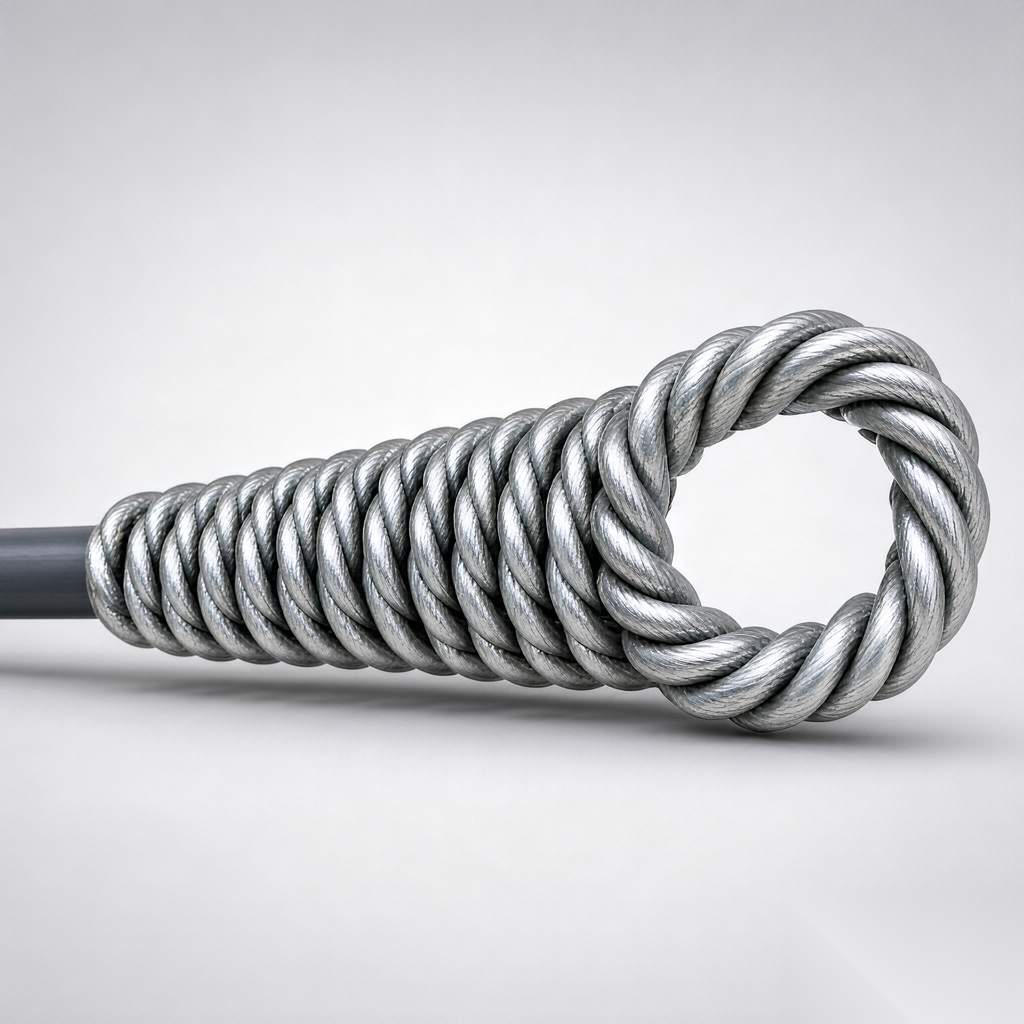
Since the English title was adjusted around this product family, the principle is worth setting out in full. The core component of a preformed fitting is a set of preformed helical wires: at the factory each wire has already been bent into a helical tube matched to the conductor outer diameter, and at installation no crimping machine and no explosive compression are needed - a worker wearing ordinary gloves can wind the set of wires on coil by coil. The inner surface of the wires is embedded with grit particles, and once wound tight the load is transferred through the large contact area of friction and grip between wires and conductor. On the same principle, made in tension form it is a preformed tension clamp, in suspension form a suspension clamp, shortened it becomes armour rods, and with a jointing section added it becomes a jointing fitting - one process logic covers several categories within the OCS.
Its advantages over conventional bolted and crimped fittings are felt directly in the field: stress is distributed along the whole grip length with no concentrated stress point such as crimping produces, so the probability of broken strands at the mouth of the grip falls markedly; installation is fast and working time at height is short, which is popular on lines with tight maintenance windows; and removal and re-installation do not damage the conductor, so rework on the same span can be carried out fairly calmly. The price is sensitivity to conductor outer diameter tolerance: the wire set must match the conductor diameter strictly, and when the outer diameter falls outside the mating range the grip is discounted - which is also why the contact wire standard controls outer diameter tolerance so tightly. The two standards are in fact tied together.
5.3 Changes to the drafting team
Two noteworthy companies appear among the drafting organisations of the 2026 edition: Beijing PLP Line Fittings (the Chinese operation of the American company Preformed Line Products) and Beijing Yingdian Electric. The original patented technology for preformed fittings is held by international manufacturers, and after years of assimilation domestic manufacturers have built up a complete supply capability; bringing representative companies into the drafting team means the standard has to reconcile a fuller range of technical routes, and it also shows that the localisation of this product family has reached the stage where it can "set the rules".
5.4 The limits of verification
To be clear: the draft for comment for this part is not publicly archived, so the technical changes at clause level - whether the grip index of tension clamps, the radius of curvature of suspension clamps or the tensile strength requirement for the wire material have been adjusted - cannot be verified clause by clause at present, and can only be filled in against the 2020 edition once the official text is published. For product information on preformed fittings, see our connections and fasteners product category.
6. Drafts for Comment versus the Published Version: Five Confirmed Differences
Comparing the August 2024 drafts for comment with the final announcement, at least five differences can be confirmed, and every one of them deserves the attention of anyone writing tender documents.
First, the standard titles fall back. The drafts for comment were titled Cables for electrified railway overhead contact systems - Contact wires and Cables for electrified railway overhead contact systems - Strands, with "Cable for…" in the English, striking the pose of building a "cable" series of OCS standards. The published version abandoned that series name and fell back to Copper alloy contact wires for electrified railway overhead contact systems and Strands for electrified railway overhead contact systems - Part X, exactly matching the standard titles in the book information on sale from China Railway Publishing House.
Second, the strand standard was split in two. The single merged standard proposed in the draft for comment (together with the deletion of aluminium-clad steel stranded conductors) was changed to publication in two parts, and the replacement arrangement for aluminium-clad steel stranded conductors disappeared entirely - the outcome analysed in section 4.4.
Third, the administrative home and classification are stable. The three wire and fitting standards still belong to the Traction Power Supply Subcommittee, with ICS classification 29.280 and Chinese standard classification S82, consistent with the drafts for comment; the rumoured change of administrative home did not come true.
Fourth, the registration information became publicly checkable. The registration numbers of the three wire standards are 108095/108096/108097-2026, the registration announcement is No. 8 of 2026, and the catalogue pages on the National Standards Information Public Service Platform can be checked item by item.
Fifth, and most importantly: the specific parameters in the drafts for comment (composition tables, strength grading, test tension grades, current-carrying capacity values) may be adjusted in the official text. The published text is issued by China Railway Publishing House and the full text is not public, so every value in this article marked as coming from a "draft for comment" should be checked one last time against the published text before use.
7. Impact Checklist for Design, Procurement, Manufacturing and Operations
A standard revision ultimately comes down to specific actions at each stage. They are broken down by stage below.
Design side. Two things move first in the selection manual: the plain copper row is deleted from the contact wire selection table, and the selection freedom of CTCZ, CTCZM and JTCZ is added; the tension grades (15~35kN for contact wire, 1.5~25kN for strands) can be read straight from the table. Now that aluminium-clad steel stranded conductors have lost their product standard, any messenger wire scheme involving such products must have its basis for selection re-checked, and where necessary moved onto the GB/T standard system or the reference relationship stated in the design. At the level of design codes, Code for design of railway electric traction power supply system (TB 10009-2016) is still the current version, so the code basis on the design side has not changed in step - product standards are replaced first and design codes follow afterwards, which has always been the rhythm.
For a concrete reference: take the Zhengzhou-Xi'an high-speed line, where public literature records CTMH-150 contact wire at a rated tension of 28.5kN and JTMH-120 messenger wire at a rated tension of 23kN. Against the recommended test tension grades of the new standard, the 35kN grade leaves a place for CTMH150 and CTCZM150, so copper-chromium-zirconium wire is upward compatible within the existing tension system - which is the practical reason it is seen as a candidate material for the new generation of lines.
Procurement and tendering side. The most urgent action is updating the standard references in tender documents: TB/T 2809-2017 becomes the 2026 edition; TB/T 3111-2017 becomes TB/T 3111.1-2026; TB/T 2937-1998 becomes TB/T 3111.2-2026; TB/T 2075.24-2020 becomes the 2026 edition; and all clauses citing TB/T 2938 are void and must be rewritten. Where a contract signed from 1 September onwards cites a withdrawn standard, neither side will be able to save face at acceptance. The inspection clauses in technical specifications must be revised in step - inspection rules, current-carrying capacity assessment conditions (the two bands of 95°C and 150°C, split indoor and outdoor), the reference mass per unit length and the other new and changed indices will all appear directly in type test reports and factory inspection items.
Incoming acceptance also has new accounts to settle. In the past, re-testing of delivered contact wire looked mainly at three items: cross-section dimensions, breaking force and conductivity. Once the new edition takes effect, the reference mass per unit length and vibration fatigue at the recommended tension grade (breaking force retention ≥95%) may both become routine items on the re-test sheet, so the acceptance department should estimate its workload in advance; the standard numbers and clause references on the supplier's quality certificate must be checked clause by clause against the new standard, and for stock products manufactured under the old inspection rules it is best to write clearly in the contract which edition applies to batches delivered after 1 September. Procurement of preformed fittings needs one extra step: check the English title references on the supplier's drawings and inspection reports - the new edition records "Preformed fittings", and technical documents still using the old title will be counted as non-compliant in overseas projects.
Manufacturing and inspection side. Indices such as rod blank process, grain size (remember that 0.200mm for copper-chromium-zirconium and 0.030mm for the solid-solution strengthened alloys are two different gauges), reference mass per unit length and breaking force retention after vibration fatigue (≥95%) enter the inspection process. The implementation rules for CRCC certified products are expected to be updated with the standard revision, and certified suppliers should watch closely for the certification body's revision notice and transitional arrangements so that no gap opens in certificate continuity. The wire manufacturers that took part in drafting (Jiangyin Electrical Alloy, Yantai Jinhui, Hengtong, Jinghui, Tongda and others) generally lead in process know-how, and whether a supplier has volume production capability for copper-chromium-zirconium can be scored as a plus when comparing suppliers.
Operations side. Equipment already in service is unaffected; this round consists entirely of product standards and has no retroactive effect on lines in operation. The impact falls on maintenance and replacement: the standard references in the technical conditions for spare parts procurement must follow the new standards, especially for contact wire joints and strand joints; and for preformed fitting spares, note the drawing comparison problem caused by the change of English title - an item marked "Helical fittings" on an old drawing corresponds exactly to "Preformed fittings" in the new edition.
| Stage | Core actions |
|---|---|
| Design | Delete the plain copper option; add CTCZ/CTCZM/JTCZ options; read tension grades from the table; re-check the basis for aluminium-clad steel strand schemes |
| Procurement / tendering | Update the four standard references immediately; clear clauses citing 2938; revise inspection rules and current-carrying capacity assessment clauses |
| Manufacturing / inspection | Two sets of grain size gauges; add reference mass per unit length to inspection; breaking force after fatigue ≥95%; watch the CRCC revision transition |
| Operations | No retroactive effect on installed equipment; declare maintenance spare parts under the new standards; update the English comparison table for fittings |
We have already reworked our current product pages for contact wire and strands to the basis of the new standards; see CTM/CTMH copper-magnesium alloy contact wire, CTS copper-tin alloy contact wire, JTM/JTMH copper-magnesium alloy strand and aluminium-clad steel core aluminium stranded conductor; for more wire categories see the contact wire and messenger wire product category.
8. Conclusion
Looking at the changes to the four standards together, this revision round really has only two main threads. The first is material upgrading: the copper-chromium-zirconium system lands simultaneously in the contact wire and strand categories, adding a cost-effective fulcrum to the strength-conductivity balance and stocking ammunition for OCS schemes with higher tension and lower energy loss. The second is system rationalisation: model rules, naming rules and test methods all move towards national standards and common industry practice, plain copper is cut, the strand standard is split, aluminium-clad steel stranded conductors exit, and the product range is drawn tighter.
For practitioners, rather than memorising ten change points it is better to remember one timetable: from 1 September 2026 the new standards take effect and the old ones are withdrawn; contracts already in transit during the transition run according to their terms, and all newly signed contracts carry the new standard numbers. When the official published texts arrive, re-check the parameters quoted from the drafts for comment item by item, especially the composition tables and the tension grades, the two places where old draft data is most easily cited by mistake. We will also track and check the data in this article once the text is public, and will mark any corrections in the article.
A standard's life cycle usually starts at ten years, and once this batch is in place it will accompany the OCS through the next overhaul cycle. Whether copper-chromium-zirconium can deliver on its laboratory promise depends on type test batches and on-line operating data over the next few years; and which standard family aluminium-clad steel stranded conductors move into after leaving the railway standard series is also worth watching. For people at the front line there is only one thing to do right now: pull out the technical documents in hand and replace the four old standard numbers with three new ones - plus one gap that needs another basis found for it.
Sources: National Railway Administration Announcement No. 7 of 2026 (second batch of equipment technology standards for 2026, approved 2026-02-27, effective 2026-09-01); the drafts for comment and drafting notes for Cables for electrified railway overhead contact systems - Contact wires and Cables for electrified railway overhead contact systems - Strands (completed 2024-08-31, archived on creeb.net, with the drafting notes also archived on doc88); the catalogue pages of each standard on the National Standards Information Public Service Platform (registration numbers 108095/108096/108097-2026); the TB/T 2809-2026 publication information from China Railway Publishing House (Beijing Railway Bookstore); standard catalogue records and announcement reprints from gongbiao.com; and the OCS parameters of the Zhengzhou-Xi'an high-speed line, cited from public journal literature. All parameters marked as coming from a "draft for comment" are the content of the August 2024 drafts; the text published by China Railway Publishing House prevails.