Picture a contact wire parting on a winter night somewhere along a tension length. Both anchored ends of the section are alive: compensation devices hang from each one, and the moment the wire breaks, those counterweights are free to fall, dragging wire out of the spans toward both ends of the section. Without anything to stop the run, droppers snap in cascade, stitch wires tear from their clamps, stagger is destroyed along hundreds of metres, and the section is out of service for days rather than hours.
The mid-point anchor is the fitting that turns that scenario into a local event. At one mast close to the middle of every tension length, the contact wire and the messenger wire are both fixed to the structure through anchor clamps and an anchor rope, dividing the tension length into two independent halves. A break on one side now releases only that half; the other side keeps its tension, its geometry and its serviceability, and the repair crew replaces a span of wire instead of rebuilding a section.
This article explains the mechanics of mid-point anchoring, where the anchor sits and why, how the clamps and rope are assembled, and what must be inspected after any wire break in the section.
What a mid-point anchor actually does
Tension lengths are anchored at both ends and compensated at one or both, which is precisely why a break is so energetic: the compensation stacks hold stored energy that a severed wire releases. The mid-point anchor inserts a fixed point at the centre of that chain. Once clamped, the wires can no longer slide past the middle mast — their movement toward either anchor is arrested at the anchor rope, the rope loads the structure, and the tension in the intact half is preserved because the anchor, not the far compensation device, now defines its end of the elastic chain.
The anchor performs a second, quieter duty every day of the year. Wires creep and tensions differ subtly side to side, and without a fixed point the whole wiring of a section can migrate slowly along the track — pulling stagger out of registration and eventually over-travelling the compensators. By clamping both wires at the middle, the mid-point anchor acts as an anti-drift reference: it balances the tensions on both sides and stops temperature change or creep from walking the wires to one end.
Placement within the tension length
The anchor belongs as close to the mid-point of the tension length as the structure allows, and the reason is arithmetic. Each half of the section behaves as its own tension length after a break, and the anchor splits the section into two roughly equal halves so that neither side carries an extreme share of the total wire mass, creep or travel. An anchor placed near one end protects almost nothing: a break on the long side still collapses a long run of wiring.
In practice the exact mast is chosen with the structure. The anchor rope must reach sound anchoring steel or a suitably rated foundation, the mast must carry the longitudinal load that a break imposes — which is far above everyday service load — and the span geometry around the mast must tolerate the clamps without disturbing stagger. Designers therefore select the nearest suitable mast to the theoretical mid-point rather than bending the layout to hit it exactly, and the anchor is built to TB/T 2075.6-2024, the mid-point anchor assembly part of the Chinese OCS fittings standard.
The clamps: gripping contact wire and messenger wire
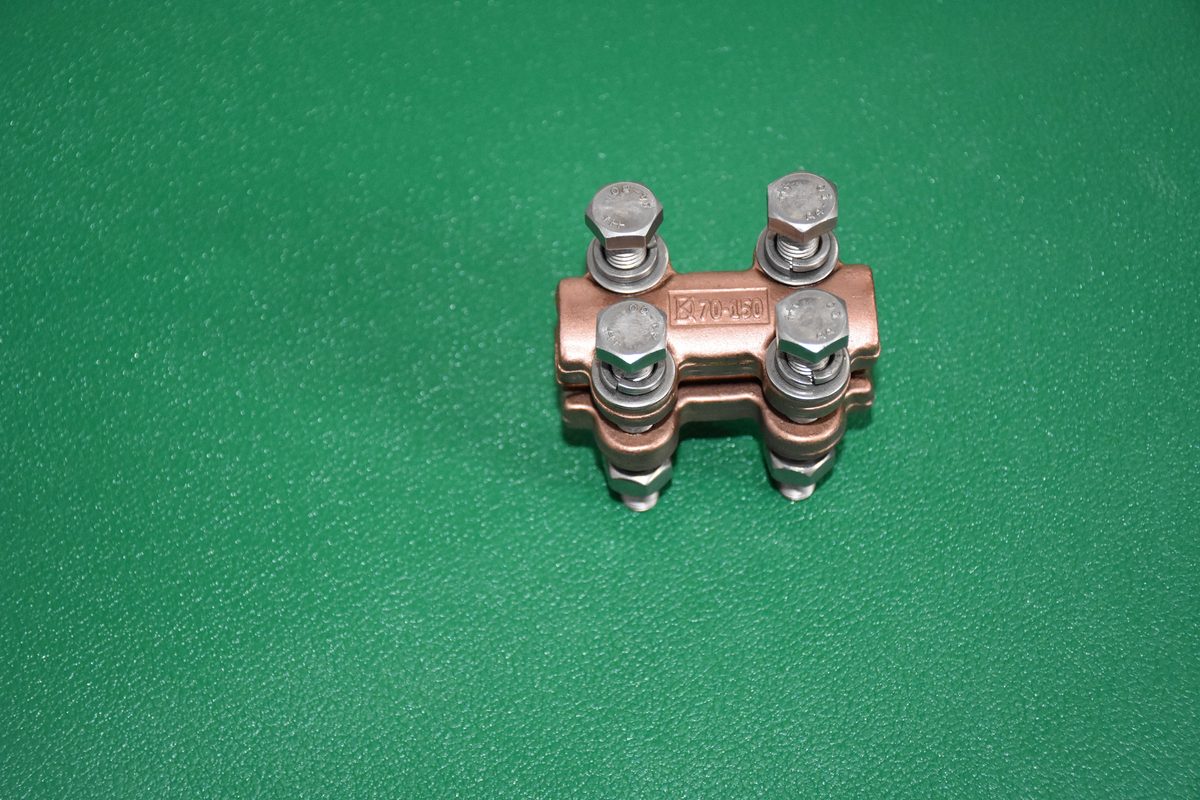
Two clamps do the gripping, one per wire. The 6-1 contact wire mid-point anchor clamp fixes the anchor rope to the contact wire at the joint between the two. Its clamping surface is toothed and lined with copper, so it grips the wire reliably without damaging it, and a matched wedge fastening secures the rope end firmly; bolt fastening keeps the assembly simple to install and inspect. The material pairing with the contact wire is deliberate, chosen to resist galvanic corrosion at the grip.
The 6-2 messenger wire mid-point anchor clamp does the same duty overhead on the messenger wire. Its body is copper alloy with a toothed surface, the rope end is held by a cone-sleeve wedge structure, and it ships with complete bolt fastener sets. The two clamps are typically supplied and installed as a pair at the same mast, with the speed class of the installation governed by the certification and design documents for the line.
Both clamps rely on the same principle: teeth that bite into the wire under bolt load, backed by a wedge that tightens as tension rises. Neither is a friction-only grip, which is what allows them to hold the longitudinal load of a break without slipping along the wire.
Anchor rope routing and pre-tension
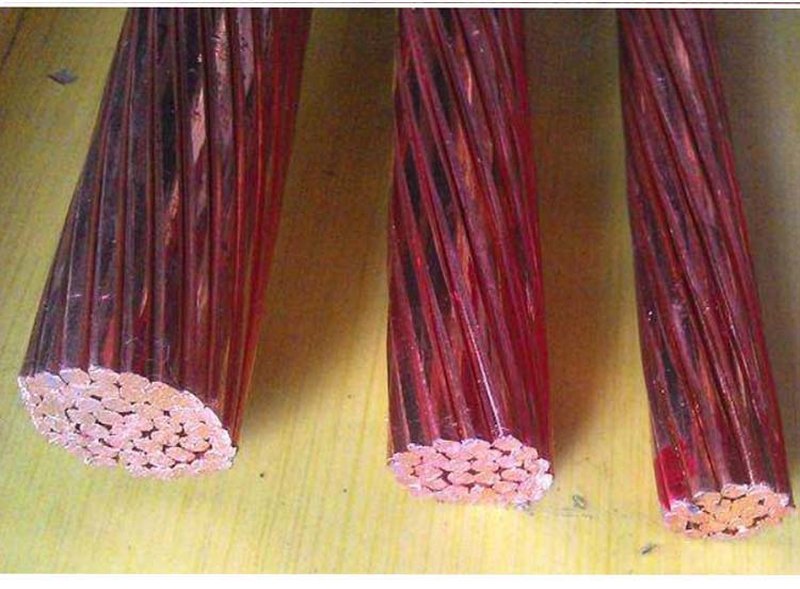
The contact wire mid-point anchor rope ties the clamped wires to the structure. Rope specification follows the design — size is selected by design tension and span — and it is supplied together with the clamps as one certified assembly rather than as site-cut material. Routing keeps the rope runs short and direct to the anchoring steel, with terminations made in the fittings designed for them, not improvised around adjacent hardware.
Pre-tension is the assembly step that separates a working anchor from a decorative one. After installation, the rope pre-tension must be adjusted to specification: too little and the anchor permits drift before it engages, too much and the anchor permanently steals tension from one half of the section, distorting sag and stagger from the day it is commissioned. The setting is made against the section calculation, recorded at handover, and re-checked whenever adjacent tensioning hardware is disturbed.
Living with the tensioning devices at the section ends
A mid-point anchor and the end compensators divide their responsibilities cleanly: the compensators absorb daily and seasonal length change at the ends, while the anchor fixes the longitudinal datum in the middle. Their interaction shows in the stack positions. If the anchor drifts or its clamps slip even slightly, the two compensation stacks rebalance around the error — one travels further than it should, the other less — and the asymmetry is visible at the anchorages long before it is visible in the contact wire.
For the same reason, any work that changes the length of one half — a re-tensioning, a wire renewal, a dropper campaign that disturbs the wiring — should end with a check of the mid-point anchor position and both stack positions against the temperature table. The anchor is the reference the whole section is set from; disturb it unknowingly and every reading after it is wrong.
Inspection after a wire break, and in routine service
After any wire break in the section, the mid-point anchor is a primary inspection point even if it is on the untouched half, because the break loads it to levels it never sees in service. Check that the clamps have not slipped along either wire — original paint lines or scribe marks make slip measurable — that teeth and wedges remain seated, that the anchor rope shows no strand damage or permanent stretch, and that the mast, stays and anchor steel have accepted the load without displacement. Only then re-tension and restore the affected half.
Routine inspection is shorter: bolt torque and condition on both clamps, rope terminations and pre-tension, and the position of the anchor relative to its commissioning record. Signs of drift — a clamp found away from its mark, one stack riding consistently high — are investigated rather than reset, because the cause, usually creeping tension imbalance, will simply move it again.
Mid-point anchor assemblies, clamps and ropes can be supplied as complete matched sets for new tension lengths or renewals. Our engineering team can confirm placement, rope sizing and pre-tension values against your section design.