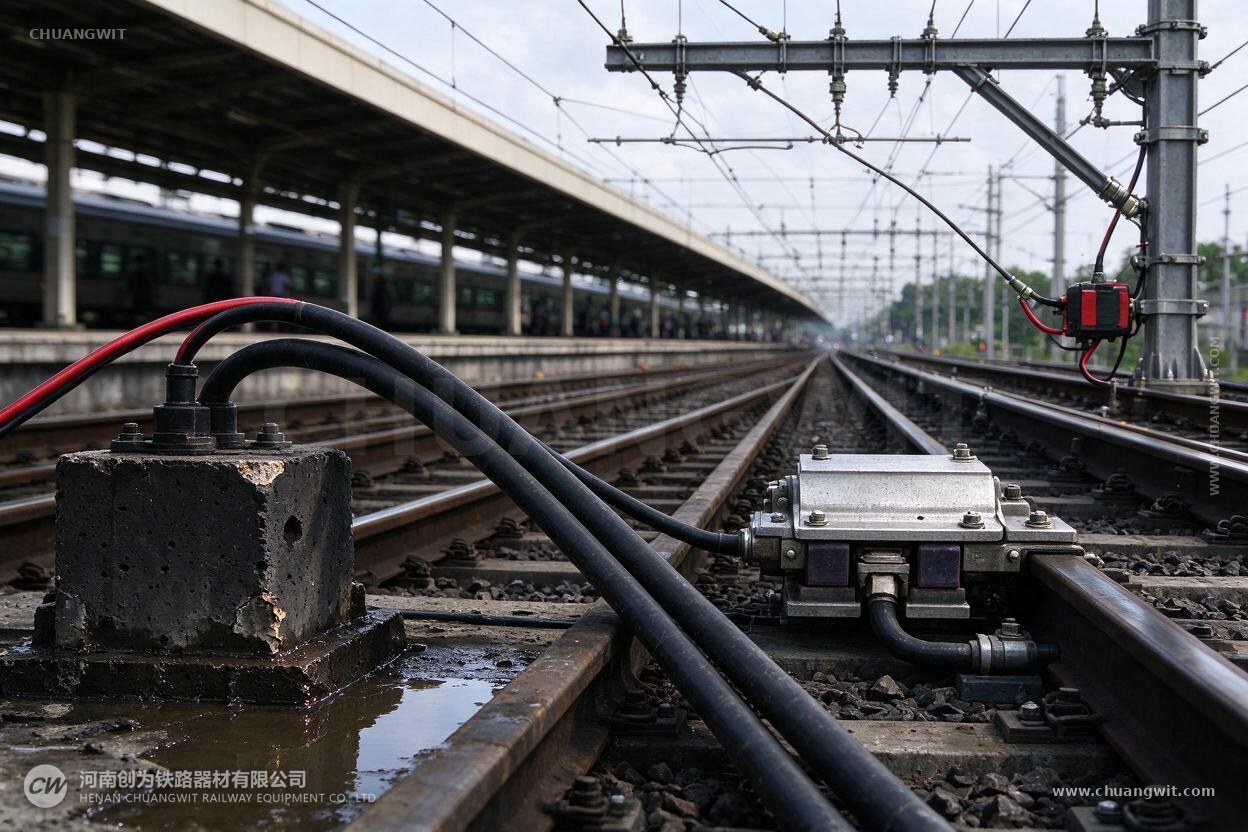
AC and DC traction both move trains on grid electricity, but they split the engineering job. Mainlines standardized on single-phase 25 kV AC at 50 Hz because high voltage covers long feeds with fewer substations. Urban metros run direct current, 1.5 kV overhead or a typical 750 V third rail, where distances are short and trains draw heavy currents at low voltage. Third-rail collection is practically limited to about 160 km/h.
Key Takeaways
- AC won the mainlines on transmission physics: at 25 kV the same power flows at much lower current, so substations sit farther apart and conductor cross-sections stay moderate.
- DC won the cities on simplicity and clearance: 1.5 kV overhead metro systems and typical 750 V DC third rail feed trains directly, with components standardized for urban rail under TB/T 3252-2022.
- Low voltage taxes current: third-rail sets such as the LIRR M7 and M9 manage roughly 1,500 to 1,600 kW per two-car set, and DC lines need more substations per route-kilometer than AC.
- Third-rail collection tops out around 160 km/h in practice, with a world record of 175 km/h by a British Class 442 in 1988; overhead AC serves high-speed lines.
- 2x25 kV autotransformer feeding runs 50 kV between catenary and negative feeder, with centre-tapped autotransformers about every 10 to 15 km, cutting losses and electromagnetic interference on busy corridors.
Why Did Railways End Up Using Both AC and DC?
History set the split, and physics kept it. Early electric traction had workable DC motors, so the first electrified lines generated direct current locally and fed it at the low voltages the insulation of the day could manage. City networks grew around that pattern, and their tunnels and short hops never punished the high currents it implies.
Interurban and mainline railways faced the opposite problem: distance. Feeding tens of kilometers from each substation at low voltage wastes power and copper, and the way out was alternating current, which a transformer on the locomotive steps down cheaply and efficiently. Once single-phase 25 kV AC at the grid frequency of 50 Hz became established, long-distance electrification followed it almost everywhere outside legacy DC countries.
Modern power electronics blurred the motor argument but not the supply argument. A train today converts whatever it receives into a controlled drive either way, so the choice of AC or DC is made on line length, traffic density, structures and the surrounding network, which is why both systems continue to be built.
What Are the Electrical Trade-offs Between AC and DC Traction?
The comparison compresses into a few rows, and each row has a hardware consequence at trackside.
| Characteristic | 25 kV AC mainline supply | DC urban supply |
|---|---|---|
| Nominal voltage (kV) | 25 AC, 50 Hz | 1.5 overhead, 0.75 typical third rail |
| Collector current at equal power (A) | Low | High |
| Substation spacing | Long feeds, fewer substations | Short feeds, more substations than AC |
| Train power example (kW) | Transformers allow high installed power | LIRR M7 and M9: about 1,500 to 1,600 per two-car set |
| Practical speed ceiling (km/h) | High-speed service with overhead wire | Third rail about 160 practical, 175 record, 1988 |
| Phase management | Neutral sections between phases required | Not applicable |
Source: third-rail ceiling and record values and LIRR unit power per verified traction references; 750 V DC as typical UK third-rail network voltage.
Two rows deserve comment. The current row explains hardware mass: DC shoe gear and rails are built for very large currents, which is also why DC conductor rail is vulnerable to icing and stray objects, and why exposed energized rail demands strict access rules. The speed row explains why commuter lines that flirt with higher speeds eventually convert to overhead supply or cap their ambitions.
What Is the Difference Between AC and DC Traction Motors?
Classically, the answer was the motor itself. DC traction used series-wound commutator motors, rugged and easy to control by resistor steps, but limited by the commutator and brush wear. AC traction at supply frequency fought synchronous and induction machines that were hard to control before electronics, which is why some early AC systems even used low dedicated frequencies rather than the grid one.
Today the motors have converged and the supply has not. Almost every modern train, whatever it collects, rectifies and converts the input onboard and drives three-phase AC machines through inverters, with precise torque control and regenerative braking. On 25 kV AC the chain starts with a transformer; on DC the chain starts at the collector, saving the transformer but demanding heavy current equipment instead. The real AC versus DC question is now about the line, not the motor.
Why Is 25 kV Used in Railway Traction Systems?
Because 25 kV sits at a workable optimum. High enough that feeding distances and conductor sizes stay economical, low enough that clearance to structures, tunnels and staff can be engineered at bearable cost, and as a single-phase voltage at the standard 50 Hz it lets substations connect to the public grid without frequency conversion, which early dedicated-frequency systems could not avoid.
On busy corridors the scheme is stretched further with 2x25 kV autotransformer feeding: the substation supplies 50 kV between the catenary, at plus 25 kV to rail, and a negative feeder at minus 25 kV, while centre-tapped autotransformers about every 10 to 15 km give trains their 25 kV catenary-to-rail supply. Return current flows in the negative feeder between autotransformers, which lowers losses and electromagnetic interference along the route. The classic alternative, booster transformer feeding, forces return current into a dedicated return conductor and remains the textbook comparison case. The suspended assembly for such corridors is treated in fully compensated catenary suspension under AT feeding.
How Does the Supply Choice Change the Trackside Hardware?
AC lines carry the marks of phase management. The national grid is three-phase, so successive catenary sections are fed from different phases and must be separated electrically: neutral sections built to TB/T 3037-2002 provide the phase break, with devices rated for 25 kV AC, 50 Hz systems, design speeds up to 160 km/h, service from minus 40 to plus 70 degrees Celsius and altitudes to 4,000 m. The structure and selection logic is in neutral section insulator: structure, working principle and selection.
Section insulators subdivide each fed zone further, with the FYFH series for 25 kV service to TB/T 3036-2016; the family map is in section insulator model guide. DC metros carry different marks: section insulators to TB/T 3252-2022 rated for speeds up to 120 km/h in flexible suspension, DC switchgear, and on third-rail lines the composite contact rail itself, described in fully enclosed light rail steel-aluminium composite contact rail, with its switching apparatus covered in DC disconnectors for metro and urban rail.
Which System Should a New Line Choose?
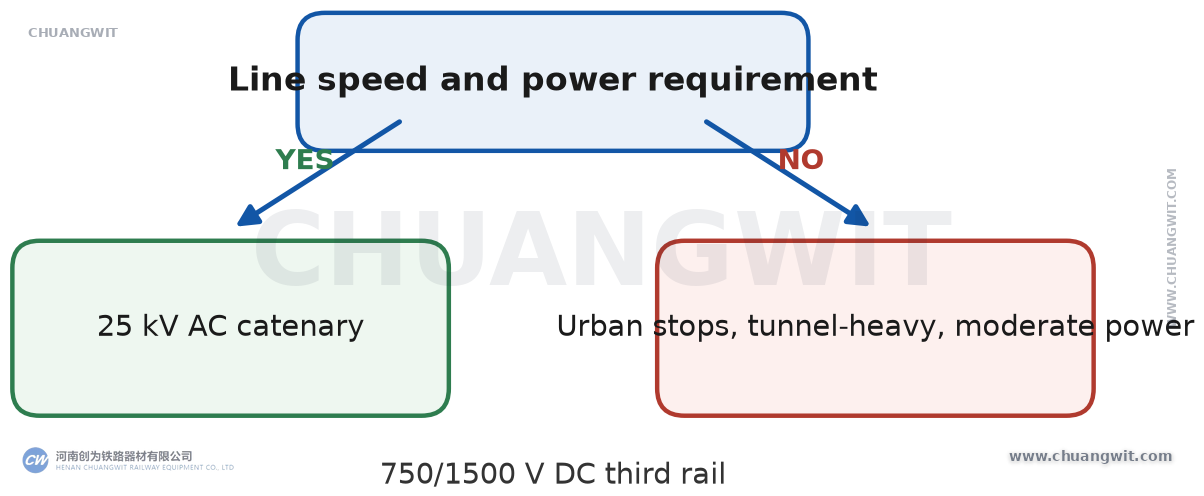
Choose by corridor, not by ideology. Long or fast lines, heavy freight gradients and high traffic density argue for 25 kV AC, ideally with autotransformer feeding where losses and interference matter. Short, slow, tunnel-heavy urban lines with frequent stops are natural DC territory, 1.5 kV overhead where pantograph clearance exists, conductor rail where height is at a premium. Compatibility is the quiet third criterion: joining an existing DC network or an AC network usually decides the answer before economics do.
The strategic framing, energy efficiency, regenerative braking, emissions and grid decarbonization, is laid out in why railways electrify: energy economics and climate, and the full power chain from substation to wheel in how electric traction works.
Frequently Asked Questions
Which is better, AC or DC traction?
Neither is better everywhere. AC at 25 kV, 50 Hz transmits large power over long feeds with fewer substations, so it owns mainlines and high-speed rail. DC at 1.5 kV overhead or a typical 750 V third rail is simpler and more compact for metros, at the price of higher currents, more substations and, for third rail, a practical ceiling near 160 km/h.
Why is 25 kV used in railway traction systems?
Because it balances feeding and clearances: high enough for economical conductor sizes and long feeding distances, low enough for realistic structure clearances, and at 50 Hz it connects to the public grid without frequency conversion. Busy corridors extend the scheme with 2x25 kV autotransformer feeding, running 50 kV between catenary and negative feeder with autotransformers about every 10 to 15 km.
What is the difference between AC and DC traction motors?
Classically DC traction used series commutator machines and AC was hard to control, but modern trains converge: whatever the supply, onboard converters drive three-phase AC machines through inverters. The difference left is the input chain, since a 25 kV AC train carries a transformer and a DC train carries heavy current equipment instead, so supply voltage, not motor type, defines the two systems today.
Which is better, third rail or overhead line?
Third rail suits tunnels, tight clearances and moderate speeds, and its typical 750 V DC infrastructure is compact, but collection is practically limited to about 160 km/h, with a 175 km/h record from 1988, and gaps at switches plus ice sensitivity remain. Overhead line serves any speed, carries 25 kV AC for long feeds, and is the choice wherever trains run fast or heavy.
Choosing Next Steps
The AC versus DC decision is really a corridor decision: distance, speed, traffic and the neighboring network point to one system, and the trackside hardware follows. For engineers on AC projects the phase and sectioning hardware dominates the component list; for DC projects it is rail-bonded return circuits and urban-rail-rated switchgear.
Chuangwit manufactures components for both worlds on the overhead side, from neutral section and section insulators to disconnectors, arresters and catenary fittings, built to the TB/T and GB/T families cited above. To match components to a specific supply system, contact our engineering team.