Ask any maintenance gang where the overhead contact system (OCS) shows burn marks first, and the answer is nearly always the same: at the section insulators. These devices interrupt the contact wire for barely a metre, yet they collect a wildly disproportionate share of all arcing damage on an electrified route. Arcing at a sectioning point is not a defect in itself — a short, quiet arc is part of normal run-through — but sustained, visible burning is always evidence that something in the system, the device or the installation is wrong.
The engineering response begins with diagnosis. Burn damage has a grammar of its own: where it sits on the runners, whether it appears on one side or both, and how far along the wire it spreads each tell a different story about speed, height, alignment and insulation condition. Read correctly, a few photographs from a night inspection can localise the root cause faster than any instrumented measurement campaign.
This article works through why arcs concentrate at these devices, the root causes behind section insulator arcing and burning, the damage patterns to look for, the inspection points that matter, and the prevention measures that actually hold: correct class selection, precise height adjustment and disciplined maintenance intervals.
Why arcs concentrate at section insulators
Along ordinary contact wire, the pantograph slides on copper at controlled force, and current transfers through a stable, conductive interface. At a section insulator, that interface is replaced by a sequence of different surfaces: runner or glide plate segments, insulating bars, and an air gap in which no conductor exists at all. Current flow must therefore stop and restart, not once but twice, in every passage — once at the gap and again as the strip leaves the trailing surfaces.
Every interruption is a potential arc. In a 50 Hz AC system the current passes through zero every ten milliseconds, which naturally truncates arcs and limits the energy per event, but the arc still burns for the microseconds needed to melt shallow craters into metal surfaces. Speed sharpens the problem in both directions. A fast passage stretches the arc physically as the strip departs, while a slow passage holds the arc root on one spot far longer — which is why crawling trains through station throats burn devices that happily survive line-speed running. The insulator also sits at a mechanical hard point, so contact force peaks here first whenever the pantograph suspension is marginal.
The five root causes of section insulator burning
- Passage far below the design speed range. Depot approaches and station exits are classic cases: a train accelerating from a standstill holds the arc at the air gap for many times longer than the designers assumed, concentrating heat on one runner edge.
- Worn or damaged glide plates. Once the leading ramp is worn away or chipped, the carbon strip strikes an edge instead of a slope. The impact lifts the strip, the current interrupts outside the designed zone, and the arc burns unprotected surfaces.
- Contaminated or carbonised insulation. Layers of brake dust, tunnel grime and previous arc deposits form a partly conductive film across the insulating bars. Surface tracking then keeps the arc alive across the barrier that was meant to extinguish it, carbonising the insulation further in a self-accelerating loop.
- Incorrect installation height. Runners set too low are struck late and hard; runners set too high carry the strip for longer than intended and increase wear on both surfaces. Both errors convert a designed transition into an uncontrolled one.
- Alignment and pantograph faults. Stagger that carries the device out of the pantograph sweep centre, degraded head springs, or chipped carbon strips each shift the contact point onto runner edges where arcing damage concentrates.
Damage patterns and what each tells you
Symmetrical burns at the air gap, on both runners, point to electrical causes: passages far below design speed, or system overvoltage events. Single-sided burning almost always means geometry — stagger error, a tilted device, or a pantograph running off-centre. Pitting combined with a glazed, rainbow-coloured insulator surface indicates contamination and tracking rather than mechanical abuse. Melted, mushroomed runner edges reveal that the ramp profile has been lost, usually after months of impact loading. Finally, burn marks on the contact wire extending several metres beyond the device are the signature of a hard spot exciting contact force oscillations — the device may be healthy, but the installation is not.
The DC metro case
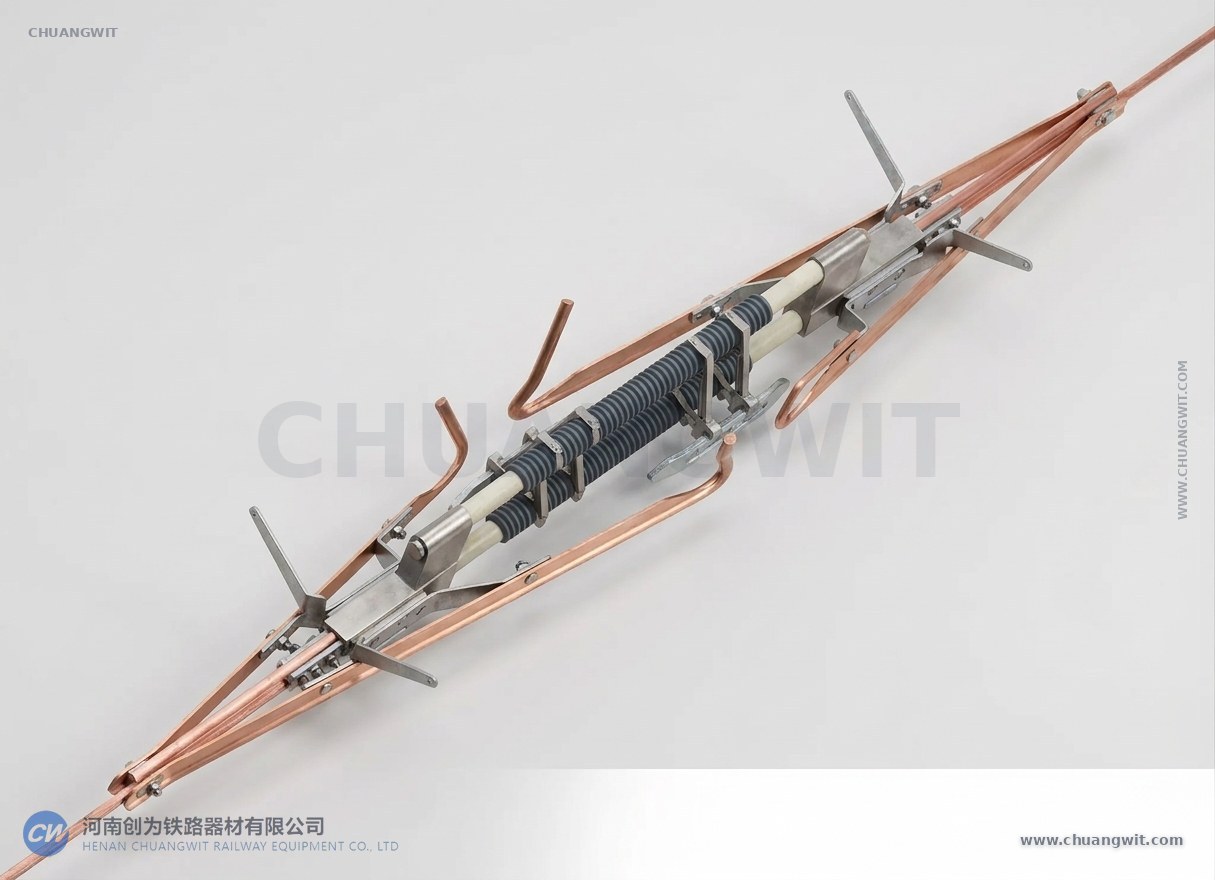
Direct current removes the mercy of the zero crossing. On a DC 1500 V metro line, an arc that would self-extinguish in an AC system can persist as long as the physical gap allows, so arcing damage at sectioning devices is more aggressive per event even though the voltage is far lower. Metro duty also adds brake-dust-laden tunnel air, frequent stop-start passages and stabling movements at walking pace — the exact profile that stresses runners most. Purpose-built metro devices such as the FYFH-1.0TG-DC single-line section insulator, rated DC 1500 V with a 120 km/h design speed and built with aluminium alloy runners and stainless steel fasteners for tunnel atmospheres, exist precisely because mainline AC hardware does not transfer well to this duty.
Inspection points that catch problems early
Periodic inspection should be organised around six checks, each tied to a failure mode. First, gauge the runner wear against the manufacturers limit profile and record the trend between inspections. Second, measure the air insulation gap and compare it with the type test value for the device class. Third, verify installed height relative to the contact wire using a measuring frame at several points along the run. Fourth, examine insulator surfaces for carbonised tracks and clean or replace before tracking bridges the barrier. Fifth, check fastener torque and look for slip marks at the wire joints, which betray tension anomalies. Sixth, inspect the contact wire on both sides for burn signatures that extend beyond the device, since these indicate installation-level rather than device-level faults.
Prevention: selection, height and maintenance intervals
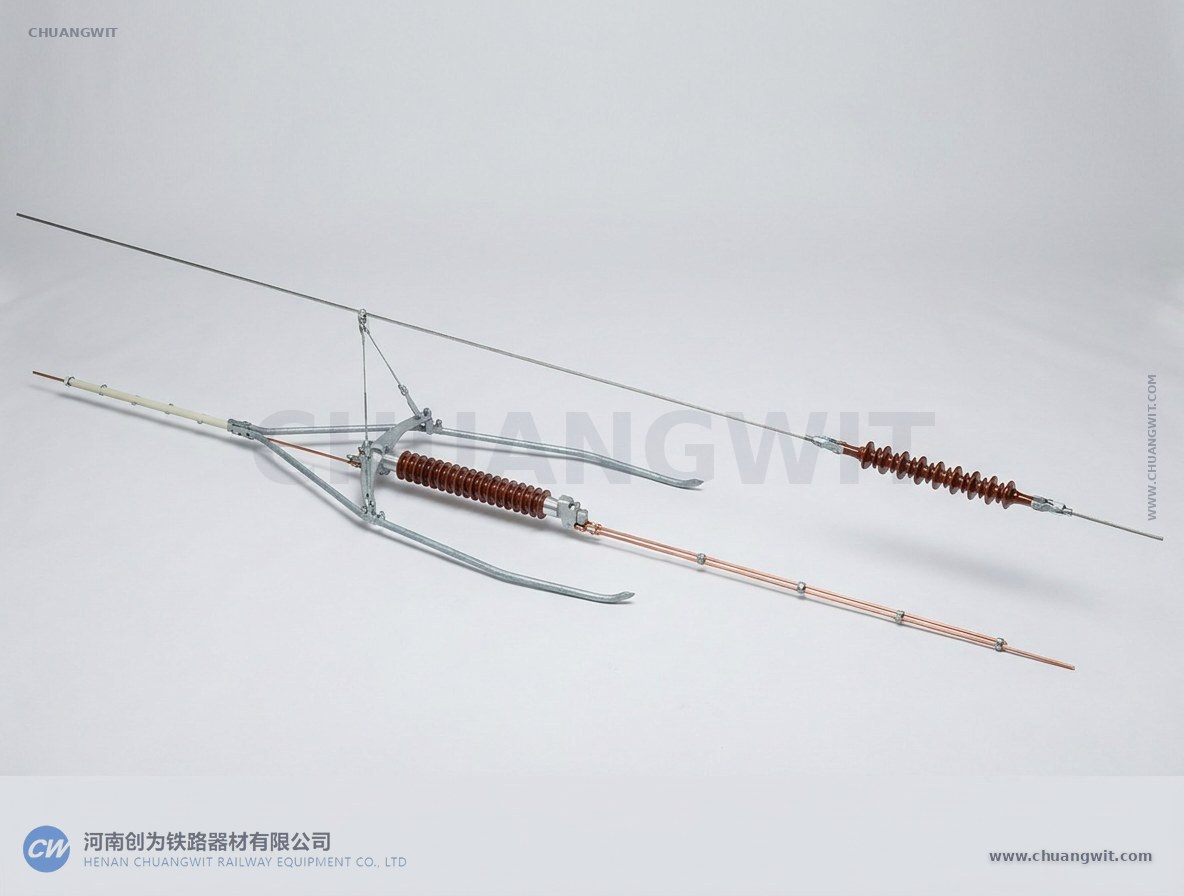
Prevention starts at specification. Match the device class to the real passage-speed profile of the location, including depot crawling, not just the line speed, and where the environment is aggressive choose enhanced insulation. The FYFH-1.6AT-E enhanced section insulator enlarges the air insulation gap to at least 430 mm — against roughly 300 mm on standard types — and extends creepage for polluted, coastal and high-altitude territory; the same enhanced philosophy in a 200 km/h inter-phase-capable class is available in the FYFH-1.8BT-E enhanced section insulator for severe-service sites. On AC systems, both families benefit from the natural arc extinction at each 50 Hz current zero, which the larger gaps reinforce.
Height adjustment deserves its own discipline: after any wire re-tensioning or registration change, re-measure the device rather than assuming the original setting survived. Maintenance intervals are best scheduled by pantograph passage count rather than calendar time, tightened at locations with slow passages, and paired with carbon strip condition monitoring on the fleets that use the route most. A device that is cleaned, gauged and re-heighted on schedule will survive decades; the same device neglected for a year of dense traffic can be destroyed in months.
If a sectioning point on your route shows recurring burn damage, our engineering team can review the passage-speed profile, insulation class and installation record to isolate the root cause.