A catenary tension length behaves like a very long spring. Every degree of temperature change stretches or shrinks the contact wire and the messenger wire, and unless that movement is absorbed somewhere, tension drifts away from its design value — and sag, stagger and pantograph contact force drift with it. Automatic compensation devices solve the problem at the anchored ends of every tension length. They couple the wires to a hanging counterweight stack so the pull stays essentially constant while the wires themselves grow and shrink with the weather.
Two mechanical families dominate practice. Ratchet compensation devices route the compensation rope over a toothed wheel restrained by a pawl, while pulley compensation devices build their mechanical advantage from sheave blocks and multiple rope parts. In the Chinese standard series TB/T 2075, Part 12 governs pulley compensation devices and Part 13 governs ratchet compensation devices, and both types appear across 25 kV AC mainline and 1.5 kV DC metro overhead contact systems (OCS). Neither family is universally superior; the decision hinges on ratio, counterweight travel, available footprint, inspection access and the consequence of a wire break at the anchor concerned.
This comparison works through those parameters in turn: how each design achieves its compensation ratio, how far the weights must travel across the temperature range, how friction behaves, which failure modes dominate, and where each type fits in tunnels, stations and open mainline.
What both designs must deliver
Before the differences come the shared duties. A compensation device must hold wire tension within a narrow band across the full temperature range of the site, because tension error converts directly into sag error and contact-force variation under the pantograph. It must convert slow daily and seasonal length changes into smooth counterweight travel without stick-slip, survive decades of outdoor duty with minimal attention, and — critically — it must not let the counterweight stack fall when a wire or rope fails. A falling stack endangers anyone working below and wrecks the anchor it was meant to protect.
Friction sets the precision limit of both families. Every sheave or wheel the rope passes over steals a little of the transmitted force, so the tension the wire actually sees differs slightly between the warming stroke, when the weights descend, and the cooling stroke, when they rise. Chuangwit quotes a transmission efficiency of 97% or higher for both its ratchet and pulley compensation families, and that figure is what keeps the hysteresis band narrow enough for high-speed service. Efficiency also decays with dirty or seized bearings, which is why the inspection routines for the two designs matter as much as their geometry.
How ratchet compensation devices work
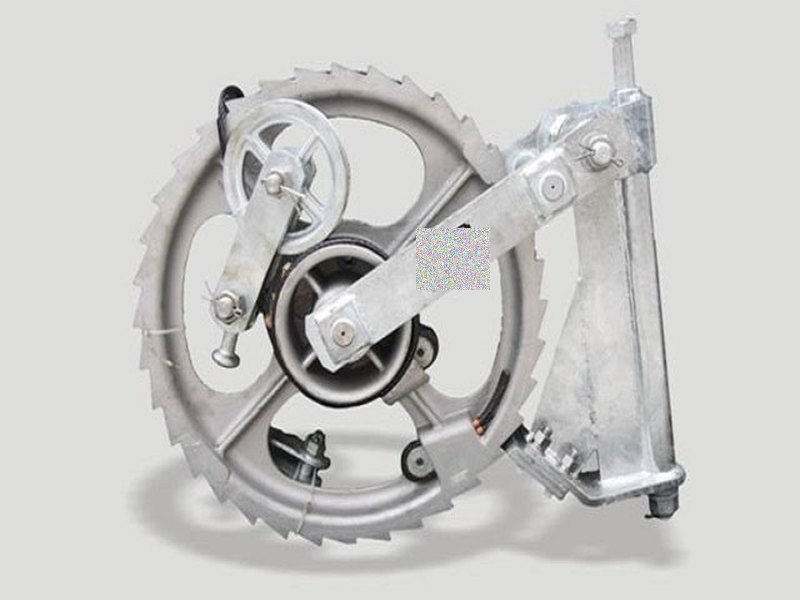
The defining component is the ratchet wheel: a grooved drum with a ring of teeth, riding in a bracket at the anchor. The compensation rope wraps the drum, one end reaching the wires through double-eye wedge-type clamps, the other carrying the counterweight stack. A pawl watches the teeth. During normal operation the wheel turns freely in both directions as the wires lengthen and shorten; if the rope ever loses tension suddenly, the signature of a wire break, the pawl drops, locks the wheel and arrests the stack within a fraction of its fall.
A complete device of this family, such as the 13-1G ratchet compensation device built to TB/T 2075.13-2024, ships as a matched set: ratchet wheel in stainless steel, ratchet bracket, equalizing wheel, compensation rope and double-eye wedge-type clamps, with cast steel or cast iron counterweights sized from the nominal tension of the tension length. The equalizing wheel deserves a note of its own, because it sits where the rope divides into the contact wire and messenger wire branches and keeps the two sharing the load evenly throughout the travel. The compact 13-1H ratchet tensioner applies the same principle at anchor masts and anchor brackets, where its ratio allows a comparatively small counterweight stack to maintain the full nominal tension of the section.
Because the pawl brake is inherent to the geometry rather than an added mechanism, wire-break protection is where ratchet devices are strongest. The trade is the teeth and pawl themselves: corrosion or debris in the pawl seat can prevent clean engagement, so the pawl travel and tooth flanks belong on the scheduled visual check, which takes minutes.
How pulley compensation devices work
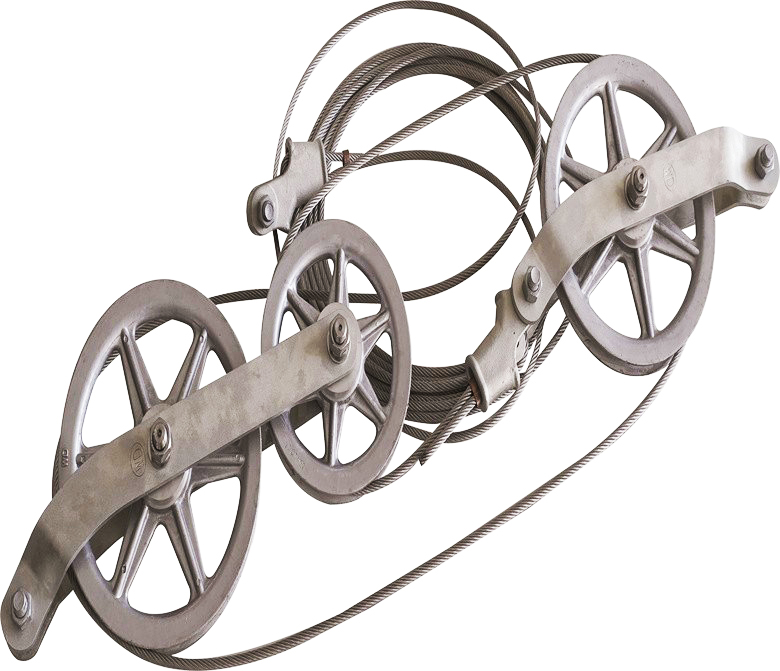
Pulley compensation replaces the toothed drum with sheave blocks arranged as a tackle. The rope leaves the wire anchor, passes over fixed and moving sheaves, and reaches the counterweight hanger; the number of rope parts supporting the moving block sets the compensation ratio. The 12-1G pulley compensation device (1:3 ratio) is the standard configuration built to TB/T 2075.12-2024, with other ratios available to suit the anchor section design, and it relies on a braking function that acts on sudden rope slack rather than on wheel teeth.
Detailing decides whether a pulley set runs sweetly for decades or eats ropes. Sheaves on the 12-1H block are aluminium with maintenance-free, solid-lubricated bearings, and each rope groove is sized to the compensation rope diameter so the rope cannot wander, wedge or wear unevenly. Where the rope must change direction toward the anchor base, guide pulleys keep the fleet angle small so the rope enters each groove straight instead of scrubbing the cheek. Rope dressing on a schedule, and rope replacement by calendar rather than by visible damage, is the discipline that keeps the whole tackle honest.
Compensation ratio, stack mass and travel
The ratio is the most consequential number in the selection because it couples two quantities that both need physical accommodation: how heavy the counterweight stack is, and how far it must move. Energy conservation fixes the relationship. In a 1:3 arrangement the stack weighs three times the tension it holds and travels one third of the wire-end movement, and the same pattern holds at every other ratio. Higher ratios therefore buy shorter travel at the price of a heavier stack, and the loading that stack imposes on brackets, bases and, in tunnels, on the wall itself.
The ratios on offer show how designers exploit this. The 12-1H compensation pulley block comes in 1:2, 1:3 and 1:4 from one hardware family, letting the engineer trade pit depth or shaft length against stack mass at the drawing stage. A ratchet wheel achieves its ratio through drum and gearing geometry instead, which is how the 13-1H holds full tension from a comparatively small stack. Whichever family carries the anchor, verify both numbers against the site: the travel needed for the local temperature swing, and the space actually available below the anchor, including clearance for the stack at its lowest position.
Failure modes compared: rope wear versus pawl jamming
The dominant wear item in a pulley set is the rope. External corrosion, broken strands near the sockets and groove polishing are the usual findings, and a rope that jumps a groove under wind pumping can be cut through in months. Fleet angle errors at guide pulleys, grooves worn wide, and bearings that have lost their lubrication all accelerate the same end. Ratchet devices shift the risk to the brake path: a pawl that cannot seat, teeth chipped by repeated shock loading, or a drum groove gone rough enough to abrade the rope it was meant to protect.
| Aspect | Ratchet device | Pulley device |
|---|---|---|
| Mechanical core | Toothed drum, pawl, single rope path | Sheave blocks, multi-part rope tackle |
| Ratio provision | Drum and gearing geometry | Number of rope parts, typically 1:2 to 1:4 |
| Wire-break protection | Pawl locks wheel directly | Brake acts on sudden rope slack |
| Main wear item | Pawl seat, tooth flanks, drum groove | Rope, sheave grooves, bearings |
| Inspection character | Visual: teeth, pawl travel, rope wrap | Visual: rope condition, groove wear, grease |
| Stack size for a given tension | Smaller, ratio-dependent | Heavier at higher ratios |
Housekeeping around the stack matters equally for both. Weeds and debris in the counterweight pit, ice bridging the stack guides, and objects left under the travel path all turn a routine movement into a jam, and a jammed stack silently stops compensating long before anything looks broken. Any inspection of a compensation anchor should therefore start at ground level, not at the wheel.
Choosing by location: tunnels, stations and mainline
Tunnels punish travel. Headroom and wall space are finite, drain locations are fixed and maintenance windows are short, so high-ratio pulley sets — supported by limit frames that guide the moving parts and by direction-change guide pulleys — or compact ratchet tensioners with small stacks fit best. Stations add footfall beneath the anchor: the inherent braking certainty of a ratchet device is often worth specifying there for the protection of platform staff and passengers alone. Open mainline, with the largest temperature swings and the longest tension lengths, favours whichever family the maintenance organisation knows how to keep; ratchet compensation devices are proven on both high-speed and conventional lines, and pulley sets remain the workhorse of countless conventional anchors.
Selection ultimately reduces to four site questions: how much travel the local climate demands, how much stack mass the structure accepts, what a wire break would drop onto, and who will inspect the gear for the next thirty years. Answer those and the family choice usually makes itself.
If an anchor section on your project sits on the boundary between the two designs, our engineering team can review the tension length, temperature range and space envelope and recommend a ratio and device pairing with the calculations behind it.