Contact wire is the one conductor in an overhead contact system (OCS) that the pantograph actually touches, so the alloy running above the track governs current collection quality, wear life and the speed a line can sustain. Designations such as CT120, CTA150, CTMH120 or CTCZ150 tell a designer exactly what is being bought, yet the letters are frequently read without understanding the metallurgy behind them. Choosing badly between contact wire types either wastes money on strength the line will never use, or puts a wire on a fast route that will soften, sag and wear out years before it should.
This guide explains the contact wire families used across mainline, metro and light rail electrification: hard-drawn copper (CT), copper-silver (CTA/CTAH), copper-magnesium (CTM/CTMH), copper-tin (CTS) and copper-chromium-zirconium (CTCZ/CTCZM). It covers how each designation is built, how alloying trades conductivity against tensile strength, and which families suit high-speed, heavy-haul, metro and conventional duty. Cross-section sizes and their pairing with tensioning close the article, because material and tension can never be selected in isolation.
The figures quoted for each family below are the published values for the Chuangwit wire ranges, manufactured to GB/T 12971.1 for copper and copper alloy contact wires and to the TB/T 2809 series for railway copper alloy contact wire. Treat them as comparison anchors: the exact values a project should use always come from the design calculations for that line.
How to read a contact wire designation
Every model in this field starts with CT, short for contact wire, followed by a letter or letter pair identifying the alloying element and a number giving the nominal cross-section in square millimetres. CTA120 is therefore a copper-silver wire of 120 mm², while CTMH150 is a high-strength copper-magnesium wire of 150 mm². The suffix H marks the high-strength grade within a family, which carries greater tensile force at the cost of some conductivity.
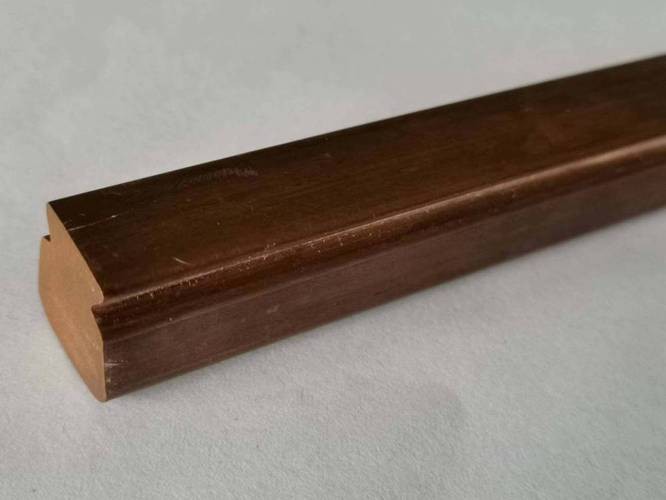
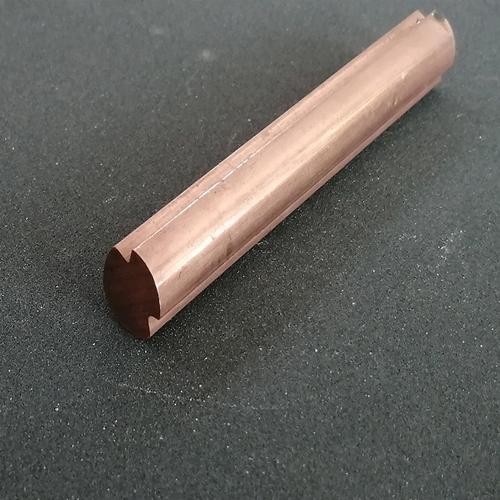
The cross-section itself is not round but grooved, with two symmetrical suspension grooves formed into the upper part of the profile. Clamps, splices and dropper fittings grip in those grooves, leaving the lower face clean for the pantograph strips. The geometry is shared across the families, so hardware and tooling are generally interchangeable between same-size wires of different alloys, which simplifies maintenance stocking on mixed-fleet railways.
The five copper contact wire families
CT hard-drawn copper
Pure hard-drawn copper remains the reference conductor: Chuangwit CT series copper contact wire offers a minimum conductivity of 97% IACS and spans sizes from CT65 to CT150, with a minimum tensile force of 43.56 kN at the 120 mm² size. Its electrical performance is unmatched and its price the lowest of the group, which keeps it attractive on conventional and speed-raised lines up to roughly 200 km/h. The limitation is thermal: hard copper softens when conductor temperatures climb, so sustained heavy currents or aggressive braking duty accelerate annealing and creep. Notably, the railway alloy standard TB/T 2809 has removed pure copper types from its scope, which signals where alloy selection is now expected on anything faster or more heavily loaded than a regional line.
CTA and CTAH copper-silver
Alloying a small silver addition into copper raises the softening temperature and the strength while barely touching conductivity. CTA/CTAH copper-silver contact wire retains at least 97% IACS, with CTA120 rated at 350 MPa minimum tensile strength and the CTAH120 high-strength grade at 360 MPa; both deliver a minimum tensile force of 43.56 kN at that size. Rated for lines up to 250 km/h depending on the tension arrangement, the family is the classic answer where current loads are heavy but speeds moderate: approach sections, station throats and busy conventional mainlines where heat build-up, not speed, is the design constraint.
CTM and CTMH copper-magnesium
Magnesium strengthens copper far more aggressively than silver, at a real cost in conductivity. CTM/CTMH copper-magnesium contact wire comes in 110, 120 and 150 mm² sizes: CTM holds a minimum of 77% IACS with 430 MPa and 52.03 kN minimum tensile force at 120 mm², while high-strength CTMH carries 490 MPa and 59.29 kN at the same size on 62% IACS minimum conductivity. The standard grade serves lines up to 250 km/h; CTMH is rated up to 350 km/h, which makes it the workhorse of high-speed fleets when paired with an equally strong JTMH messenger wire under high mechanical tension.
CTS copper-tin
Tin sits between silver and magnesium on both axes. CTS copper-tin contact wire offers at least 93% IACS conductivity together with 420 MPa and 50.82 kN minimum tensile force at 120 mm², in 110, 120 and 150 mm² sizes, with speed capability up to 250 km/h by wire type and tension configuration. That balance of respectable conductivity, solid strength and good corrosion behaviour explains why copper-tin is a common choice for urban rail transit, tunnels and coastal alignments, where neither extreme speed nor extreme current dominates the duty cycle.
CTCZ and CTCZM copper-chromium-zirconium
The newest family in the TB/T 2809 standard adds chromium and zirconium, which precipitate within the copper matrix to give strength that survives heat. CTCZ holds a minimum of 90% IACS with 469 MPa tensile strength at 120 mm², while the medium-strength CTCZM reaches 560 MPa on 75% IACS, and the CTCZM150 grade carries at least 82.87 kN, the highest tensile force among current contact wire types. Sizes are consolidated at 120 and 150 mm², aimed at large-tension high-speed suspensions, heavy-haul sections with high temperature rise, and high-current terminal yards where a wire must keep its strength while running hot.
Conductivity versus tensile strength
The underlying physics is simple: foreign atoms and heavy cold work that obstruct dislocation movement also scatter conduction electrons, so every gain in strength is paid for in % IACS conductivity. Silver barely interferes, magnesium interferes a great deal, and chromium-zirconium buys most of its strength back through heat-resistant precipitates rather than raw solute content. The table below gathers the published minimums side by side.
| Type | Alloy | Conductivity | Strength at 120 mm² | Typical duty |
|---|---|---|---|---|
| CT | Hard copper | 97% IACS | 43.56 kN | Conventional, up to 200 km/h |
| CTA / CTAH | Copper-silver | 97% IACS | 43.56 kN | 250 km/h, heavy current duty |
| CTS | Copper-tin | 93% IACS | 50.82 kN | 250 km/h, metro and tunnels |
| CTM | Copper-magnesium | 77% IACS | 52.03 kN | 250 km/h mainline |
| CTMH | Copper-magnesium, high strength | 62% IACS | 59.29 kN | Up to 350 km/h high-speed |
| CTCZ / CTCZM | Copper-chromium-zirconium | 90% / 75% IACS | 469 / 560 MPa | High current, high temperature rise |
Read the table as a menu of compromises rather than a ranking. A 62% IACS wire is not worse than a 97% one; it is a wire designed for a different job, and the traction power supply calculation decides how much conductivity the line can afford to give away.
Matching contact wire types to line duty
For 300 km/h-plus operation, wave propagation speed in the wire becomes the governing criterion, which demands high working tension and therefore the CTMH or CTCZM strength classes at 120 or 150 mm². Between 200 and 250 km/h, CTAH, CTS and CTM all have valid claims depending on current load and climate. Heavy-haul lines care less about speed and more about amperes and wear: high-conductivity copper-silver keeps energy losses and conductor temperature down, while copper-magnesium tolerates the higher mechanical duty of aggressive tension schemes. metros and light rail on DC supply commonly select CTS or CTM in 110 or 120 mm², balancing ampacity, corrosion resistance and cost. Coastal and industrially polluted environments push selection toward the alloy families in general, as they resist atmospheric corrosion measurably better than plain copper.
Cross-section size and the tension pairing
Cross-section sets the copper available for current and for tension. The CT family spans 65 to 150 mm²; the high-strength alloys concentrate at 110, 120 and 150 mm² because those sizes carry the tensile forces that high-speed tensioning applies. A 150 mm² wire offers roughly 25% more conduction area than 120 mm² and a proportionally higher tensile force, at the price of added mass per metre, greater stiffness and higher cost. The working tension then fixes sag, elasticity and the uniformity of the pantograph path, held constant across temperature by compensation devices at the anchor points. Material, size and tension form a single decision: a strong alloy at high tension gives a steady contact surface at speed, while a modest tension on a conductive alloy suits a slow, heavily loaded conventional line. When that three-way selection needs to be resolved for a specific project, our engineering team can review the duty data against the published wire ratings and propose the family, size and tension arrangement together.