Arrester housings fail in two different anatomies, and the difference decides what happens below the device when internal energy is released. Porcelain housings are rigid, gas-tight shells that can shatter under internal pressure, creating burst risk with hard fragments. Polymer housings vent instead of bursting, but their sheds can slip or track as insulation ages. Both families meet the same GB/T 11032 electrical requirements for traction service, so the choice turns on failure behavior and installation environment.
Key Takeaways
- Gapless metal-oxide arresters built on zinc-oxide (ZnO) varistor blocks are the current standard on railway overhead contact systems (OCS); the housing is the sealed boundary around the varistor column.
- Porcelain fails by shatter: an over-pressurized rigid shell can burst and throw fragments, which is the dominant personnel risk directly below a mast-mounted arrester.
- Polymer fails by surface degradation: sheds discolor, track, crack or slip, and the defect usually remains visible from the ground before it becomes an outage.
- Both housing families must satisfy the same GB/T 11032 electrical requirements for traction service — housing choice is not an electrical class choice.
- The published Y5WT-42/120 porcelain-housing class carries a 5 kA nominal discharge class, a 600 A 2 ms square-wave withstand and 1600 mm of creepage, sealed for outdoor service from minus 40 to plus 70 degrees Celsius to GB/T 11032.
What Does the Housing Do in a Metal Oxide Arrester?
Gapless metal-oxide arresters built on zinc-oxide varistor columns are the current standard on railway OCS. The column itself is a highly nonlinear resistor: at normal system voltage it conducts a negligible current, and when a surge arrives its resistance collapses, diverting the discharge current to earth and clamping the residual voltage that the line insulation sees. The column does the electrical work; the housing does everything protective around it.
Four duties fall on the housing. It seals the varistor column against moisture, because ingress at the block interfaces is the classic root of internal arcing. It provides the external creepage path that keeps the surface from flashing over in pollution and wetting. It carries the mechanical loads of mast-top mounting, conductor connection and wind. And when an internal fault does develop, it is the pressure boundary that decides whether the failure vents quietly or bursts.
That last duty is where porcelain and polymer part ways. The electrical column inside a porcelain-housed and a polymer-housed arrester of equal rating is functionally the same — both must meet the same GB/T 11032 requirements for traction service. What differs is the failure anatomy, the aging mechanism and the inspection signature of each material.
How Does a Porcelain Arrester Housing Fail?
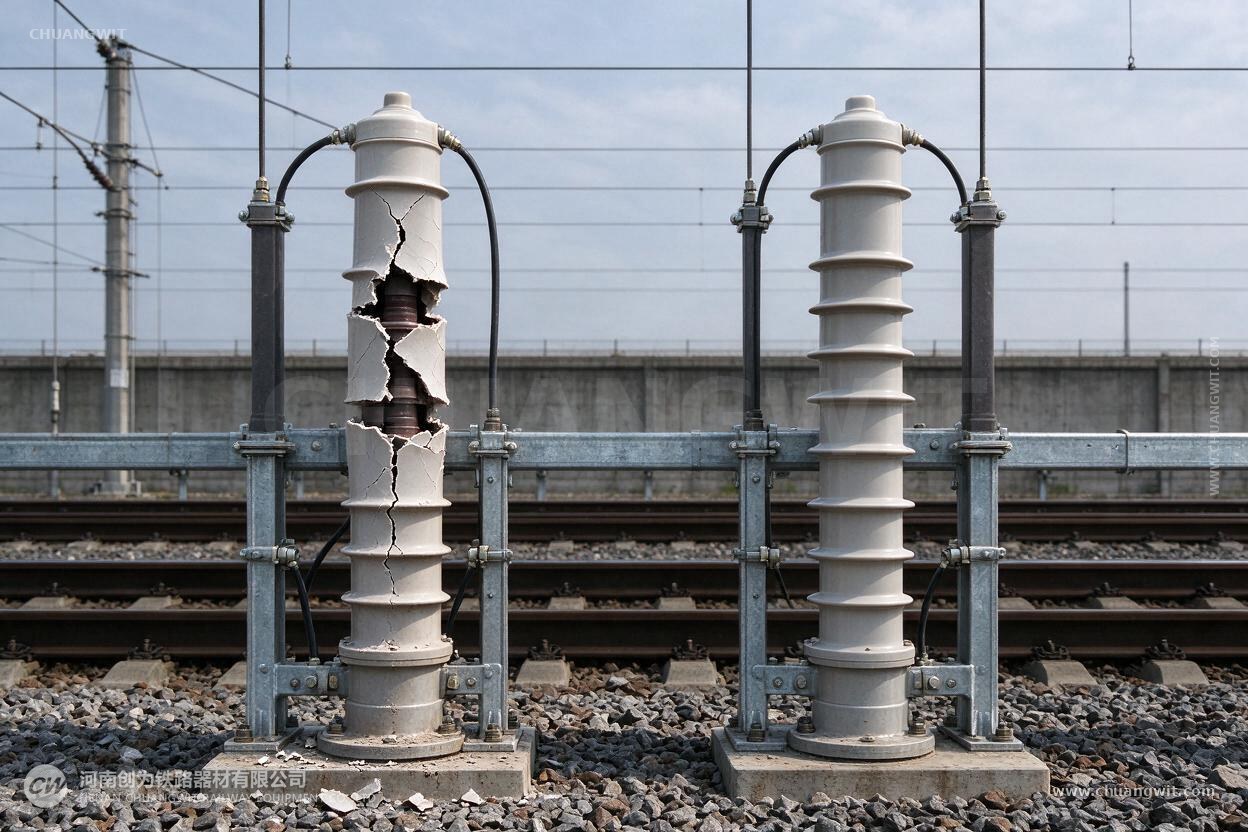
Porcelain is a rigid ceramic fired with a glazed surface, and a porcelain-housing arrester is assembled as a sealed shell with metal end caps cemented at both ends. The failure sequence almost always begins with the seal rather than the ceramic: moisture enters through a degraded cap joint or a microcrack in the glaze, the wetted varistor interfaces begin to conduct continuously, and the sustained leakage heats the column until an internal arc develops. The arc produces gas, pressure builds faster than a rigid shell can relieve it, and the housing shatters.
The terminal event is energetic. Fragments of glazed ceramic can be thrown across the trackside zone, which is why porcelain arresters in service are mounted with attention to what sits below them, and why many operators schedule replacement the moment cap corrosion or glaze damage is confirmed. Burst risk is the single word that summarizes porcelain failure.
The compensating strength is inspectability and stability. Porcelain degradation is progressive and legible: glaze cracking or chipping at the sheds, corrosion at the cement lines, and rust staining that betrays a breathing seal are all visible during routine inspection, months or years before any terminal event. The Y5WT-42/120 porcelain-housing metal-oxide surge arrester exemplifies the class — a 5 kA nominal discharge class, a 600 A 2 ms square-wave withstand, 1600 mm of creepage and operation from minus 40 to plus 70 degrees Celsius, all sealed for long-term energised outdoor service to GB/T 11032. Decades of mainline service on this construction are part of the record behind the standard.
| Housing material | Pre-failure signature | Terminal failure mode | Primary residual risk |
|---|---|---|---|
| Porcelain | Glaze cracks, chipped sheds, cement-line corrosion, rust staining at caps | Rigid shell shatters under internal arc pressure | Fragment throw near personnel and adjacent equipment |
| Polymer | Shed discoloration, tracking lines, chalking, shed slip or cracking | Surface tracking or housing puncture; non-explosive in most cases | Loss of external insulation, conductive surface path |
Source: qualitative failure anatomy of gapless metal-oxide arresters in traction service; published ratings of the Y5WT-42/120 class to GB/T 11032.

How Does a Polymer Housed Arrester Fail?
A polymer housed arrester molds an elastomer body with sheds directly around the varistor column, without a brittle ceramic boundary. Because the housing can deform and vent under internal pressure, an internal fault usually does not burst the device — the construction is pressure-tolerant, which is exactly why polymer housings are preferred near platforms, in tunnels and anywhere fragment throw is intolerable.
The counterpart is that polymer degrades from the outside in rather than from the seal in. Ultraviolet exposure, cycling temperatures and surface pollution erode the shed material; when pollution layers wet and dry repeatedly, leakage current can carbonize tracking lines into the surface; in the worst cases the bond between sheds and core fails and sheds slip along the housing. Each mechanism is visible from the ground or from an inspection platform, which turns polymer aging into a maintenance-planning problem rather than a surprise.
One more difference belongs in the comparison: surface performance under pollution. Polymer shed materials resist wetting — water beads rather than films — so the surface withstands pollution episodes that would force a longer porcelain creepage path. The advantage is qualitative but real in coastal and industrial environments, and it is the same trade-off that drives composite insulator selection elsewhere on the OCS.
Which Housing Fits a 27.5 kV Catenary Installation?
The decision compresses into a short list, with the caveat that both families meet the same GB/T 11032 electrical requirements for traction service. Porcelain suits locations with reliable inspection access and a stable service record, and where its published creepage — 1600 mm in the Y5WT-42/120 class — matches the site pollution duty. Polymer suits dense urban trackside, tunnel mouths and approaches, and every location where a burst, even a rare one, is unacceptable.
Environment tilts the choice in both directions. Heavy pollution favors the hydrophobic polymer surface; wide temperature swings and mechanical exposure favor whichever product family has the longer verified record on that specific railway. Neither housing changes the arrester class — the traction classes themselves, Y5WT and Y10WT-42/120 per TB/T 1844, are covered in why 27.5 kV lines need railway-specific arresters, and the model-level comparison sits in railway surge arrester selection: Y5WT versus Y10WT.
Housing choice also interacts with the accessories that make condition visible. Both families can be specified with monitoring, and some traction arresters for 25 kV systems are offered in disconnector-equipped versions that drop free and signal a failed unit electrically. The diagnostic layer is covered in surge counters and leakage current monitors.
How Do You Catch a Failing Housing Before It Fails?
Detection is layered, and each layer maps onto one of the failure stages described above. Visual inspection catches shed damage, glaze cracking and cap corrosion. Thermography from the ground catches uneven varistor grading and hot connections, both early markers of internal stress. A surge counter registers how much discharge duty the device has absorbed, and leakage current monitoring trends the resistive component that grows as the column degrades — the internal precursor common to both housings.
Put together, the layering means neither housing type should fail without warning. The full inspect-test-replace decision flow, including what triggers removal from service, is in surge arrester maintenance. The wider system view — where arresters sit relative to shielding wire and earthing in the lightning-protection design — is in catenary lightning protection, and the housing trade-off as it applies to arresters generally is developed in composite versus porcelain arresters for railway overhead lines.
Frequently Asked Questions
What is a polymer housed surge arrester?
It is a gapless metal-oxide arrester whose varistor column is sealed in a molded polymer body with sheds, instead of a porcelain shell. The column performs the same voltage-clamping duty under the same GB/T 11032 electrical requirements; the difference is the housing, which vents rather than bursts under internal faults and resists surface wetting in pollution. Polymer housings dominate where fragment throw must be excluded.
How does a polymer housed metal oxide surge arrester fail?
Polymer arresters fail from the surface inward. Pollution and ultraviolet exposure degrade the sheds, wetting and drying cycles can carbonize tracking lines, and in advanced cases sheds crack or slip along the core. Moisture ingress at degraded interfaces then stresses the varistor column itself. The failure is rarely explosive; the practical consequence is a gradual loss of external insulation that visual inspection and leakage monitoring can track for years.
Which is better, polymer or porcelain arresters?
Neither is universally better; both must satisfy the same GB/T 11032 requirements. Porcelain offers a long verified record, stable creepage such as the 1600 mm of the Y5WT-42/120 class, and an inspectable aging signature, at the cost of shatter risk. Polymer offers pressure-tolerant failure and hydrophobic pollution performance, at the cost of surface-aging management. The site — pollution, personnel exposure, inspection regime — decides.
Porcelain, polymer or glass: which insulator housing is safest?
For arresters the practical choice is porcelain versus polymer, because arresters are built as sealed varistor columns, not as glass disc strings. Glass belongs to suspension insulator hardware, where its self-shattering behavior turns a cracked body into an obvious visual signal rather than a hidden defect. Safety in every case is housing-specific: porcelain arresters burst, polymer arresters track, glass discs shatter visibly — the safest choice is the failure mode a given location can best tolerate and inspect.
Choosing on Failure Behavior
Specify the electrical class first, then choose the housing for the failure behavior the location can live with. Write the tender around the standard and the published ratings — GB/T 11032 compliance, nominal discharge class, square-wave withstand, creepage and the temperature range — and require the housing-failure statement that matches the installation: fragment containment near people, surface-aging management in pollution.
For a housing decision on a specific 27.5 kV catenary project, send the site conditions to our engineering team and we will match the housing family to the exposure, duty and inspection regime.