Surge arrester maintenance on an overhead contact system (OCS) is three disciplines in one: understanding what the arrester classes mean, inspecting the fleet on a consistent cycle, and replacing devices on evidence rather than on age alone. Gapless metal-oxide arresters are the current standard on railway OCS, in traction classes such as the Y5WT and Y10WT-42/120 series per TB/T 1844, built to GB/T 11032 — and their failure precursors are visible long before an outage, provided someone looks for them on a schedule.
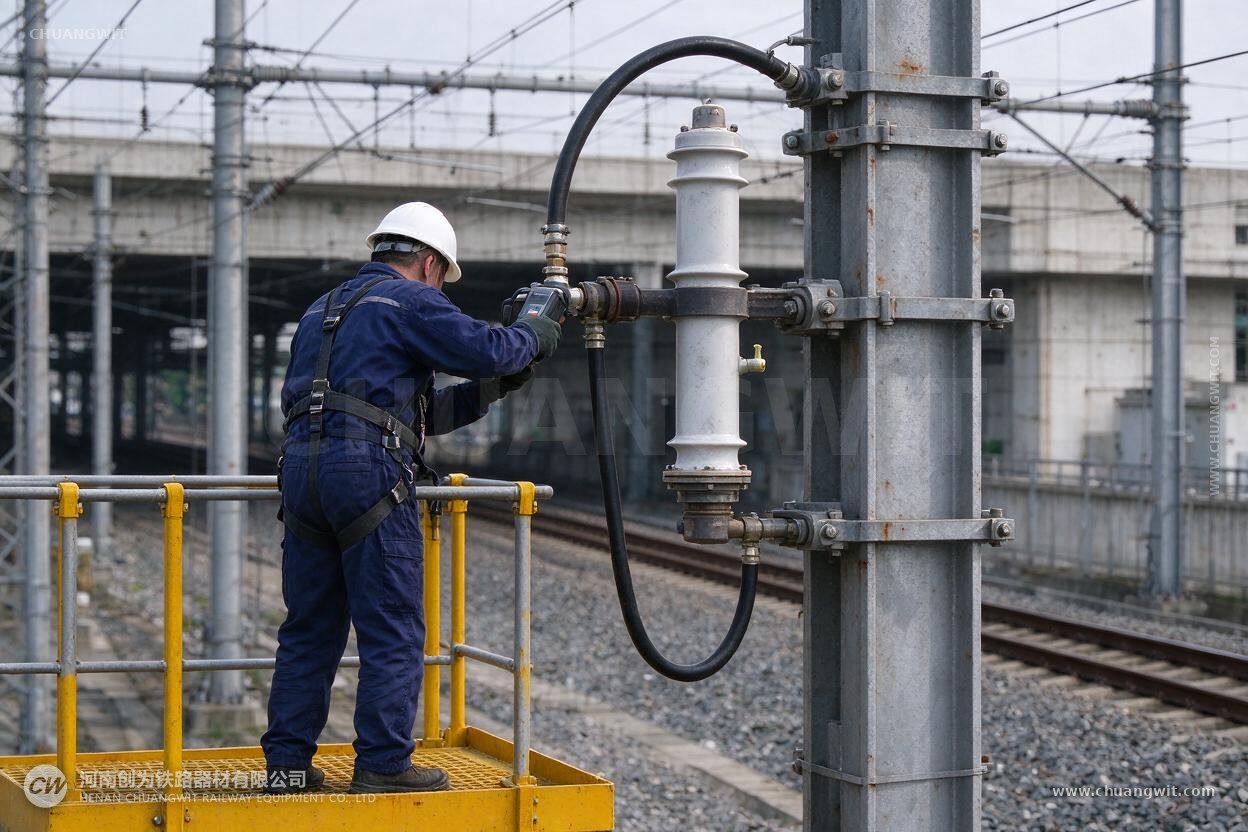
Key Takeaways
- Maintenance decisions follow class understanding: Y5WT and Y10WT-42/120 are traction classes per TB/T 1844 aligned to GB 11032-2020, and their published duties define what normal service looks like.
- The Y5WT-42/120 class publishes a 5 kA nominal discharge class, a 600 A 2 ms square-wave withstand, 1600 mm of creepage and service from minus 40 to plus 70 degrees Celsius to GB/T 11032.
- Arresters age from accumulated duty — surge counts, switching events, moisture at degraded seals — not from calendar time alone, so inspection routines must capture duty, condition and trend.
- Replacement triggers are physical and measurable: housing damage, corrosion at seals or caps, abnormal counter behavior, growing resistive leakage, hot spots, or a dropped disconnector flag on equipped versions.
- Inspection data only pays when it is logged per device position; a reading without a baseline and a trend is decoration, not diagnostics.
What Is the Purpose of a Surge Arrester on the OCS?
The purpose of a surge arrester is to protect OCS insulation and connected equipment from transient overvoltages — clamping the surge and absorbing its energy. On a railway this means the arresters on the catenary stand guard over insulators, section insulators, disconnectors and the feeding connections, against both atmospheric surges and the switching transients of the traction feeding system.
On 25 kV AC electrification the guarded network is demanding. The traction feeding system carries a rated voltage of 27.5 kV, and feeding architectures such as 2x25 kV autotransformer supply — 50 kV between catenary and negative feeder, with autotransformers roughly every 10 to 15 km — generate switching duty on every operation. The arrester fleet absorbs that duty continuously, which is why the dedicated traction classes exist at all: the argument is laid out in why 27.5 kV lines need railway-specific arresters.
How Does a Surge Arrester Work — and How Does It Age?
A gapless metal-oxide arrester is a column of zinc-oxide varistor blocks between the energized conductor and earth. At service voltage the column carries only a small leakage current; under surge voltage its resistance collapses, the discharge current flows to earth, and the voltage across the protected insulation is held at the arrester residual voltage. When the surge passes the column returns to its insulating state without any interrupting gap.
Aging attacks that cycle in three ways. Electrical aging: each absorbed event shifts the varistor characteristics slightly, and the continuous leakage current grows as the blocks degrade. Thermal aging: repeated energy deposits that outpace cooling — the regime the 600 A 2 ms square-wave withstand of the Y5WT-42/120 class is tested against — cumulatively stress the column. Environmental aging: seals admit moisture, housings crack or track, and connections corrode. The first two show up in leakage trends, the third in visual inspection, and the anatomy of the terminal failures that follow is compared in polymer versus porcelain arrester housings.
What Are Surge Arrester Classes?
Classes exist so that duty, not marketing, is comparable. For traction arresters the operative framework is small: the Y5WT and Y10WT-42/120 series per TB/T 1844, the 1987 standard as modified and aligned to GB 11032-2020, with devices built and tested to GB/T 11032; internationally, IEC 60099-4 covers arrester classification and line discharge classes for testing and duty. Reading a class correctly is the first maintenance skill, because the published duties are the baseline against which abnormal service is recognized.
| Published rating (unit) | Y5WT-42/120 value | What maintenance reads from it |
|---|---|---|
| Nominal discharge current (kA) | 5 | The impulse class the device is proven for — context for surge counter activity |
| Square-wave withstand (A over 2 ms) | 600 | Energy absorption under switching-type duty — context for feeding-system events |
| Creepage distance (mm) | 1600 | Pollution margin — context for surface-condition findings |
| Service temperature (degrees Celsius) | minus 40 to plus 70 | Climate envelope — context for housing and seal inspection |
Source: published ratings of the Y5WT-42/120 porcelain-housing metal-oxide surge arrester for traction duty to GB/T 11032; class series per TB/T 1844.
The meaning behind those duties — why energy capability and line discharge classes matter for a fleet that keeps switching — is developed in arrester energy class and line discharge duty explained, and the model-level selection between the series in railway surge arrester selection: Y5WT versus Y10WT.

What Does a Field Inspection Cover?
Inspection is layered so that each failure precursor from the aging section has a matching check. The table is the routine; the discipline is logging everything against device position.
| Inspection layer | What is checked | What it detects |
|---|---|---|
| Visual, from ground or platform | Housing cracks, chipped sheds, tracking lines, shed slip, cement or seal corrosion, rust staining | Environmental aging, seal failure, surface degradation |
| Connections | Conductor terminal and earth lead tightness, corrosion, burned or discolored joints | High-resistance joints that distort duty and discharge paths |
| Surge counter reading | Register advance since last reading, compared with lightning season and neighboring positions | Absorbed duty; frozen registers indicating counter or connection failure |
| Leakage trend | Continuous and resistive current components against baseline | Varistor aging and moisture ingress — the internal precursor |
| Thermography | Temperature distribution along the housing and at terminals | Uneven varistor grading, hot joints, internal stress |
| Disconnector flag, where fitted | Position of the disconnect device on equipped versions | A unit that has already failed and freed itself from the line |
Source: qualitative field-inspection practice for traction arresters of the TB/T 1844 classes to GB/T 11032.
The counter and leakage layers deserve their own training, because they produce the trend data that converts inspection from snapshot to trajectory. Instrumentation and procedure are covered in surge counters and leakage current monitors.
When Should an Arrester Be Replaced?
Replacement criteria fall into three groups, in rising order of urgency. First, condition triggers: confirmed housing damage — cracked porcelain glaze, slipped or deeply tracked polymer sheds — corrosion at the caps or seals, or a burned connection that re-torquing cannot cure. Second, diagnostic triggers: a leakage trend whose resistive component climbs steadily against baseline, a counter that advances far faster than its neighbors season after season, or a thermographic hot spot that persists between readings. Third, state triggers: a dropped disconnector flag on equipped versions, evidence of internal arcing, or any device that has physically failed, including burst housings found below the mast.
What does not trigger replacement, by itself, is age. A device with clean visuals, a flat leakage trend and proportionate counter activity is earning its duty regardless of years in service — and a device that fails two diagnostic layers is a replacement candidate regardless of how new it is. The economic logic is simple: planned replacement on trend costs a maintenance window; unplanned replacement after a fault costs a fault investigation as well.
Fleet policy ties it together: every device position carries a dossier — class, installation date, baseline readings, inspection history — and the annual review ranks positions into keep, watch and replace. That ranking, not a calendar, drives the procurement plan.
Frequently Asked Questions
What are surge arrester classes?
Classes standardize arrester duty so devices are comparable. For traction service the classes are the Y5WT and Y10WT-42/120 series per TB/T 1844, aligned to GB 11032-2020, with devices built to GB/T 11032; internationally IEC 60099-4 covers classification and line discharge duty. The published Y5WT-42/120 class carries a 5 kA nominal discharge class, a 600 A 2 ms square-wave withstand and 1600 mm of creepage — the duty baseline maintenance reads against.
What is the purpose of a surge arrester?
It protects OCS insulation and connected equipment from transient overvoltages by clamping the surge and absorbing its energy. On railway feeders the duty is continuous — atmospheric surges plus the switching transients of traction feeding — so the arrester fleet quietly absorbs events through its whole service life, and maintenance exists to verify that it still can.
How do you maintain a surge arrester on an overhead line?
With a layered routine: visual inspection of housings and connections, surge counter readings against baseline, leakage current trending, thermography where access allows, and checks of disconnector flags on equipped versions — all logged per device position. Findings feed a keep-watch-replace ranking reviewed each cycle. The layers map one-to-one onto the aging mechanisms, so no failure precursor goes unobserved.
When should a railway surge arrester be replaced?
On evidence, not age. Replace on confirmed housing damage, cap or seal corrosion, a steadily growing resistive leakage component, counter activity far above neighboring positions, persistent hot spots, a dropped disconnector flag, or any internal-arc indication. Age alone is not a trigger: a device with clean visuals and flat trends stays; a device failing two diagnostic layers goes, however new it is.
Practical Takeaways for the Fleet
Arrester maintenance succeeds on routine and records. Fix the class framework — TB/T 1844 traction classes to GB/T 11032 — run the layered inspection on a set cycle, log every reading against its position, and let the trend ranking decide procurement. Arresters maintained that way fail in the plan, not on the line.
For inspection-program design or replacement-planning support on a traction arrester fleet, contact our engineering team — the wider protection design context is in catenary lightning protection.