Catenary wire is the term most people use for the suspended wiring of a railway overhead contact line, and in its strict sense it means the messenger wire: the upper conductor that hangs in a natural curve between supports and carries the contact wire. The name comes from the catenary curve a free-hanging chain traces under its own weight. Stranded conductors for this duty follow the TB/T 3111 series.
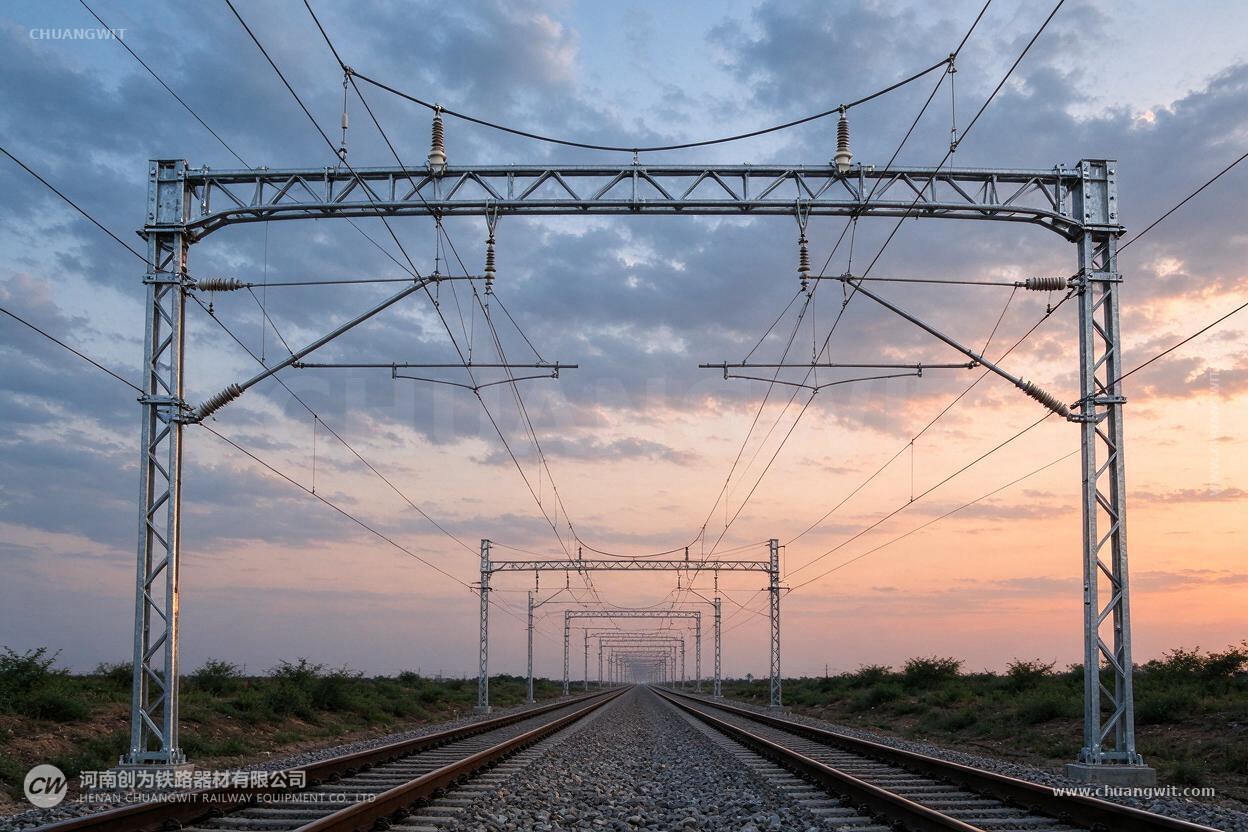
Key Takeaways
- Strictly, catenary wire means the messenger wire, the upper load-bearing conductor of the suspended assembly, made of strands governed by the TB/T 3111 series.
- The word catenary is mathematics before it is hardware: the curve a chain forms when hung from two points, which a tensioned messenger wire follows closely.
- In everyday speech the term stretches to cover the messenger-contact wire pair, or even the whole overhead contact line, which is why specifications should name parts precisely.
- The contact wire, the conductor the pantograph touches, is a different component made of copper alloys such as CuAg 0.1 and CuMg 0.5 to EN 50149, in sections of 100 to 150 mm².
- The 2026 revision round split the strand standard into TB/T 3111.1 for copper and copper alloy strands and TB/T 3111.2 for aluminium-clad steel core aluminium conductors.
What Does Catenary Mean in a Railway?
Catenary is a curve before it is a component. Hang a chain from two points and it settles into the shape mathematicians call the catenary, which early thinkers mistook for a parabola until analysis showed the two curves differ. A wire strung under tension with its own weight behaves the same way, sagging most at midspan and rising toward every support.
Railway engineers borrowed the word for the suspended assembly itself. When a line is described as catenary suspended, or when a drawing labels the catenary wire, the reference is to a messenger wire deliberately allowed to take that natural curve, with the working conductor hung beneath it. The curve is not a defect to be eliminated; it is the shape the structure is designed around.
That is also why the term confuses newcomers. In pure mechanics the catenary is a curve of a freely hanging chain, while on the railway the same word names a wire, an assembly and sometimes an entire supply system. Context, and the standards, restore the precision.
This article untangles the word so that a specification written tomorrow can use it without ambiguity, whoever reads it.
What Do People Mean When They Say Catenary Wire?
Three usages account for nearly all the confusion. First, the strict usage: the catenary wire is the messenger wire alone, the upper conductor doing the structural work. Second, the assembly usage: the same words describe the messenger and contact wire acting together as a suspended pair. Third, the popular usage: any railway overhead wiring, including steady arms and supports, gets called the catenary in casual speech.
| Element | Role in the assembly | Size basis (mm²) | Governing standard |
|---|---|---|---|
| Messenger, or catenary, wire | Upper load-bearing conductor hung with calculated sag | Strand bundles sized to mechanical design | TB/T 3111 series |
| Contact wire | Lower conductor, the pantograph running surface | 100, 107, 120 and 150 typical | EN 50149; GB/T 12971.1 and TB/T 2809 series |
| Droppers | Short hangers setting contact wire height and elasticity | Sized per mechanical design | JL02(7A)-2010 and TB/T 2075 series |
Source: TB/T 3111 series for strands; EN 50149 for contact wire alloys and sections.
For an element-by-element walkthrough of the whole system, see OCS components: a complete guide to overhead contact system parts. International projects align the definitions with EN 50119, the European standard for overhead contact line design.
Catenary Wire vs Contact Wire: What Separates Them?
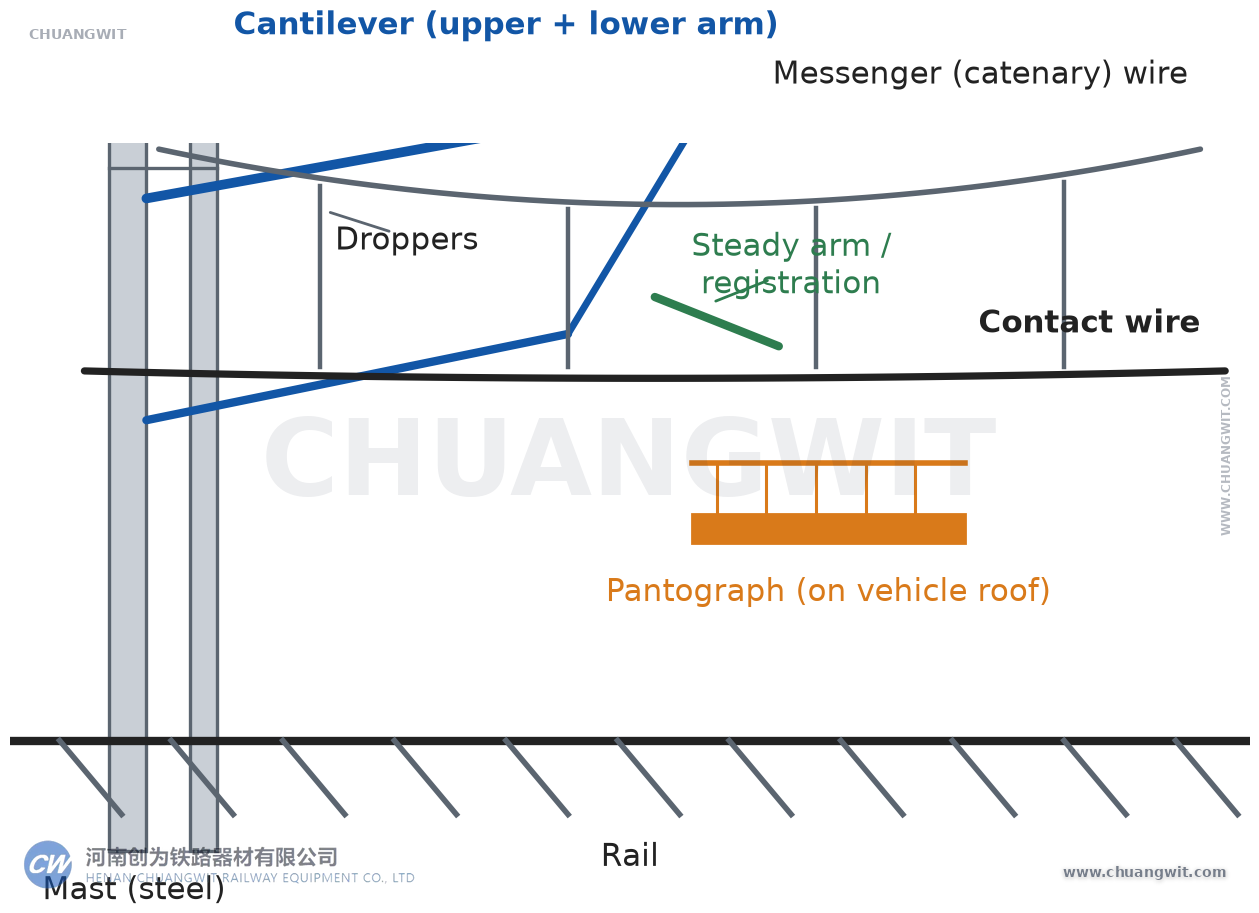
The two wires are easy to tell apart once the roles are clear. The catenary wire sags in a calculated curve and never meets the pantograph; the contact wire hangs from it through droppers and runs almost level, because a level surface is what smooth current collection demands. One carries load, the other carries wear.
The contact wire pays for its position in surface wear and eventual replacement, which is why it is specified as a copper alloy conductor. CuAg 0.1 sections from 80 to 150 mm² suit long-distance service up to about 250 km/h, while CuMg 0.5 and CuMg 0.7 higher-strength variants, marked by three identification grooves, serve high-speed lines per EN 50149. The full component story is in what a messenger wire does in railway catenary.
What Does a Catenary Wire Setup Involve?
A working setup is more than wires in the air. Each tension length, typically in the region of 1.5 to 1.9 km on mainlines, is anchored at both ends, protected by a mid-point anchor built to TB/T 2075.6-2024, and tensioned by compensation devices such as the 13-1G ratchet or 12-1G pulley types from the TB/T 2075 series. Droppers, stitch wires and steady arms then fix the contact wire height and lateral position span by span.
At the anchor points themselves, terminal anchor clamps built to TB/T 2075.5-2024 carry the full wire tension, and their type codes encode speed class, construction and body material, which makes selection systematic provided the code is read correctly.
The mechanics of that assembly, and why each element exists, are explained in how catenary wires work, while the tension and sag side is covered in contact wire tension and sag: compensated versus uncompensated catenary.
Which Standards Govern Catenary Wire Today?
On the Chinese standard system, the TB/T 3111 series covers strands for overhead contact systems, and its 2026 revision split the document in two: TB/T 3111.1 for copper and copper alloy strands and TB/T 3111.2 for aluminium-clad steel core aluminium stranded conductors. Contact wire has its own standard, TB/T 2809, reissued in 2026, with the withdrawn 2017 edition ending its transition on 1 September 2026. The same round reissued the fittings series itself, adding preformed fittings as Part 24 of the TB/T 2075 series.
For procurement this matters directly: a specification that cites a withdrawn edition, or that uses catenary wire to mean two different conductors, produces bids that cannot be compared. The full revision story, including the four new overhead contact system standards of 2026, is in reading the four new railway standards for OCS.
Is Catenary Wire the Same as an Overhead Cable?
No, and the distinction is worth one paragraph. Utility overhead cables are usually insulated conductors carrying alternating current at distribution or transmission voltages, supported but not designed for a moving collector. Railway catenary wire is a bare, tensioned conductor system engineered for a pantograph sliding along it at speed, with geometry held to tight limits by droppers, steady arms and compensation.
The hardware families reflect that difference: railway fittings, insulators and sectioning devices follow standards such as the TB/T 2075 series and TB/T 3036-2016, none of which apply to a static utility span. Using the terms loosely costs nothing in conversation, but in a specification the words overhead cable and catenary wire point at different product worlds.
Frequently Asked Questions
What is catenary wire?
Catenary wire, strictly, is the messenger wire of a railway overhead contact line: the upper conductor that hangs in a catenary curve and carries the contact wire through droppers. Colloquially the same words often mean the whole suspended assembly, or even the entire overhead line, which is why engineers learn to read the context before answering.
What is catenary in railway?
In railway language, catenary refers to the suspended assembly of an overhead contact system: a messenger wire hung with a calculated sag, a contact wire held almost level beneath it, and droppers joining the two. The pantograph presses only against the contact wire. The name borrows the curve a hanging chain naturally traces.
What is the difference between catenary and contact wire?
The catenary wire is the structural carrier above; the contact wire is the conductor the pantograph touches. The catenary wire sags in a calculated curve and takes the mechanical load, while the contact wire, in copper alloys such as CuAg 0.1 or CuMg 0.5 to EN 50149, runs almost level to give the pantograph a smooth current collection surface.
What does a catenary wire setup involve?
A setup means anchoring and tensioning the messenger wire over each tension length, suspending the contact wire from it with droppers, registering it laterally with steady arms, and compensating the tension so the geometry survives temperature change. The aim throughout is a contact wire that stays level and correctly positioned for the pantograph at line speed.
Using the Term Precisely
Use catenary wire with care and specifications get clearer: call the upper conductor the messenger wire, name the working conductor the contact wire, and reserve overhead contact line for the assembled system. Precision at the tender stage prevents mismatched quotes and non-compliant deliveries later, and it maps cleanly onto the standards that govern each part, from the TB/T 3111 series for strands to EN 50149 for contact wire.
Chuangwit works with these distinctions daily, manufacturing catenary fittings to the TB/T 2075 series and wire ranges to GB/T 12971.1 and the TB/T 2809 series. For help wording a specification or matching components to a line class, contact our engineering team.