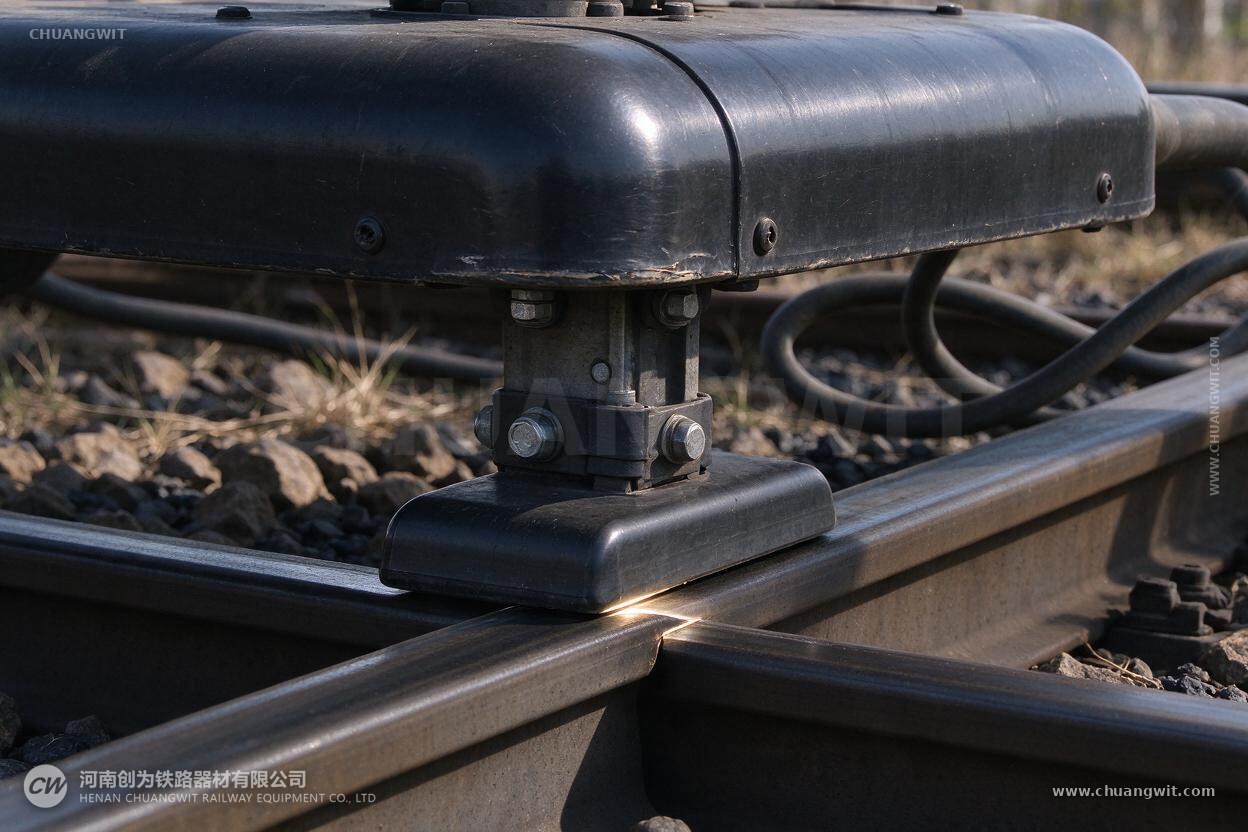
Contact orientation defines the three third rail families. On a top contact third rail the shoe presses down onto the running surface of the rail; on a bottom contact third rail the rail is inverted so the shoe collects from underneath, which shields the collecting surface from ice, snow and debris; on a side contact third rail collection happens on the vertical face. Orientation, not voltage, drives weather behaviour, shoe wear and installation detail on systems of the 750 V DC class typical of UK third-rail networks.
Key Takeaways
- Top contact collects from the rail running surface with the shoe pressing downward; it is the classic arrangement but leaves the working face exposed to weather and debris.
- Bottom contact inverts the conductor rail so the shoe collects from beneath; the rail body shields its own working face, which sharply reduces icing and contamination trouble.
- Side contact collects on the vertical face of the rail and places the shoe to one side, a compromise between exposure and accessibility.
- Icing and debris sensitivity is a recognised third-rail constraint, and orientation is the primary design lever against it.
- All three orientations serve the same DC traction role, typically at the 750 V DC level of UK third-rail networks, with gaps at switches and level crossings handled by ramps.
What Does Contact Orientation Mean on a Third Rail?
Orientation states which face of the conductor rail the collector shoe runs on: the top surface, the underside or the side. The choice fixes the direction of the shoe holding force, the shape of the shoegear, the mounting geometry of supports and covers, and, decisively, how exposed the current-carrying surface is to the trackside environment. The electrical function is identical in every case, delivering DC traction power, typically 750 V DC on UK third-rail networks, from substation to traction motors.
The distinction matters because a conductor rail is an exposed, energised component at track level, whatever its orientation. It is interrupted by gaps at switches and level crossings, it collects whatever the environment deposits on it, and its working surface must survive the sliding of shoes under currents on the order of a thousand amperes. Whether that surface faces up, down or sideways determines which of those threats actually reach the contact interface, which is why orientation is the first selection an engineer makes after choosing third rail at all.
What Is a Top Contact Third Rail?
A top contact third rail runs with its largest face upward, mounted on insulators beside the running rails, and the collector shoe presses down onto this upper running surface under spring force from the shoegear above. Gravity helps the arrangement in one sense, because shoe force adds directly to contact pressure, and the geometry is simple, robust and proven across the long service history of networks such as the classic UK 750 V DC system.
The weakness is exposure. The collecting face looks at the sky, so snow, ice, leaves, ballast dust and dropped objects all land exactly where the shoe must collect current. Icing on the contact surface is a recognised third-rail failure mode, and top contact bears it worst, which is why networks using the arrangement invest in de-icing trains, seasonal preparation and, on some corridors, full covers over the rail. Top contact therefore suits climates and corridors where ice is manageable and where the simplicity of downward shoe force is worth the weather exposure.
What Is a Bottom Contact Third Rail?
A bottom contact third rail is inverted relative to the top contact form: the shoe approaches from below and collects on the underside of the rail. The body of the rail itself now sits over the working face, so snow and debris that would settle on a top contact surface fall past instead. The collecting surface also retains shoe lubricant and wear debris better, and contamination has to travel upward to reach the interface, which it rarely does under normal conditions.
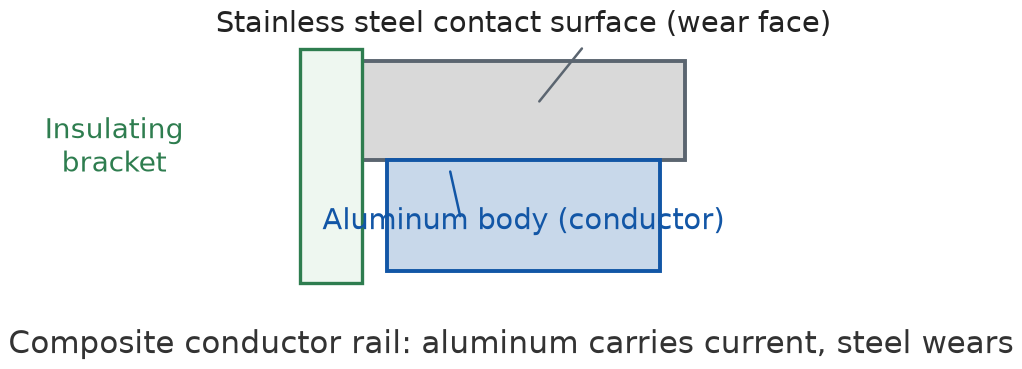
The mechanical price is upward shoe force. The shoegear must press the shoe up against the rail and keep it there through vertical track movement, which asks more of beams, springs and guidance than a downward press. Supports also hold the rail overhead of the shoe path, so bracket and insulator design differs from the top contact arrangement. Modern metro and light rail projects accept that complexity precisely for weather immunity, and fully enclosed systems carry the idea further by surrounding the conductor rail in a protective housing, an approach described in our article on the steel-aluminium composite contact rail for enclosed light rail.
What Is a Side Contact Third Rail?
A side contact third rail presents its vertical face to the shoe, which presses laterally from beside the rail rather than from above or below. The arrangement puts the working surface at an angle to falling contamination, so it sheds snow and debris better than a face that looks straight up, without asking for upward shoe force. It has served several historic systems and remains a natural fit where the conductor rail must sit against a wall or in a constrained side channel.
Side contact trades in both directions. The face is partly exposed to wind-driven contamination and splash from the running rails, so protection is intermediate rather than complete, and the lateral shoe force introduces its own guidance requirements on curves, where the vehicle moves relative to the rail. Covers and housings designed for side collection compensate well, and in several installations the orientation was chosen simply because the trackside space available had the shape of a side channel rather than a shoulder.
Which Orientation Should a Project Choose?
Choose by environment, then by shoegear philosophy. Where ice and snow are regular events, bottom contact or a fully enclosed arrangement protects the interface that top contact leaves open. Where the climate is mild and the maintenance regime is strong, top contact remains a straightforward, well-understood answer. Side contact earns its place in constrained side-mounted installations and where splash, rather than snowfall, is the dominant contaminant. The comparison compresses as follows.
| Attribute | Top contact | Bottom contact | Side contact |
|---|---|---|---|
| Shoe approach | Downward onto rail top | Upward onto rail underside | Lateral onto rail face |
| Weather protection of working face | None; face is upward | Rail body shields the face | Partial; face is vertical |
| Icing exposure | Highest | Lowest | Intermediate |
| Shoegear force direction | Downward spring force | Upward spring force | Lateral spring force |
| Typical setting | Classic networks in mild climates | Modern metros, enclosed systems | Side-constrained corridors |
Source: established conductor rail engineering practice; system voltage context is the 750 V DC typical UK third-rail network.
Orientation also frames the maintenance story. A face that collects contamination collects wear with it, because shoes slide on whatever rests on the rail, and arcing at gaps grows when contact quality drops. Those mechanisms, and the inspection responses they demand, are treated in detail in our companion article on common third rail problems, while the mechanics of the shoe-rail interface itself are covered in how third rail current collection works.
Does Orientation Change the Rest of the System?
Less than newcomers expect, more than optimists hope. Voltage class, substation spacing, return circuit bonding and the electrical sectioning philosophy are common to all three orientations, and the gaps at switches and level crossings appear in every case, handled by ramps that lift the shoe on and off the rail. Support insulators, covers, joints and anchors, however, are orientation-specific hardware, and retrofitting an installation from one orientation to another is effectively a rebuild rather than a modification.
Vehicles feel the difference through shoegear. Beams, springs, shoes and strikers are designed around the force direction the orientation imposes, and mixed fleets on a shared network must carry hardware suited to whichever orientation each electrified section uses. Designers therefore fix orientation early, alongside conductor rail material choice, and hold it consistent across the route. The wider context of the DC traction arrangement, from feeding to return circuit, is introduced in what a third rail system is, and tunnel-specific installations with rigid overhead conductor rail are a separate technology treated in our article on rigid section insulators for metro tunnel conductor rail systems.
Frequently Asked Questions
What is a bottom contact third rail?
A bottom contact third rail is a conductor rail mounted so the collector shoe collects current from its underside. Because the rail body sits above the working face, snow, ice and debris largely pass by instead of settling on the collecting surface, which makes the orientation the standard answer for weather-exposed and enclosed metro systems despite its upward shoe force requirement.
What is a side contact third rail?
A side contact third rail collects current on its vertical face, with the shoe pressing laterally. It offers intermediate protection between top and bottom contact, sheds falling contamination better than an upward face, and fits installations where the conductor rail must sit in a side channel or against a wall, at the cost of lateral guidance demands on the shoegear.
What is a top contact third rail?
A top contact third rail runs with its collecting face upward and the shoe pressing down onto it. It is the classic, mechanically simple arrangement used on networks such as the UK 750 V DC third-rail system, and its main weakness is exposure: ice, snow and debris land directly on the working surface, so de-icing and seasonal preparation carry the reliability programme.
Where is the third rail on a train track?
The third rail, formally the conductor rail, sits beside the running rails slightly outside the wheel path, mounted on insulators at a fixed offset, with ramps at switches and level crossings where the supply is interrupted. Top contact rails run face-up on track shoulders, bottom contact rails are inverted above the shoe path, and side contact rails occupy a vertical position in side channels.
Practical Takeaways
Orientation is the first weather-management decision in third rail design and one of the hardest to reverse. Match it to climate, contamination and trackside space before detailed hardware selection begins, and keep it consistent across the route so vehicles and spares stay standard. Bottom contact or enclosed designs buy reliability where winters are real; top contact rewards mild climates with simplicity; side contact solves geometry problems the other two cannot.
Chuangwit manufactures overhead contact system components, including section insulators built to TB/T 3036-2016 for 25 kV lines and DC urban rail types to TB/T 3252-2022, alongside arresters, insulators and catenary fittings. To discuss how an OCS or DC traction project maps onto these families, contact our engineering team.