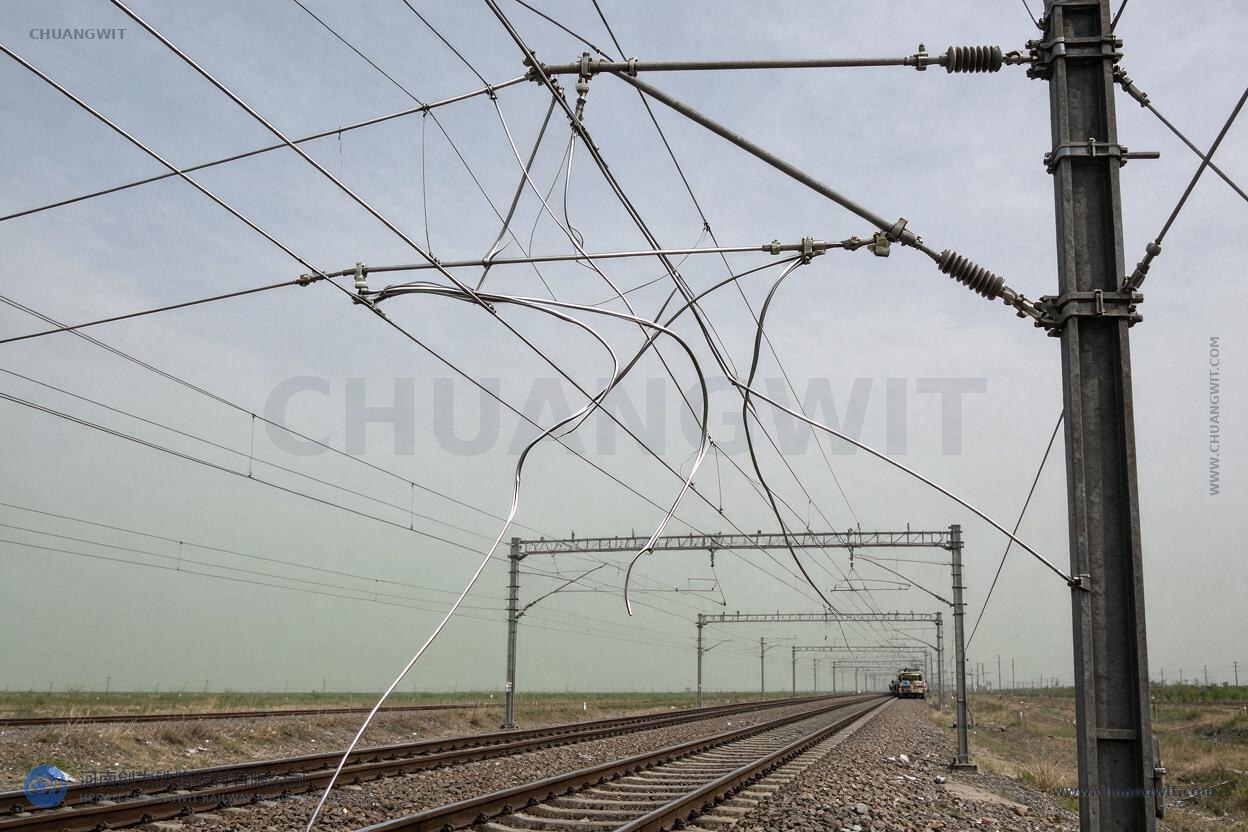
Pantograph entanglement, or dewiring, is the event in which the pantograph head hooks a fitting, a dropper or a kinked wire and drags the contact wire down with it, or destroys itself against the structure. Prevention rests on the EN 50367 force discipline, F_m = 0.00097·v² + 70 N for AC and DC 1.5 kV systems within ±10%, and on a line that presents nothing the head can catch.
Key Takeaways
- Entanglement starts as a snag and escalates: the moving head tears the wire from its droppers and registration over long distances, which is why a single defect can close a line for hours.
- Force discipline is preventive: EN 50367 targets F_m = 0.00097·v² + 70 N for AC and DC 1.5 kV systems and F_m = 0.00097·v² + 54 N for DC 3 kV systems, within ±10%, because over-pressed or bouncing heads both raise snag risk.
- Most snags live at known addresses: stagger defects, dropper misfits, protruding splice fittings, crossing wires and damaged section insulator runners.
- In-line devices must be speed matched: DC 1500 V section insulators to TB/T 3252-2022 are rated up to 120 km/h, 25 kV types to TB/T 3036-2016 up to 160 km/h, and reinforced phase-break types such as the FYFH-1.8BT-E serve lines up to 200 km/h.
- The railway 6C inspection system under TB/T 2076-2020 processes up to 120 GB of data per day and is the main instrument for catching the precursors before they catch a pantograph.
- After any dewiring, the wire, the pantograph and the supports of the whole tension length must be inspected before re-energizing.
What Is Pantograph Entanglement?
Dewiring is the loss of the collector into the overhead contact system (OCS). Instead of sliding under the wire, the head catches something on or near it; the forward motion of the train then converts into tension in the wire, and the wire either tears free of its droppers and steady arms or the pantograph is torn from the roof.
The damage chain explains why the event is feared. A dragging wire whips through successive supports, destroying registration hardware, bending cantilevers and masting hardware, and the broken wire ends can strike the vehicle roof below the damaged pantograph. Secondary arcing follows wherever the broken wire still carries voltage, and the automatic dropping device on the pantograph, valuable as it is, only limits how long the destruction runs.
The economic asymmetry is stark: the initiating defect is usually a small fitting or geometry error, while the consequence is a blocked line, a destroyed pantograph and repairs across a whole tension length. Prevention is therefore always the cheaper engineering choice.
What on the Line Catches a Pantograph?
Snags have addresses, and the list is short enough to inspect against. Stagger defects come first: where the wire deviates from its intended zigzag path, the strip can ride off the wire edge or the horn of the head can strike the wire from below, so stagger design and adjustment practice, described in contact wire stagger: calculation, adjustment and common defects, is the first chapter of dewiring prevention.
Droppers come next. A dropper installed with the wrong fittings or hanging slack can present a loop or a stiff point to the passing head, which is why dropper types and spacing practice, covered in catenary droppers: types, spacing and installation practice, matters as a safety subject, not only an elasticity one. Splices are third: a poorly set joint in the contact wire leaves a step or a protruding part above the running surface, and keeping the pantograph path smooth is the whole point of contact wire joints and splices.
Crossings at turnouts concentrate several of these risks at once, since wires converge and change character mid-passage; their wiring schemes and the resulting pantograph paths are explained in OCS crossings at turnouts: Y, T and S types. Finally, damaged section insulators with burned, chipped or misaligned runners strike the strips at every passage until something hooks.

How Do Condition Defects Turn Into Dewiring?
Wear turns into snagging when limits are ignored. A contact wire worn beyond its safe section can fail under normal pantograph press, and the measurement methods and replacement criteria for exactly this are set out in contact wire wear limits: measurement methods and replacement criteria. Hard spots and kinks from earlier arcing or impact bend the wire into a shape the head cannot follow at speed, and a kinked wire is a loaded spring waiting for a strip horn.
Force settings participate from the vehicle side. A mean press far above the EN 50367 target, F_m = 0.00097·v² + 70 N for AC and DC 1.5 kV systems and F_m = 0.00097·v² + 54 N for DC 3 kV systems with v in km/h, hammers the wire and its fittings toward failure, while a bouncing head from a press below target can climb out of the running band at exactly the wrong moment. The force rules are developed in pantograph contact force: why the target is around 70 N.
Weather adds the seasonal overlay: ice loading changes wire geometry and mass, wind displaces the wire laterally, and both turn marginal geometry into catching geometry. This is why inspection intensity rises in winter, supported by the imagery of the 6C system specified by TB/T 2076-2020, which processes up to 120 GB of data per day.
How Is Dewiring Prevented by Design and Setting?
Prevention is designed in before it is maintained in. Stagger is set so the wire always sits within the working band of the head; tension lengths are anchored at their mid-points so that a failure at one end cannot cascade the whole length, the role explained in mid-point anchors: why every tension length needs one; and every in-line device is chosen for the actual line speed, because a device rated below line speed is a snag by specification.
The table below collects the in-line devices the head must cross with their verified rating anchors, a quick cross-check for any speed-mismatch review.
| In-line device | System | Governing standard | Rated passing speed (km/h) |
|---|---|---|---|
| FYFH series section insulator | 25 kV AC main line | TB/T 3036-2016 | Up to 160 |
| FYFH-1.0TG-DC with aluminium alloy runners | DC 1500 V urban rail | TB/T 3252-2022 | Up to 120 |
| FYFH-1.8BT-E reinforced phase-break type | 25 kV AC, BT feeding phase break | TB/T 3036-2016 | Up to 200 |
| Neutral section insulator for inter-phase sectioning | 25 kV AC, 50 Hz | TB/T 3037-2002 | Up to 160 |
Source: device ratings per TB/T 3036-2016, TB/T 3252-2022 and TB/T 3037-2002 type documentation; pantograph force duty per EN 50367 (F_m = 0.00097·v² + 70 N for AC and DC 1.5 kV, F_m = 0.00097·v² + 54 N for DC 3 kV, tolerance ±10%).
What Must Be Checked After a Dewiring Event?
The aftermath has its own discipline, and skipping steps invites a second event on the same line. A sound sequence is as follows.
- Isolate and earth the affected section before any person or plant approaches the fallen wire.
- Inspect the full tension length, not only the failure point: droppers, steady arms, cantilever hardware and the wire itself for kinks and stretch.
- Inspect the involved pantograph completely, including head, strips, horns and the roof insulators, before any unit returns to service.
- Replace rather than reform any suspect fittings, and re-check stagger through the repaired zone before energizing.
- Review 6C inspection imagery from before the event to find the initiating defect and any neighboring locations with the same signature.
Frequently Asked Questions
What is pantograph entanglement?
It is the event, also called dewiring, in which the pantograph head catches a fitting, dropper or kinked wire and the moving train drags the contact wire off its supports, or destroys the pantograph against the structure. It usually starts from a small line defect such as a stagger error or a burned runner, and it escalates into damage across a whole tension length within seconds.
How can pantograph entanglement be prevented?
By removing what the head can catch and keeping the press correct: maintain stagger within its intended path, use droppers and splices that leave the running surface smooth, match every in-line device to line speed, and hold the mean contact force on the EN 50367 target. Backing all of this with 6C imagery under TB/T 2076-2020 catches the precursors early.
How does a catenary system work?
A messenger wire carries the mechanical load, droppers hang the contact wire from it in a nearly level path, and steady arms hold the lateral stagger. The pantograph presses against the contact wire of this suspended assembly with the EN 50367 mean force, so every component the head passes must sit flush with the running surface to avoid snagging.
How do you cut catenary wire safely?
Only inside a proper possession: the section is isolated, proved dead and earthed before any cutting, and the wire is restrained against its tension so cut ends cannot whip. Cutting then follows the repair plan, whether splicing per approved practice or renewing a length, and stagger plus tension are restored and checked before the section is re-energized.
Practical Takeaways
Dewiring prevention is a geometry and discipline business: correct stagger, smooth splices, speed-matched in-line devices, sound droppers and a force setting on the EN 50367 target together remove nearly every opportunity for a head to hook the wire. After an event, inspect the whole tension length and the involved pantograph, and mine the 6C record for the initiating defect before the line re-opens.
Chuangwit manufactures the hardware this discipline depends on, from droppers and splice hardware to FYFH series section insulators to TB/T 3036-2016 for 25 kV lines and DC 1500 V urban rail types to TB/T 3252-2022 rated up to 120 km/h. If a dewiring review points at line-side components, contact our engineering team for replacement selection and matching.