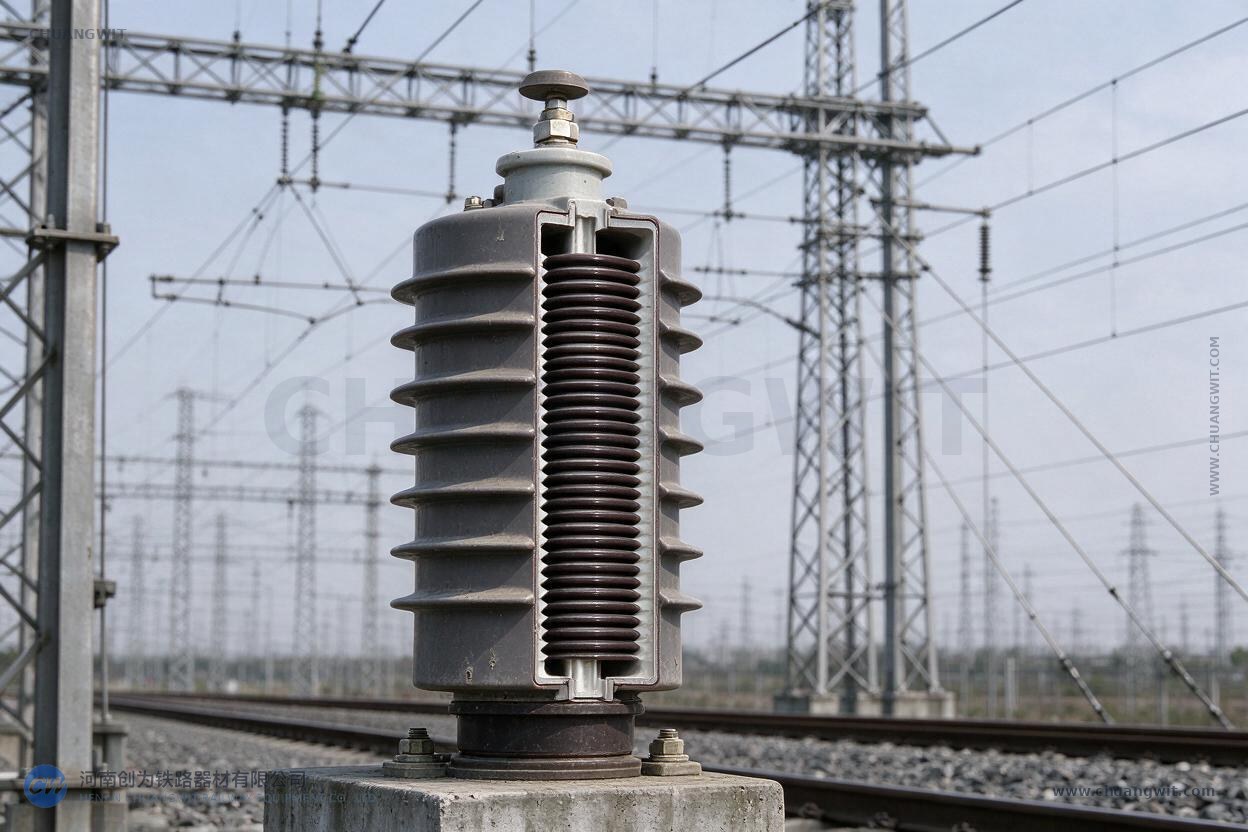
A metal oxide varistor (MOV) arrester is a gapless surge arrester whose active element is a column of zinc oxide (ZnO) varistor blocks. At service voltage the column conducts only a small leakage current; when a surge arrives it switches within microseconds into a heavily conducting state, clamping the voltage and absorbing the surge energy. Gapless metal-oxide arresters are the current standard on railway overhead contact systems.
Key Takeaways
- An MOV arrester connects the varistor column permanently between conductor and earth, with no series gaps and no sparkover timing to manage.
- The ZnO blocks act through grain boundaries whose conduction is highly nonlinear: near-insulating at service voltage, strongly conducting under surge.
- The Y5WT-42/120 catenary class to GB/T 11032 carries a 5 kA nominal discharge class, a 600 A 2 ms square-wave withstand and 1600 mm of creepage, for -40 to +70 degrees Celsius service.
- Housing failure anatomy differs: porcelain housings shatter with burst risk, while polymer housings slip and track, a distinction the comparison below unpacks.
- IEC 60099-4 defines classification and line discharge duty; TB/T 1844 with Modification No.1 aligned to GB 11032-2020 governs the Y5WT and Y10WT-42/120 series in use on catenary.
How does a metal oxide varistor arrester work?
The operating principle is a permanent connection with a nonlinear valve. One terminal of the varistor column ties to the phase, the catenary or the feeder, and the other to earth. In normal service the column behaves almost as an insulator, carrying only a small leakage current, so the arrester stays effectively invisible to the power system.
When a lightning or switching surge lifts the voltage, the resistance of the column collapses and the arrester becomes the preferred path to earth for the surge current. The voltage across the terminals settles at the residual voltage, the protective level the surrounding insulation must withstand, and when the surge passes the column recovers its insulating behaviour without any arc extinction, because no arc was struck. The meaning of that clamped voltage, and how it is coordinated with insulation, continues in our companion article on arrester residual voltage.
What is inside a zinc oxide varistor block?
A varistor block is a ceramic: zinc oxide grains sintered with additives into a dense body, with electrodes on the faces. Conduction happens at the grain boundaries, which behave like back-to-back semiconductor junctions. At low voltage those junctions block; once the field across them passes a threshold, they conduct copiously, and because enormous numbers of boundaries act in series and parallel through the body, the transition is sharp and the energy absorption large.
The practical consequences follow from the microstructure. The voltage at which the block switches scales with the number of grain boundaries in series, so blocks are stacked in a column to reach the system voltage; the cross-section sets the current and energy capability. The height of the column and the quality of the blocks are what the rating sheet ultimately describes.
Manufacturing controls the spread of those properties. Pressing uniformity, sintering profile and additive chemistry decide how sharply the column switches and how evenly the blocks share voltage; a column is only as good as its weakest block, because the units sit in series electrically and mechanically stacked. This is also why blocks from different production batches are not freely mixed in a rebuild: matching the voltage-current characteristic keeps the stress shared as the designer intended.
Why did gapless MOV designs replace gapped arresters?
Older arrester generations put spark gaps in series with silicon carbide resistor elements: the gaps fired at a set sparkover voltage and the resistor limited the follow current until the arc extinguished at a current zero. That architecture carried three burdens: sparkover scattered with surge front steepness, follow current arced inside the housing, and parts wore with every operation.
The metal-oxide column removed all three at once. Because it conducts continuously but minimally at service voltage, no gaps are needed, no follow current arc exists, and the protective level is set by the residual voltage characteristic instead of a statistical sparkover. That tight, repeatable clamping is precisely what modern insulation coordination exploits, and it is why gapless metal-oxide arresters are the current standard on railway OCS.
The gapless architecture also changed maintenance. A gapped arrester degraded visibly through its gap behaviour; a gapless arrester degrades quietly through its leakage and reference voltage, so test regimes built around gap inspection had to evolve into electrical measurement programs. The arrester counter, where fitted, tallies heavy discharges and gives the maintenance planner a history to read between outages.
Polymer housed or porcelain housed: how does each fail?
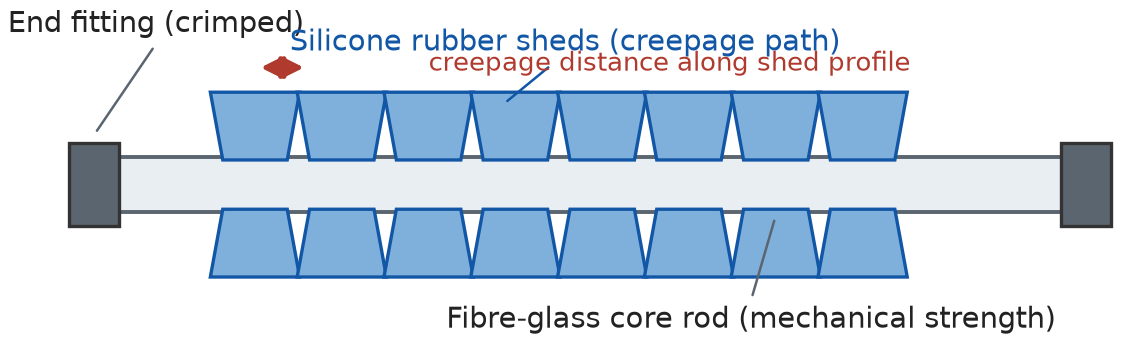
The varistor column is sealed in a housing, and the housing decides the failure anatomy. A porcelain housing is rigid and long-proven, but when internal energy overloads pressurise it, it can shatter, and fragments fall on the structure below, which is why porcelain designs carry pressure-relief arrangements. A polymer housing does not shatter: it tends to slip, track and vent its failure along sheds and interfaces, containing the debris better while demanding attention to interface quality and sealing.
Both housings meet the same electrical requirements for traction service; the choice runs through installation environment, overpressure behaviour and maintenance philosophy, as our comparison of composite versus porcelain arresters works through. For 25 kV catenary duty specifically, the Y5WT-42/120 porcelain-housed class and its polymer alternatives follow GB/T 11032.
Housing choice also interacts with the varistor column itself, because polymer designs can press the sheds directly onto a pre-assembled column while porcelain designs seal the column inside a rigid shell; both routes are proven, and both put the long-term verdict on interface sealing rather than on day-one electrical performance.
What ratings define an MOV arrester for 25 kV catenary?
Four ratings do most of the specifying work. The nominal discharge class anchors the protective level; the square-wave withstand indicates switching surge energy capability; creepage sets pollution performance; and the temperature envelope must cover the line climate. The table lists the verified envelope of the reference class.
| Parameter (unit) | Y5WT-42/120 value | Basis |
|---|---|---|
| Nominal discharge current class (kA) | 5 | GB/T 11032 |
| Square-wave withstand (A, 2 ms) | 600 | GB/T 11032 |
| Creepage distance (mm) | 1600 | GB/T 11032 |
| Service temperature (degrees Celsius) | -40 to +70 | GB/T 11032 |
Source: verified product data for the Y5WT-42/120 porcelain-housing metal-oxide surge arrester built to GB/T 11032; series classes per TB/T 1844 with Modification No.1 aligned to GB 11032-2020; duty framework per IEC 60099-4.
Selection between the Y5WT and Y10WT-42/120 classes on 25 kV catenary, including disconnector-equipped versions, is mapped in our railway surge arrester selection guide; the wider design of shielding and earthing is covered in our catenary lightning protection overview, and field identification of arresters appears in our metro OCS component identification atlas.
Installation quality decides whether the ratings survive contact with the field. The earth connection must be short and of low resistance, the line lead should not add avoidable inductance, and the mounting must keep the housing clear of surfaces that puncture or hold water. On the OCS, arresters sit at feed points, at section boundaries and at locations the lightning exposure study flags, and every one of them is only as good as its connections.
Frequently Asked Questions
How does a metal oxide varistor arrester work?
Its column of zinc oxide blocks sits permanently between the live conductor and earth. At service voltage the blocks conduct only small leakage current; under a surge their grain-boundary conduction collapses the resistance, the column diverts surge current to earth, and the terminal voltage is clamped at the residual voltage. When the surge passes the blocks recover automatically, with no gaps and no arc to extinguish.
How does a surge arrester work?
It provides a path to earth that only exists when it is needed. In the gapless metal-oxide form standard on railway OCS, a varistor column is permanently connected but near-insulating at service voltage; a surge drives it into conduction, limiting the voltage across the protected insulation to the residual voltage, and it returns to insulating behaviour once the surge ends.
What is the purpose of a lightning arrester?
To keep surge energy out of the insulation of the system it guards. On a 25 kV catenary, arresters such as the Y5WT-42/120 class to GB/T 11032 clamp lightning and switching surges by discharging them to earth through the metal-oxide column, holding the terminal voltage at a level the insulators and clearances can withstand instead of letting a flashover decide the outcome.
When should a polymer housed metal oxide surge arrester be chosen?
When failure containment, weight or corrosion exposure outweigh the long service record of porcelain. Polymer housings do not shatter under internal overpressure, since they slip, track and vent, so they suit locations where falling fragments are unacceptable, while porcelain suits traditional installation and maintenance practice. Both housings meet the same GB/T 11032 electrical requirements for traction duty.
Specifying the Varistor, Not the Label
A metal oxide varistor arrester earns its place through physics that can be written in one line, a column that insulates at service voltage and conducts under surge, and through ratings that must be read together: discharge class, residual voltage, energy duty, creepage and climate envelope. The Y5WT-42/120 class to GB/T 11032 shows how those numbers arrive as a package on 25 kV catenary.
To match an MOV arrester class to the insulation and pollution environment of your line, talk to our engineering team.