The third rail is dangerous because it is an exposed, energised conductor sitting at track level, typically at 750 V DC on UK networks, live whenever its section is switched in and carrying currents that are lethal on contact. Unlike an overhead line at height, the conductor rail sits within reach of feet and hands, so the safety case rests entirely on clearances, protection covers and disciplined isolation procedures rather than on distance.
Key Takeaways
- The conductor rail is an exposed energised rail at track level, typically 750 V DC on UK third-rail networks, and it carries traction currents far beyond human withstand capability.
- EN 50122-1 permits a prospective touch voltage of only 120 V DC in normal long-term operation on DC systems and 60 V rms on AC, which shows how far above safe limits an energised conductor rail sits.
- Gaps at switches and level crossings interrupt the rail but never make it safe; sections remain live on either side and re-energise without warning.
- Protection covers, position relative to the running rails and platform-end rules are the physical barriers; isolation, earthing and permits are the procedural ones.
- Icing and debris compound the risk by forcing winter inspection and de-icing work close to energised hardware.
Why Is the Third Rail So Dangerous?
Danger comes from the combination of exposure, silence and level. Exposure, because the collecting face of a top contact rail runs uncovered toward the sky and even shielded orientations leave conductive surface within reach of someone who steps or reaches wrongly. Silence, because a DC conductor at 750 V gives no arc, no sound and no visible sign that distinguishes a live rail from a dead one; the third rail does not announce itself the way a lightning strike or a fault arc does. Level, because the hazard shares the ground plane with people, tools and steps, not the elevated domain of an overhead contact system (OCS).
The current seals the argument. A two-car set in the 1,500 to 1,600 kW class of Long Island Rail Road M7 and M9 units draws on the order of two thousand amperes at the 750 V DC level typical of UK networks, and the supply system is sized to deliver it. Human contact with the rail puts the body into a circuit that the protection system may not even register as a fault, because a person draws far less current than a train. That is why procedures, not protective relays, are the primary defence for people.
Standards quantify how little voltage a person tolerates. EN 50122-1, the European standard for electrical safety, earthing and the return circuit in railway fixed installations, permits a prospective touch voltage of just 120 V DC in normal long-term operation on DC systems, and its 2022 edition tables work with body impedance values around 1150 Ω when deriving limits. A 750 V DC conductor rail exceeds the permissible touch voltage by roughly a factor of six, which is the arithmetic behind every rule that follows.
What Voltage Does the Third Rail Carry?
The typical UK third-rail network runs at 750 V DC, and that figure is the anchor for every clearance and procedure on such systems. The number looks modest beside the 25 kV AC of an overhead line, but the comparison misleads: at the lower voltage the same power moves at far higher current, current is what stops hearts and starts fires at the contact point, and the energy available at the rail face is enormous. Voltage class also frames what counts as a safe installation elsewhere in the circuit, where EN 50122-1 allows 60 V rms on AC and 120 V DC as long-term touch limits, with brief workplace exceedance to 50 V AC and 120 V DC only under defined conditions.
| Quantity | Value | Standard or basis |
|---|---|---|
| Third rail system voltage | 750 V DC | Typical UK third-rail network |
| Permissible touch voltage, AC systems | 60 V rms | EN 50122-1, normal operation |
| Permissible touch voltage, DC systems | 120 V | EN 50122-1, normal operation |
| Workplace short-term thresholds | 50 V AC / 120 V DC | EN 50122-1, defined conditions |
| Example body impedance in limit derivation | 1150 Ω | EN 50122-1:2022 tables |
Source: EN 50122-1 for touch voltage and impedance values; industry references for the 750 V DC third-rail level and M7/M9 power class.
Return circuit design is the quiet half of the voltage story. The running rails carry the traction return on a third-rail line, and their potential relative to earth must stay inside the touch voltage limits above, which is why bonding, impedance control and earthing receive so much design attention. The same discipline governs OCS installations, and our articles on earthing switches for safe working and catenary lightning protection and earthing design cover the equipment families that make it physical.
What Clearances and Physical Protections Exist?
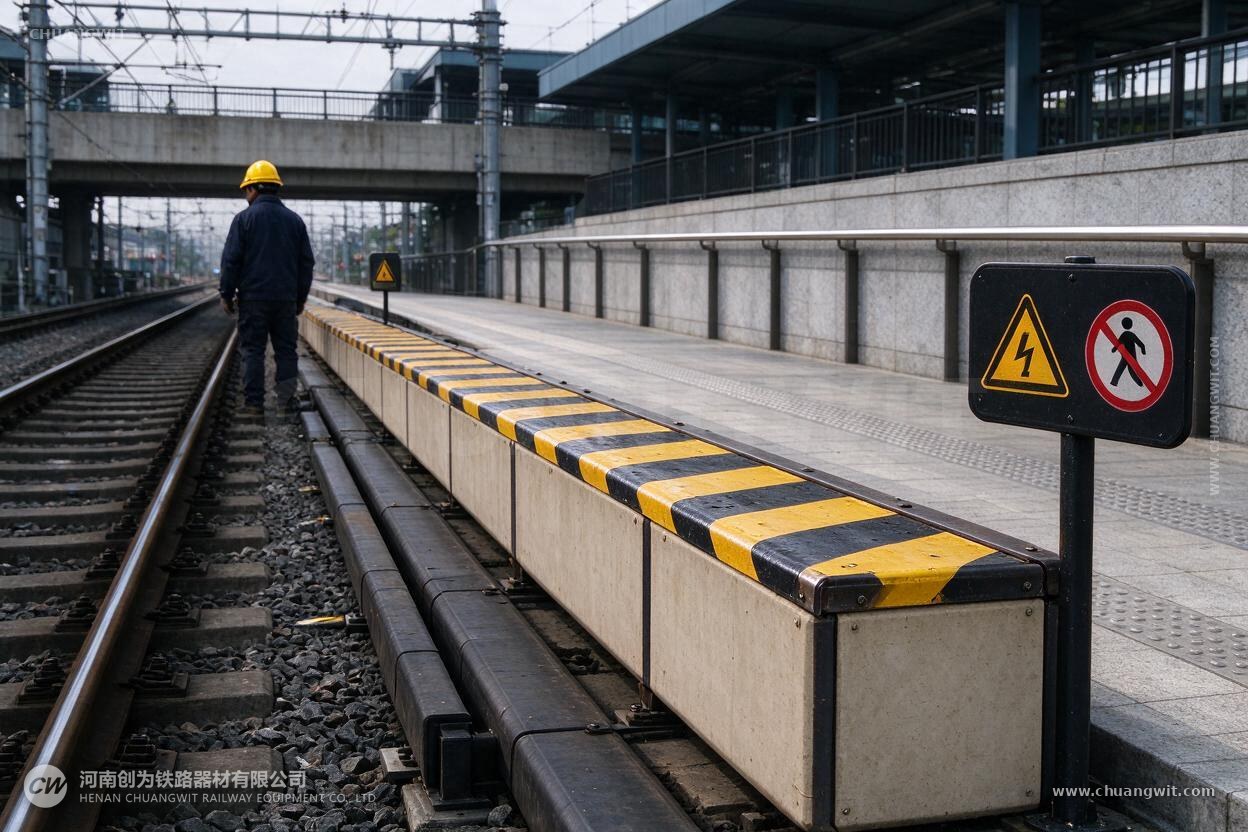
Physical protection starts with position. The conductor rail is mounted at a defined lateral offset from the running rails so that a person walking between the rails, or standing in the corridor between tracks, stays outside the reach envelope, and trackside walkways are routed on the safe side wherever the geometry allows. Protection covers then enclose the rail along public and staff exposure zones, converting an open energised surface into a guarded one, and platform ends carry additional shielding because that is where people and dropped objects converge with the rail.
Clearances extend to the interfaces. Level crossings interrupt the rail by rule, switches interrupt it by geometry, and the ramps at those gaps are engineered so the dead zone stays short and defined; the safety teaching that matters is that a gap is never an invitation, since the sections on either side remain live and the rail re-energises without any signal at the trackside. Signage, track circuit indications and access control close the loop by keeping people out of the envelope before proximity becomes contact.
Housing the rail entirely is the strongest version of this approach. Fully enclosed conductor rail systems wrap the energised surface in a protective cover along its length, an arrangement described in our article on the steel-aluminium composite contact rail for enclosed light rail, and they trade installation complexity for a hazard that is fenced rather than merely managed.
How Do Maintenance Workers Stay Safe?
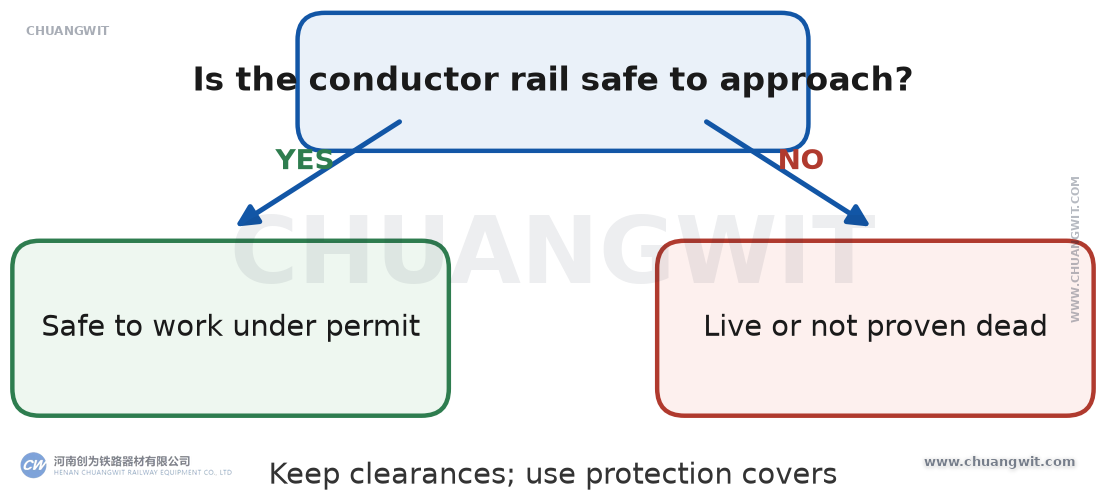
Procedure carries what hardware cannot. Work on or near the conductor rail begins with isolation: the feeding section is opened at the substation, the isolation is proved, and the section is earthed so that any re-energisation or induced charge has a safe path rather than a person. Only then does a responsible person issue the permit that lets staff enter the envelope, and the permit dies the moment conditions change. On the OCS side of the industry the same logic is executed with dedicated earthing switches, equipment our article on safe working earths explains in detail, and the principles transfer to DC installations without modification.
Winter adds its own regime. Icing on the contact surface threatens collection reliability, so inspection and de-icing runs concentrate maintainer attention on the rail exactly when conditions are worst, and those operations are planned under the same isolation discipline as any other access. The failure modes that motivate the work are described in our companion article on common third rail problems.
How Does Third Rail Risk Compare With Overhead?
The hazard profiles are mirror images. The OCS places its danger high, at 25 kV AC, where clearance and structure gauge keep people separated by geometry and where inadvertent approach by plant or people is guarded by elaborate procedures; the third rail places a lower but still lethal voltage at ground level, where separation is only as good as the covers, offsets and discipline around it. Neither system is forgiving, and both are governed by the same EN 50122-1 touch voltage philosophy at the accessible surfaces of the return circuit. Our comparison article on third rail versus overhead catenary works through the engineering trade-offs that follow from the two positions.
Public behaviour completes the picture. Trespass, retrieval of dropped items and photography near platform ends are the recurring scenarios in third-rail incidents, which is why operator communications repeat a simple rule: treat every rail as live, every gap as still dangerous, and every clearance instruction as literal. Engineers design for the person who does not know the system; everyone else has to operate as if the design were the only thing standing between them and the circuit.
Frequently Asked Questions
Is the third rail dangerous?
Yes. The third rail is an exposed conductor at track level, typically 750 V DC on UK networks, energised whenever its section is fed and carrying currents far beyond human withstand. EN 50122-1 permits only 120 V DC as a long-term touch voltage on DC systems, so the rail sits roughly six times above the permissible limit and must be treated as lethal at all times.
Why is the third rail dangerous?
Three conditions combine: the rail is exposed rather than insulated, it sits within reach at ground level rather than overhead, and a DC energised rail gives no visible or audible warning of being live. Contact puts the body into a high-current circuit that protection systems may not detect, so clearances, covers and isolation procedures, not relays, are the actual defence.
Can the third rail kill you?
Yes. Contact with a conductor rail at the typical UK level of 750 V DC drives a current through the body that exceeds fatal thresholds by a wide margin, and the supply behind it is sized for trains, not people. EN 50122-1:2022 works with body impedance values around 1150 Ω when deriving far lower permissible touch voltages, which indicates how little of the rail voltage a person can safely experience.
What happens if you touch the third rail?
The rail voltage drives current through the body across the contact path, causing severe electric shock, deep burns at the contact points and a real risk of cardiac arrest, and a person bridging rail to grounded structure completes a circuit the traction supply can sustain. This is why the operating rule is absolute: never enter the conductor rail envelope, and treat every rail and every gap as live.
Working Safely Around the Conductor Rail
Third rail safety is layered on purpose: position keeps people out of reach, covers guard what position cannot, isolation and earthing make work possible, and training keeps the layers intact under pressure. Respect all four and the system runs as quietly as any electrified railway; skip one and the arithmetic of 750 V DC against a 120 V touch limit explains the rest. For OCS projects, Chuangwit manufactures section insulators, disconnectors, arresters and fittings to the relevant TB/T families, and our engineering team answers questions on their application.