A third rail gap is a deliberate interruption of the conductor rail at a switch, crossing, level crossing or feeding boundary. Trains keep power through short breaks because several collector shoes along the train are energized at different moments, and momentum carries the train through longer ones; at level crossings the rail dives under insulated gap boards. Collection stays practical only to about 160 km/h, so gaps are a permanent, managed fact of third-rail life.
Key Takeaways
- Gaps exist for mechanical clearance at switches, for road surfaces at level crossings, and for electrical sectioning at feeding boundaries.
- A train bridges short gaps because collector shoes on different cars contact the rail at different times; longer gaps are coasted through on momentum.
- End ramps guide the shoe onto and off the rail; ramp wear and entry arcing are top maintenance items.
- The practical speed ceiling of third-rail collection is about 160 km/h, with a verified record of 175 km/h set by a British Class 442 in 1988, which is why gap dynamics stay manageable.
- A typical UK third-rail network runs at 750 V DC; every gap is also an electrical section boundary to be respected in isolation planning.
- On overhead systems the same jobs are done by section insulators per EN 50406 and by neutral sections at phase boundaries.
Why does the third rail have gaps at all?
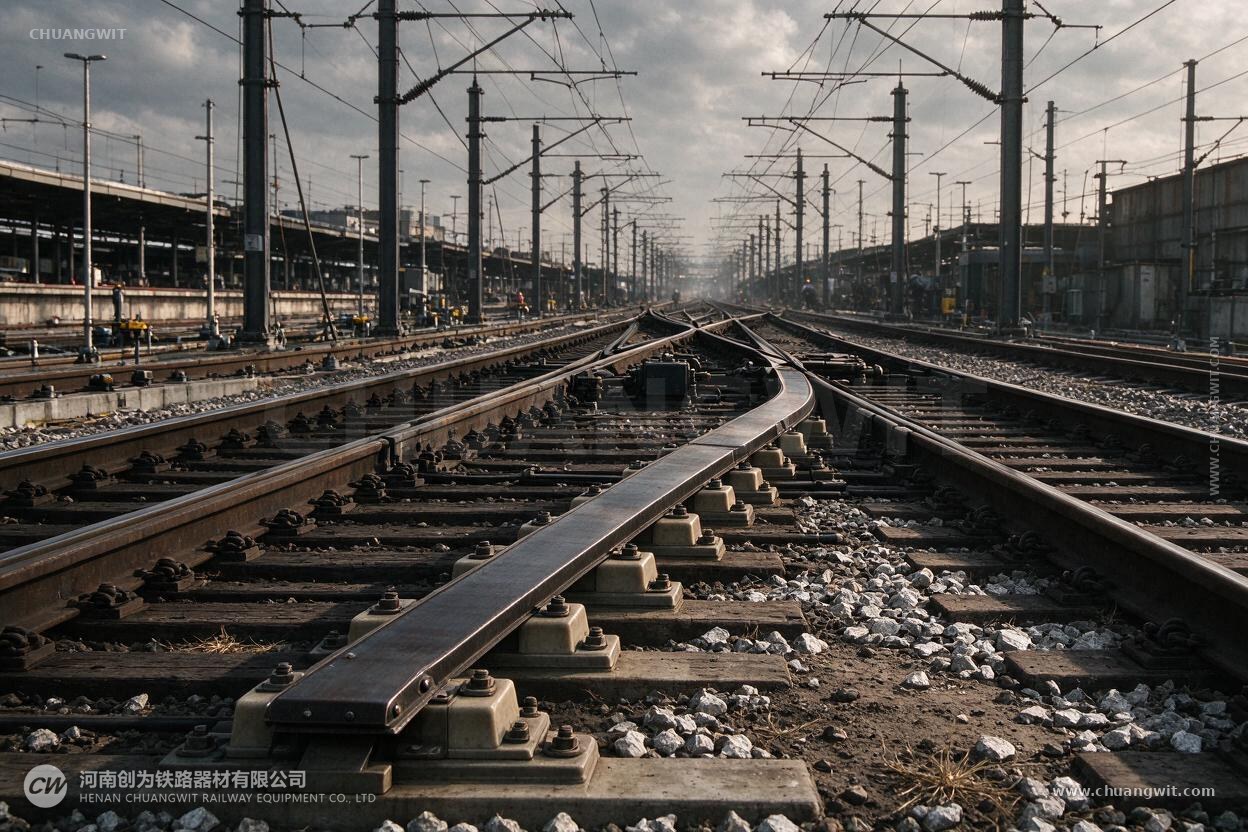
Track geometry forces the first family of gaps. At switches and crossings the conductor rail must move from one side of the track to the other so the shoe can follow the route the train takes, and the moving rails and flangeways of a turnout leave no room for a continuous conductor. The rail therefore breaks, ramps down, transfers across, and ramps up again on the far side.
Road surfaces force the second family. At level crossings the conductor rail cannot rise through the road, so it is interrupted and passed under insulated boards that carry the road load while keeping the rail protected at vehicle level. Electrical sectioning forces the third: feeding sections end in deliberate breaks so that substations, depots and fault zones can be switched independently, exactly as overhead lines use section insulators, the components that subdivide an overhead contact line into separately fed sections under the EN 50406 standard family.
Thermal and structural movement adds a quieter family of breaks. Long conductor rail runs expand and contract with temperature, so joints and occasional breathing gaps absorb the movement, and structures such as bridges and viaducts introduce movement joints of their own. These breaks are short and routine, but they belong on the same survey maps as the big functional gaps, because shoes cross them just the same.
How do trains stay powered across a gap?
The answer is shoe arithmetic. A multiple unit carries shoes on several cars, and on double-rail stretches the two conductor rails are gapped at staggered points, so the probability of every shoe sitting in a dead zone at once is engineered to be small. While any shoe rides energized rail, the whole train stays fed through its line connectors.
Long gaps are handled by physics instead. The train enters the break at speed, coasts through it, and collects again on the far side; the operating rule that matters is that trains must not stop where all shoes would land inside a dead section, because restarting from standstill without power is then impossible. Gap positions are therefore marked and briefed, and signallers protect them in disturbed running.
The whole scheme only works at moderate speed, which is the real ceiling on the method: collection is practical to about 160 km/h, and the verified record of 175 km/h by a British Class 442 in 1988 marks the edge. At overhead-line speeds the physics of shoe impact and arcing at ramp entry stop cooperating, which is one reason fast railways collect from above, as explained in where third rail systems exist and why.
Formation and coupling discipline complete the picture. Operating rules specify minimum formations through long gaps so a failed or uncoupled unit cannot strand itself with every shoe inside a dead zone, and driving policy keeps trains moving through marked breaks. Where a stop inside a long gap is unavoidable, recovery procedures account for the missing collection rather than assuming power is available.
What are end ramps and why do they matter?
Every gap ends in a ramp, an inclined section that lifts the shoe onto the rail or lowers it off. The ramp takes a beating: the shoe arrives with the train mass behind it, slams down the incline, and arcs at the moment contact makes or breaks. Ramp faces therefore show wear first, and their geometry, measured as rise over length in millimeters, is a standing item in the survey routines of the third rail maintenance guide.

Worn ramps degrade two things at once. The train experiences harder shoe impacts and more arcing, which erodes both ramp and shoe; the electrical system sees more interruption events, which disturb feeding and signaling. Renewing a ramp is cheap compared with the cascade it prevents, and ramp bolts that need endless re-torquing are the usual signal that geometry is gone.
What happens at level crossings?
The conductor rail approaches the crossing, ends in ramps, and the road surface itself is carried by insulated gap boards spanning the break. The boards must hold vehicle load, shed water, and keep every energized edge out of reach, which makes the cover-and-board interface a safety-critical assembly rather than furniture; materials and support practice are covered in third rail protection covers.
Crossings are also where foreign objects and moisture concentrate, from road salt to dropped cargo. Inspection therefore focuses on board integrity, drainage under the break, and the condition of the ramps on both approach sides, because a crossing gap that floods or fouls turns a managed break into an arcing source.
Drainage design around the boards decides winter behavior. Melting snow and road runoff collect in the break if they have nowhere to exit, and ice then loads ramps and boards that were designed for water, not for a frozen block. Inspection after cold snaps targets exactly that condition.
How do switches and crossings change the conductor rail layout?
Through a turnout, the conductor rail follows the shoe path: it continues on the straight, throws a transfer section across, and resumes on the diverging route, with gaps wherever the moving rails pass. The shoe itself transitions from one rail to the other mid-turnout, which demands precise alignment of the ramp ends on both sides. A crossing set at speed is a sequence of brief interruptions, staggered so the train never loses all collection at once.
The overhead world solves the identical problem in the opposite direction: at turnouts, crossing bars and contact wire crossings guide the pantograph through, as described for OCS crossings at turnouts, and at electrical boundaries neutral sections handle phase separation on 25 kV lines, covered in the neutral section insulator guide. The engineering problem, keeping collection continuous while the conductor changes hands, is the same; only the altitude differs.
What collection context should gap design assume?
| Characteristic | Value | Unit | Reference |
|---|---|---|---|
| Practical speed ceiling of third-rail collection | about 160 | km/h | Third-rail operating references |
| Verified collection speed record | 175 | km/h | British Class 442, 1988 |
| Typical UK third-rail network voltage | 750 | V DC | UK third-rail operating practice |
| Overhead section insulator standard family | EN 50406 | standard | EN 50406 |
Source: verified third-rail operating references (UK network practice at 750 V DC; British Class 442 record run of 1988); EN 50406 for the overhead section insulator family.
Frequently Asked Questions
How does third rail power work?
The conductor rail, typically at 750 V DC on networks such as the UK system, delivers traction power to collector shoes mounted on the train bogies. Return current flows through the running rails. End ramps guide the shoe on and off the rail, and deliberate gaps at switches, crossings and section boundaries interrupt the rail where clearance or sectioning demands it.
How do third rail trains work?
Shoes on the bogies slide along the conductor rail and feed onboard traction equipment at DC voltage. Multiple shoes along the train bridge short interruptions in turn, and momentum carries the train across longer gaps. Because collection is practical only to about 160 km/h, the method is concentrated in metros and dense suburban networks.
How do overhead power lines work on trains?
The pantograph on the roof presses a carbon strip against the contact wire, which hangs from a messenger wire in the overhead contact system. Trains draw power at line voltage, and the pantograph follows the wire through stagger and gradients. Section insulators and neutral sections manage the electrical breaks, the overhead equivalent of conductor rail gaps.
How does electrified rail work?
A traction supply feeds either an overhead contact system or a conductor rail at track level, and trains collect current through a pantograph or collector shoes. Substations feed the line in sections that can be switched independently. The running rails, or a dedicated return rail in four-rail systems, carry the current back.
Working With Gaps Instead of Against Them
Gaps are not defects in a third-rail system; they are its punctuation. Respect them in design by ramp geometry and stagger, in operation by keeping trains out of dead sections, and in maintenance by treating ramps, gap boards and drainage as first-class assets. Systems that manage gaps well run quietly; systems that neglect them arc, stall and delay.
Our scope is the overhead side of the same collection problem: section insulators that subdivide the contact line, including 25 kV FYFH units built to TB/T 3036-2016 and DC 1500 V urban rail models built to TB/T 3252-2022. If your gap and sectioning questions extend upward from the conductor rail, contact our engineering team.