Every switching point on a traction or distribution network is a purchasing decision disguised as an engineering one. Choose a circuit breaker where a load switch would do, and the project pays for interrupting capacity it will never use, in a panel that may not need it. Choose a load break switch where a breaker belongs, and the first fault finds equipment that cannot clear it. Choose either one where the duty is pure isolation, and the maintenance staff still lack the visible gap their procedures require. The load switch vs circuit breaker vs disconnector decision therefore deserves the same rigour as cable sizing.
The good news is that the decision collapses onto a small set of questions: what current must this point switch in normal service, what current must it interrupt in anger, and what must it show to a person working beyond it. This article turns those questions into a capability ladder, examines the combinations that stretch a load switch into breaker territory, and closes with a decision table mapping common railway and distribution applications onto the right device.
The capability ladder
A disconnector occupies the bottom rung. It carries current, withstands faults, and provides a visible, inspectable air gap for isolation; it breaks nothing beyond negligible charging current, and its operating interlocks exist to keep it away from load. A load switch, or switch disconnector, occupies the middle rung: with an interrupter sized for the duty, it makes and breaks load current, switching transformers and line sections under control, but a bare load switch cannot clear a short circuit. The circuit breaker takes the top rung, making, carrying and breaking both load and fault current, as often as protection demands.
Each rung up the ladder buys interrupting capability at a price in mechanism energy, tank design, testing and cost. The selection art is buying the rung the duty requires, no more and no less. A representative middle-rung device is the FN12-12 indoor high-voltage load switch, rated 12 kV and 630 A with vacuum arc extinction and a mechanical life of 10,000 operations: precisely the specification needed for routine switching duty where fault clearance is delegated elsewhere.
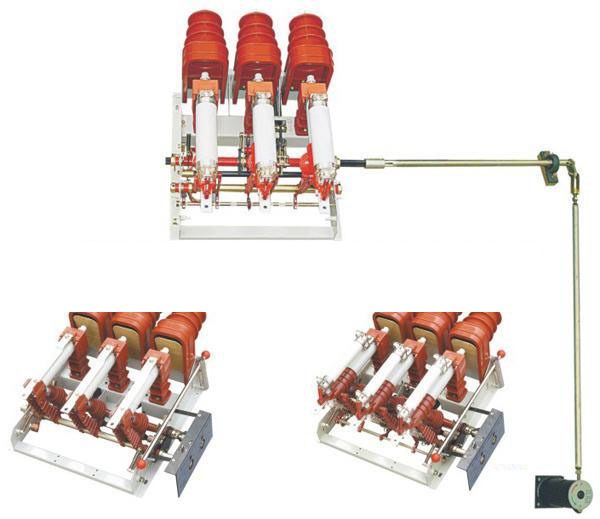
The load switch plus fuse combination
The classic way to give a load switch fault-clearing teeth is to put a fuse in series. In the combination, the load switch performs all routine switching, while the fuse element melts and clears any current beyond the switch capability. Coordination is built into the components: the fuse operates fast on high currents, protecting the switch and the circuit, and the switch handle trips open when a fuse operates, so the failed phase never sits half-switched.
The trade-offs are well understood. A fuse-switch clears one fault, then needs a replacement element and often a crew visit before restoration; a breaker clears and recloses many times over. A fuse gives no selectivity settings, no remote indication and no timed grading, so in networks where coordination matters, breaker protection wins. Where those limitations are acceptable, in small transformer feeders and remote distribution points, the combination delivers most of the protection at a fraction of the breaker cost, and its one-shot behaviour is perfectly matched to equipment that needs inspection after a fault anyway.
Integrated units: three functions in one tank
Space is often the deciding constraint indoors. A station switchboard that must switch a transformer, isolate it and earth it ahead of work needs, in principle, a load switch, a disconnector and an earthing switch, three devices and the panel length to hold them. Integration collapses all three into one unit. The FZN25-12 indoor vacuum load switch integrates the disconnector, load switch and earthing switch functions in a single 12 kV, 630 A unit, and its FZRN25 composite variant adds the fuse that provides short-circuit breaking capability, turning the same envelope into a complete protected bay.
Integration does more than save panel space. It shortens the interlock chain, because the sequence between switching, isolation and earthing is enforced inside one device instead of across three, and it removes the field wiring between separate units, along with the installation errors that wiring invites. For compact switchboards in stations, depots and industrial supply rooms, the integrated unit is frequently the rational choice even before the cost comparison.
Outdoor disconnecting load switches
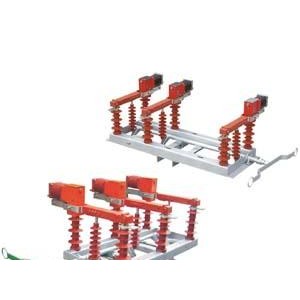
Outdoors, on a pole or a trackside bracket, the requirements merge differently: the point must switch load current, survive the weather, and still show a visible gap for isolation. The FZW32-12 outdoor high-voltage disconnecting vacuum load switch answers exactly this duty, combining vacuum load switching with a disconnecting function in an outdoor-rated 12 kV, 630 A package with a 10,000 operation mechanical life. Where a remote distribution point on the 10 kV or 12 kV network needs local switching plus a provable break, the alternative is a full breaker plus separate disconnector, and the load switch frequently wins on both cost and footprint.
A decision table for common applications
| Application | Recommended device | Reason |
|---|---|---|
| Maintenance isolation point | Disconnector, with earth switch | Visible gap, low cost |
| Station auxiliary transformer | Load switch plus fuse | Fault clearance, low cost |
| Ring section switching | Load switch | Load duty only |
| Compact indoor bay | Integrated switch unit | Space and interlocks |
| Remote pole distribution point | Outdoor disconnecting load switch | Switching plus visible break |
| Feeder outlet, high fault duty | Circuit breaker plus disconnector | Repeated fault clearance |
Treat the table as the first pass, not the last word. Protection philosophy can promote any row upward: a point destined for automation, remote reclosing or selective grading with upstream relays argues for a breaker regardless of the bare switching duty, because those functions need a device that can interrupt repeatedly on command.
Cost, footprint and protection trade-offs
On first cost, the ladder is steep: a disconnector is cheap because it is simple, a load switch costs more because it adds an interrupter, and a breaker costs most because it adds an interrupter, a stored-energy mechanism and a control chain. Footprint follows the same gradient indoors, which is why integrated units exist. Lifetime cost complicates the picture in both directions: fuse combinations consume elements at every fault, while breakers consume maintenance attention to mechanisms and control circuits, and an under-specified load switch at a faulted point can consume far more than either in outage time.
Protection capability is the dimension where no substitution works. A breaker participates in graded, selective, remotely supervised protection and restores itself after each operation. A fuse combination protects absolutely but bluntly. A disconnector protects no one and isolates everyone, which is exactly why it appears in every scheme regardless: the breaker or switch clears, and the disconnector makes the clearance safe to work behind. For help applying this selection logic to a specific feeding or distribution scheme, our engineering team reviews duty statements and proposes the switching devices that match them.