When a catenary mast is knocked down, the railway it supported stops. A road-bridge strike, a derailed vehicle, a flood-weakened foundation or a storm that folds a lattice tower onto the wiring leaves an overhead contact system (OCS) without geometry at exactly the point where traffic demands restoration. Every hour of outage accumulates delay across the timetable, so the first priority of recovery is not elegance; it is a safely supported wire through the damaged span, quickly.
The emergency repair mast exists for that purpose. They are deliberately not permanent structures: they are lightweight, bolt-together posts that a small crew can erect on short notice to carry the wiring at reduced duty until the permanent mast is rebuilt. Because they are aluminium alloy extrusions rather than galvanised steel fabrications, they trade ultimate load capacity for mass that trackside crews can actually move, and their mechanical limits define the temporary operating conditions of the section.
This article explains what an emergency repair mast must achieve, how the quick-erect designs work, what the standard models carry, how temporary operation is coordinated with speed restrictions, and how a route prepares through pre-positioning.
What the temporary mast must achieve
The immediate objective after structure damage is a stable wire geometry that a pantograph can traverse. The temporary mast must restore contact wire height and stagger through the affected span, hold the messenger and contact wire under their residual tension, and present registration that does not snag a passing pantograph at the restricted speed the incident commander will authorise. It must also be earthed: the fitted earthing terminal connects the post into the mast earthing and stray-current arrangement so the restored section is electrically coherent, not just visually upright.
Equally important is what the mast does not attempt. It does not replicate the full bending class of the permanent structure, it does not anchor a fresh tension length, and it is not left in service through seasons of weather. Treating it as a bridge, with defined limits and a defined exit, is what keeps the temporary installation safe.
Quick-erect mechanics: extrusions, bolts and small foundations
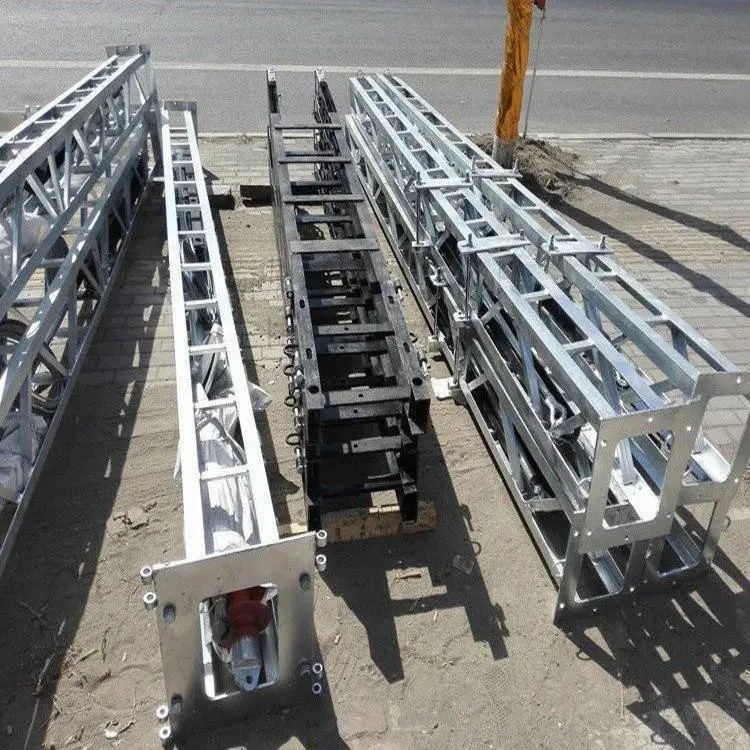
The design pattern across the standard models is consistent: 6063A aluminium alloy profiles in T6 temper, assembled as two-section bolted structures, with heights in the 8 to 9 m class that match typical catenary registration heights. At roughly 80 to 90 kg for the complete posts in this class, the sections are within reach of a small trackside crew without heavy plant, and the bolted joints mean that no welding, hot work or special tooling is needed at the point of use. Corrosion resistance is inherent to the alloy, so a cache of masts stored outdoors for years remains serviceable.
Foundations keep the same philosophy. The posts install by direct burial where soil allows, or onto a flange foundation or prepared ballast restraint where the site demands it, and the complete post erects as one piece. Temporary stays can supplement the base restraint where the span loads pull sideways, and the earthing terminal is bonded on erection, not later.
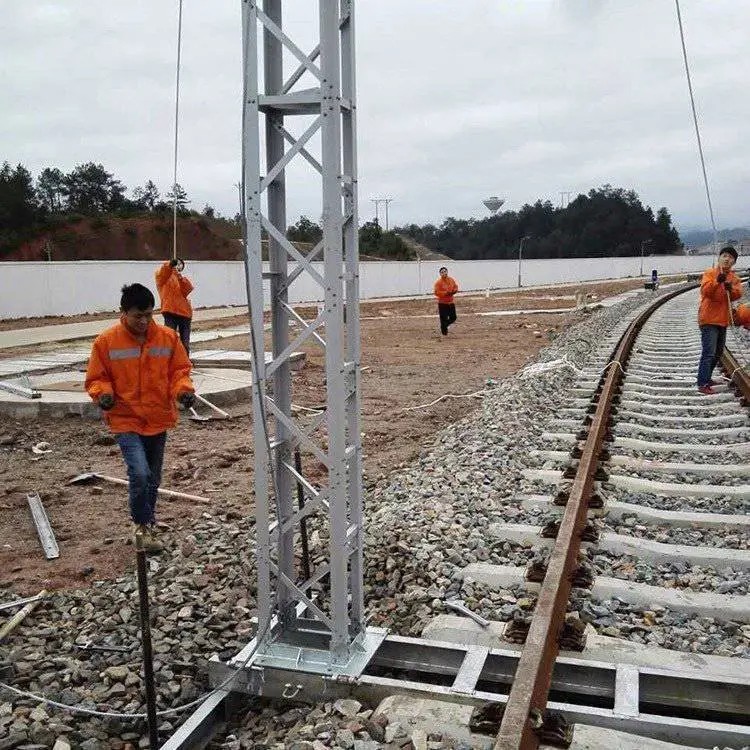
The erection sequence follows the hardware. With the traction supply switched out and earthed, the two sections are bolted together on the ground, the base is prepared by excavation or flange placement, and the assembled post is lifted upright and restrained in a single possession. Cantilever or temporary registration fittings are attached, the wiring is lifted or transferred into position, stagger and height are set against the adjoining undamaged spans, and the earthing strap is connected before anyone leaves the site. A crew drilled in the sequence treats each step as a checklist item, which is what turns an 8 m aluminium post into a restored section rather than a standing hazard.
Emergency repair mast models and load limits
Three models cover most requirements on 25 kV AC mainline and 1.5 kV DC metro systems. The TRP-8 aluminium alloy emergency repair post is the fixed-height workhorse: 8 m overall in a two-section bolted structure, with a working load of 2940 N, equivalent to 300 kg, and a large-end section of 350 x 250 mm. The LHSQT-I aluminium alloy emergency repair post declares its capacity as a bending moment: 22 kN·m at 8 m height, with a self-weight of 90 kg that keeps it crew-portable. The LQXT-8/9-30 generic aluminium alloy emergency repair mast generalises the concept, offering both 8 m and 9 m heights with a 30 kN·m capacity at a self-weight of approximately 80 kg.
The capacity figures deserve respect rather than optimism. A 22 to 30 kN·m moment class is a fraction of what a permanent intermediate mast carries, so span lengths between temporary supports must shorten, wind limits apply during and after erection, and any anchor or pull-off loads must be relieved rather than reproduced on the temporary post.
| Model | Height | Capacity | Self-weight |
|---|---|---|---|
| TRP-8 | 8 m | 2940 N working load | Not stated |
| LHSQT-I | 8 m | 22 kN·m | 90 kg |
| LQXT-8/9-30 | 8 or 9 m | 30 kN·m | Approx. 80 kg |
Coordinating temporary operation with speed restrictions
A restored span is not a normal span. Registration on an emergency post is simplified, the support point is less stiff than the permanent cantilever it replaces, and the dynamic behaviour of the wire under a fast pantograph changes accordingly. Standard practice therefore pairs the temporary installation with a local speed restriction, sized by the responsible engineer against the actual geometry achieved, the tension in the wiring and the duration foreseen for permanent repairs. Observation rides after restoration, and periodic re-inspection of the post, its base restraint and its earthing connection, confirm that the temporary arrangement is holding its settings.
Storm damage adds a coordination problem of its own: multiple structures down across a section. Here the value of standardised, interchangeable posts shows itself, because crews can work several sites with the same erection method, the same bolt tools and the same inspection checklist while the permanent recovery is planned in parallel.
Pre-positioning strategy along the route
Emergency masts only shorten outages if they are close when needed. Effective practice distributes caches at maintenance depots and selected intermediate locations so that the worst span on the route is within a defined response time, and each cache holds complete kits: posts, cross bolts, base restraints, earthing straps, temporary clamps and the tools that fit them. Storage audits and erection drills belong to the same budget as the hardware, because a crew that has not practised the two-section assembly will discover its questions in the rain, next to a live railway.
The exit plan is prepared as early as the erection. Permanent mast replacement, foundation repair and the reinstatement of full geometry proceed under normal engineering arrangements, and the emergency post returns to its cache once the rebuilt structure takes the load. Records of each deployment, including the loads observed and the restriction applied, feed back into where the next cache is placed.
Selection of cache contents follows the route profile: mast heights, wire tensions and the mixture of single and multi-track sections on the line. For help matching TRP-8, LHSQT-I or LQXT-8/9-30 units to a specific route, our engineering team advises on quantities, spacing and kit contents for depot-level stocking.