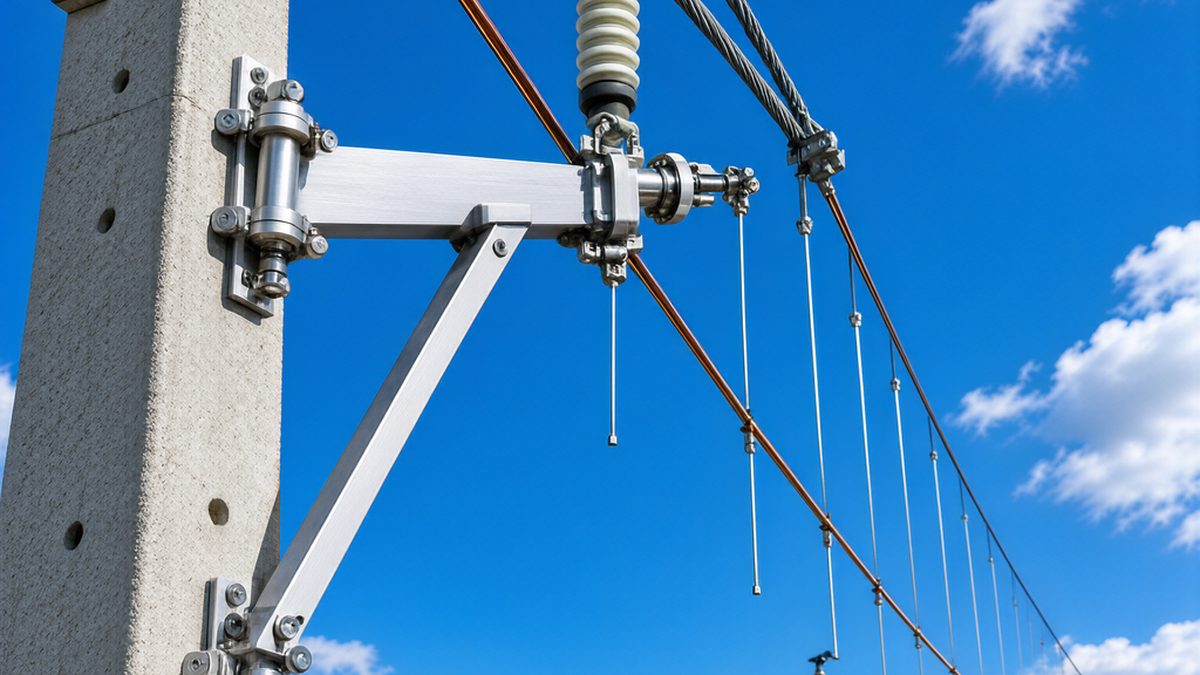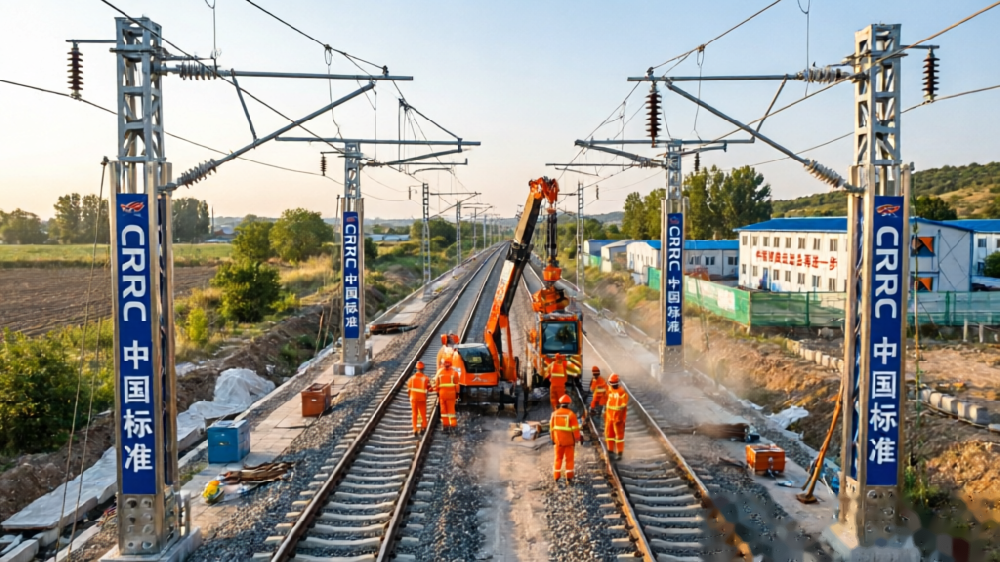
At just past 10 am on 7 August, at the construction site in Xuji Town, Yu’an District, Lu’an, Anhui, a crane slowly lifted an 8.5-metre steel column and set it firmly onto its base. This mast, weighing about 1.1 tonnes, is the first OCS pole erected on the Anhui section of the Hefei-Wuhan High-Speed Railway.
The OCS is the power line for high-speed trains, strung above the track at a voltage of 27.5 kV. A total of 5396 such masts will be erected along the Anhui section, and installing the first one means that power supply system construction has formally begun.
Tang Qingtao, project manager of the China Railway Electrification Bureau team responsible for on-site construction, said that erecting a mast looks simple but demands very high positioning accuracy: deviate the bolt holes even slightly and it will not fit. The project department prepared work instruction sheets in advance, ran through every step of transport, assembly and lifting several times, and kept management staff on site throughout to make sure it was done right first time.
The Hefei-Wuhan High-Speed Railway is part of the national Yangtze River corridor, with a main line about 360 km long and a design speed of 350 km/h; it starts from Hefei, passes through Lu’an and Jinzhai, enters Macheng and Hong’an in Hubei, and terminates at Wuhan. Nine stations are provided along the route, including Hefei South, Lu’an North and Jinzhai East. Once the line is completed there will be an additional high-speed corridor between Hefei and Wuhan, the rail network along the Yangtze will run more smoothly, and this will have real significance for travel and economic development along the route.
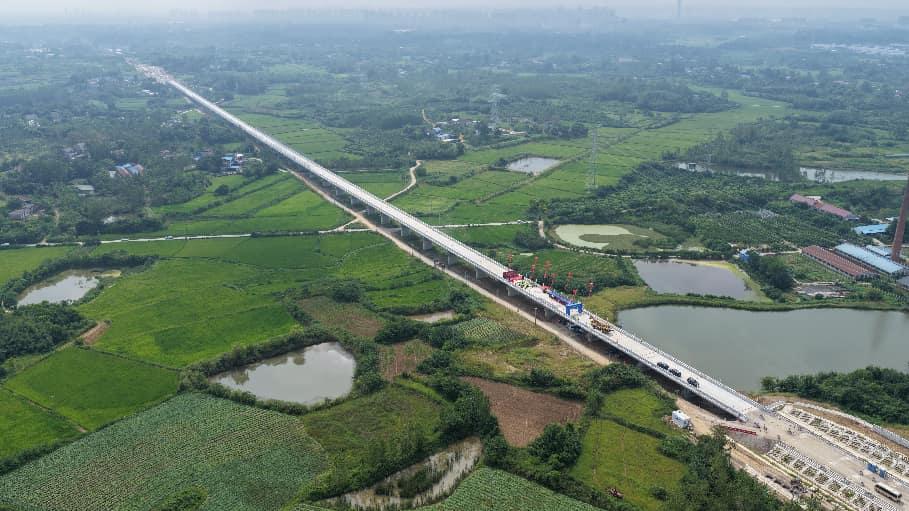
The Hefei-Wuhan High-Speed Railway has in fact seen considerable progress recently. Just one day before the mast was erected, in the early hours of 6 August, the continuous girder of the Zishuwan Baisha River mega-bridge on the Anhui section was closed. A month earlier, on 6 July, the first box girder of the project bringing the line into the Hefei hub was also successfully launched: that girder was 32.6 metres long and weighed 811.7 tonnes. From girder launching to mast erection the works have advanced step by step, with the civil works gradually wrapping up and electrification installation taking the stage.
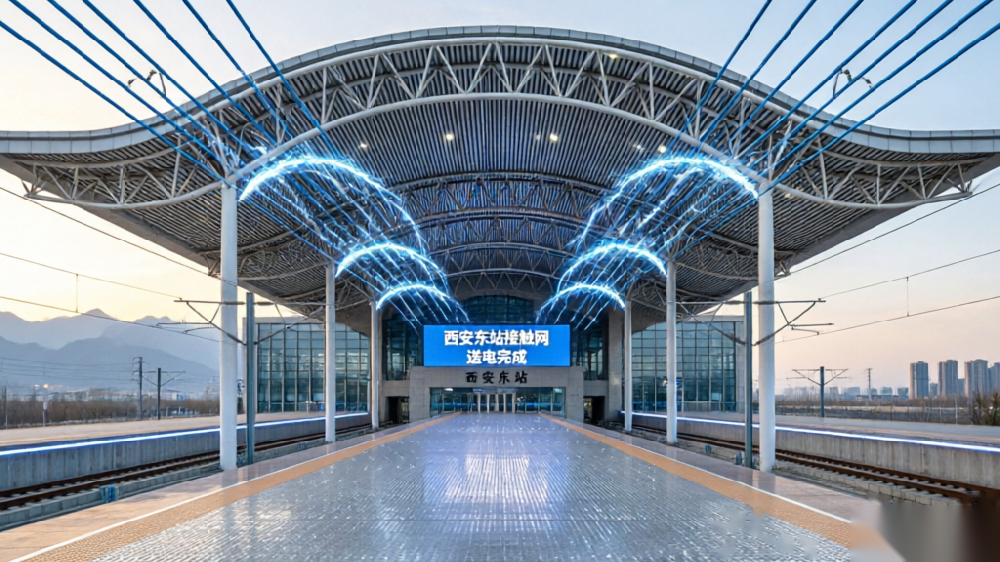
The raising of this OCS pole looks like an ordinary lifting operation on a construction site, but for the project as a whole it means a great deal. High-speed railway construction usually proceeds in two stages: first the “hard” parts such as subgrade, bridges and tunnels are completed, then the “soft” systems such as communication, signalling, power and OCS are installed. The OCS is the main framework of the power supply system, and once the first mast is up the project has formally entered the electrification construction stage. Next, more than five thousand masts will be arrayed in sequence along the Anhui section, holding up an overhead cable that supplies power to the trains.
The work ahead, however, is not easy. The Hefei-Wuhan High-Speed Railway runs through the Dabie Mountains, where the bridge and tunnel ratio is high and construction conditions are relatively complex. OCS masts must be erected on bridges, at tunnel portals and beside subgrade; each position has to be calculated precisely and every bolt has to be tightened properly. With more than 5000 masts along the whole line, erected one by one and installed section by section, there is no room for carelessness. OCS erection also involves work at height and high-voltage energisation, so the safety risk is considerable and both construction organisation and technical capability are put to the test.
Seen from a wider perspective, the Hefei-Wuhan High-Speed Railway is a key section of the Shanghai–Chongqing–Chengdu Yangtze corridor high-speed railway. The whole Yangtze corridor line runs west from Shanghai through Nanjing, Hefei, Wuhan and Chongqing to Chengdu, with a total length of more than 2000 km. The Hefei-Wuhan section sits right in the middle, connecting the Yangtze River Delta at one end and the middle Yangtze urban agglomeration at the other. Once this corridor is open, the flow of people and goods along the Yangtze will be smoother, and its role in driving the regional economy is self-evident.
At the current pace, the Hefei-Wuhan High-Speed Railway is scheduled to be completed and opened to traffic in June 2028. From the erection of the first OCS mast to the completion of commissioning of the whole electrification system there are still nearly two years to go. More than five thousand masts, each one a vital screw in this high-speed rail artery.
Source: Science and Technology Daily (www.stdaily.com), republished by this site; images have been localised and archived.