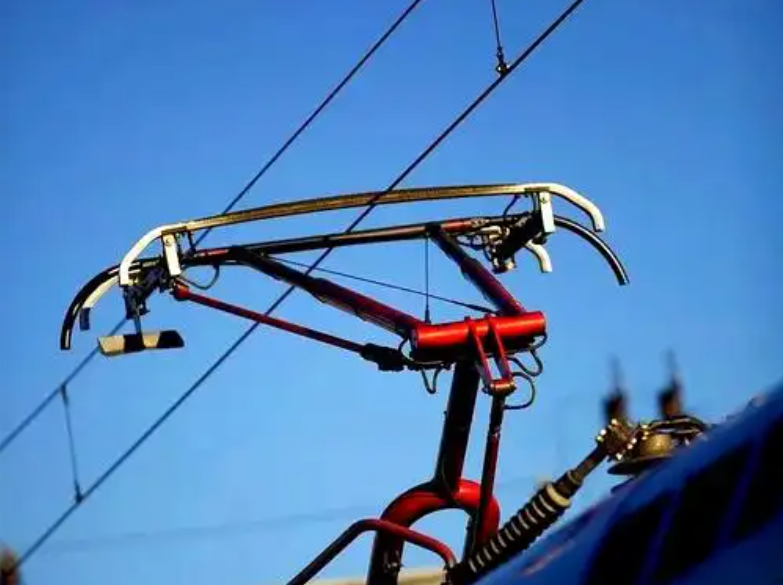
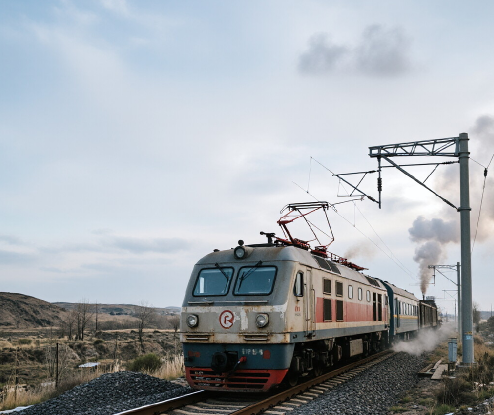
In the world of heavy-haul railways, the criteria for judging a traction power supply system are extremely plain and severe: can it withstand the impact of several thousand amperes while trains climb grades, and can it keep the pantograph-catenary relationship stable after hundreds of millions of tonnes of coal have rolled over the rails? This is especially true for coal-dedicated lines represented by the Daqin and Shuohuang railways, where trains routinely exceed 30 tonnes of axle load, run with double- or triple-headed locomotives, and draw traction currents at the 3000 A level.
This is the practical foundation on which the "high-tension reinforced catenary solution" exists.
1. Wear and Heating: The Double Stranglehold on Heavy-Haul Catenary
To understand this solution, one must first see the two core enemies faced by the contact wire on heavy-haul lines: intensified mechanical wear and current-carrying overheating that softens the conductor.
On ordinary lines, contact wire tension is usually maintained at 10-15 kN. For passenger-dedicated lines with higher speeds and smaller current draw, this stiffness is sufficient to guarantee smooth pantograph passage. But in front of a 20,000-tonne coal train, the situation is entirely different. The enormous traction demand means sustained high current output, and the thermal effect of the current causes dynamic recovery or even recrystallization inside the copper-alloy contact wire lattice — macroscopically, "softening." Once the conductor hardness drops, hard points on the pantograph carbon strip no longer cut uniformly as they pass; instead they plough deep grooves like a ploughshare. This is the so-called "wave wear." Once wave wear forms, pantograph-catenary vibration intensifies, current collection quality deteriorates further in a vicious circle, and contact-loss arcing can follow — with instantaneous temperatures of over a thousand degrees, enough to burn pits into the wire underside.
On the other hand, an insufficient current-carrying cross-section leads directly to resistive heat accumulation. For currents at the 3000 A level, a conductor with only the conventional 120 mm² cross-section runs at a persistently high temperature, causing staggering line losses; more dangerously, points of high local contact resistance (joints, clamps) readily develop hot spots that can ultimately fuse the conductor.
The technical route for heavy-haul catenary is therefore clear: use "hard" means against softening, and "large" current capacity against "high" heating.
2. The Strength of the Backbone: The Mechanics of Tension Above 20 kN
Raising the rated tension of the contact wire from 15 kN to 20 kN or even 30 kN is not a simple numbers game — it fundamentally changes the vibration modes of the conductor.
Field experience tells us that the greater the tension, the faster the wave propagation speed of the conductor, which directly weakens the uplift caused by the passing pantograph. To use an imperfect but vivid analogy: a slack clothesline sways for a long time in the wind, and a bird landing on it makes a deep dent; tighten that rope to its limit, and the same disturbance produces minimal amplitude and an extremely fast recovery. In Daqin line practice, when tension is anchored in the 27-30 kN range, the elastic displacement of the contact wire at hard spots is markedly reduced. The pantograph no longer pushes against the wire as it runs — it slides through relatively smoothly.
More importantly, high tension gives the conductor a stronger ability to resist thermal plastic deformation. Current heating tries to make the conductor expand and lengthen, increasing sag, but the externally applied constant high tension holds the wire like a pair of powerful hands, offsetting the plastic elongation from thermal expansion. This effectively suppresses the "softening–ploughing" vicious circle described above. According to before-and-after retrofit comparison data from existing lines, after adopting the high-tension design the growth rate of the contact-wire wear-surface width slows significantly. Especially on uphill sections in the loaded direction, a 30% life extension is a rather conservative estimate — in well-maintained anchor sections, doubled service life is not an isolated case.
3. Vessels and Veins: Large-Section Silver-Copper Wire and Reinforced Messenger
Having solved the backbone tension problem, the current-carrying capacity of the "vessels" must also be solved. Facing 3000 A, a large cross-section of 150-200 mm² in silver-copper alloy contact wire is a must — there is no middle road.
A detail is worth noting here: why insist on silver-copper alloy rather than plain pure copper or magnesium-copper? On heavy-haul railways we need both conductivity and tensile strength, two indicators that usually sit on a seesaw. Adding trace silver is an exquisite engineering balance point. Silver raises the recrystallization temperature of copper — plainly, it keeps the conductor from going "soft" so easily at high temperature. When a double-headed HXD locomotive restarts on a long 12‰ grade, the instantaneous inrush current drives the wire temperature sharply upward; the softening resistance of silver-copper alloy then becomes critical — it lets the conductor retain considerable hardness even when baked hot, instead of being immediately gouged by the pantograph into a deep groove.
As for the messenger wire, it is no longer a supporting actor that merely suspends the contact wire. In the heavy-haul solution, high-strength copper-alloy stranded wire must be used, together with a denser, more elastic-uniform stitch-wire structure. When a triple-headed consist passes a neutral section, the pantographs glide briefly through the dead zone and, at the instant of entering the live zone, generate an enormous electrical hard point — a voltage step plus a mechanical impact. If the messenger system is not stiff enough, the contact wire is jacked up into a steep wave crest, followed by a violent reaction force on the pantograph head that comes down as a hard injury. A high-strength messenger working with elastic droppers is like laying a highly resilient cushion above the contact wire, spreading a concentrated hard-point impact over a longer span to be absorbed.
4. A System-Level Win: More Than Longer Life
The ultimate benefit of this solution is by no means as simple as a 30% longer contact-wire replacement cycle on a report.
First, a qualitative improvement in power supply reliability. For national energy arteries such as Shuohuang and Daqin, every minute of outage caused by a broken or fused catenary is a huge tonnage loss. By avoiding local erosion and fusing, the high-tension solution fundamentally reduces the probability of wire-break accidents from current overload. What field maintenance staff fear most is not uniform wear, but internal molten cavities — point-shaped or honeycomb-shaped — that can occur at any time. Large cross-section and high tension are precisely the targeted medicine for eliminating that hidden danger.
Second, it supports greater transport potential. Only when a line can carry more than 3000 A continuously without softening can dispatchers dare to marshal heavier combined trains and maintain high-density departures in extreme cold or heat. It releases the constraint that the power supply system places on further capacity growth.
Finally, life-cycle economics. Although the initial investment in large-section silver-copper wire and heavy-duty fittings is somewhat higher than on ordinary lines, considering the labor cost of maintenance-window work and the loss from disturbing busy trunk-line traffic, extending service life and reducing replacement frequency makes the comprehensive cost clearly superior in the specific context of heavy-haul lines.
5. Conclusion
Ultimately, the design of heavy-haul railway catenary can no longer stay at the "good enough to use" stage. Facing the combination of 30-tonne axle loads and 3000 A currents, only by maximizing tension, enlarging the cross-section and strengthening the structure — building the backbone of the power supply system with an almost redundant, reinforcement-oriented mindset — can the silver arc suspended above the rails steadily hold up the ceaseless flow of a hundred million tonnes of coal. This is both the precise calculation of materials science and structural mechanics, and the simplest reverence for this steel transport artery.