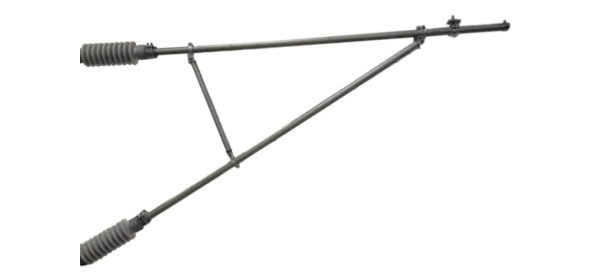
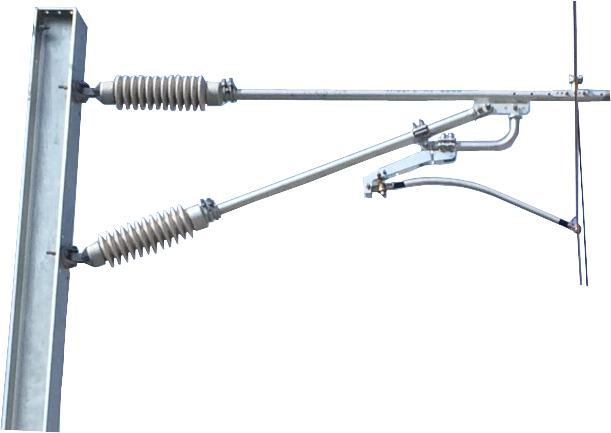
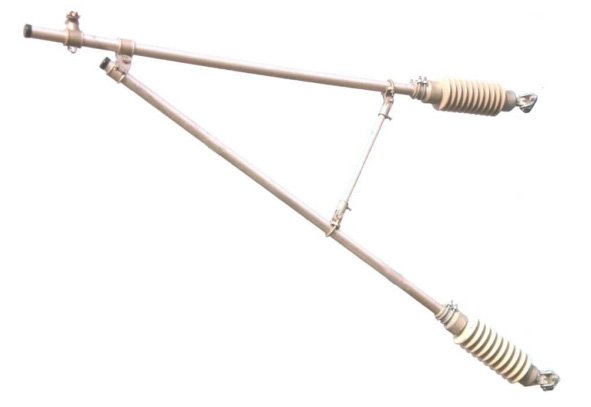
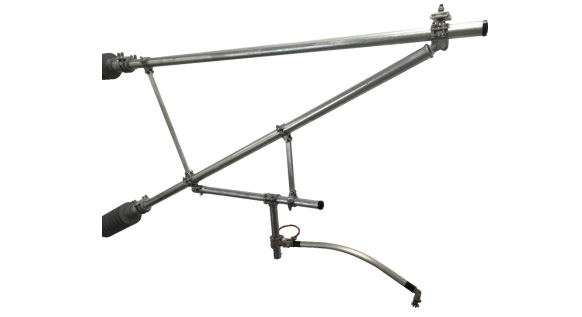
22-3 Bow Cantilever (Types A / B)
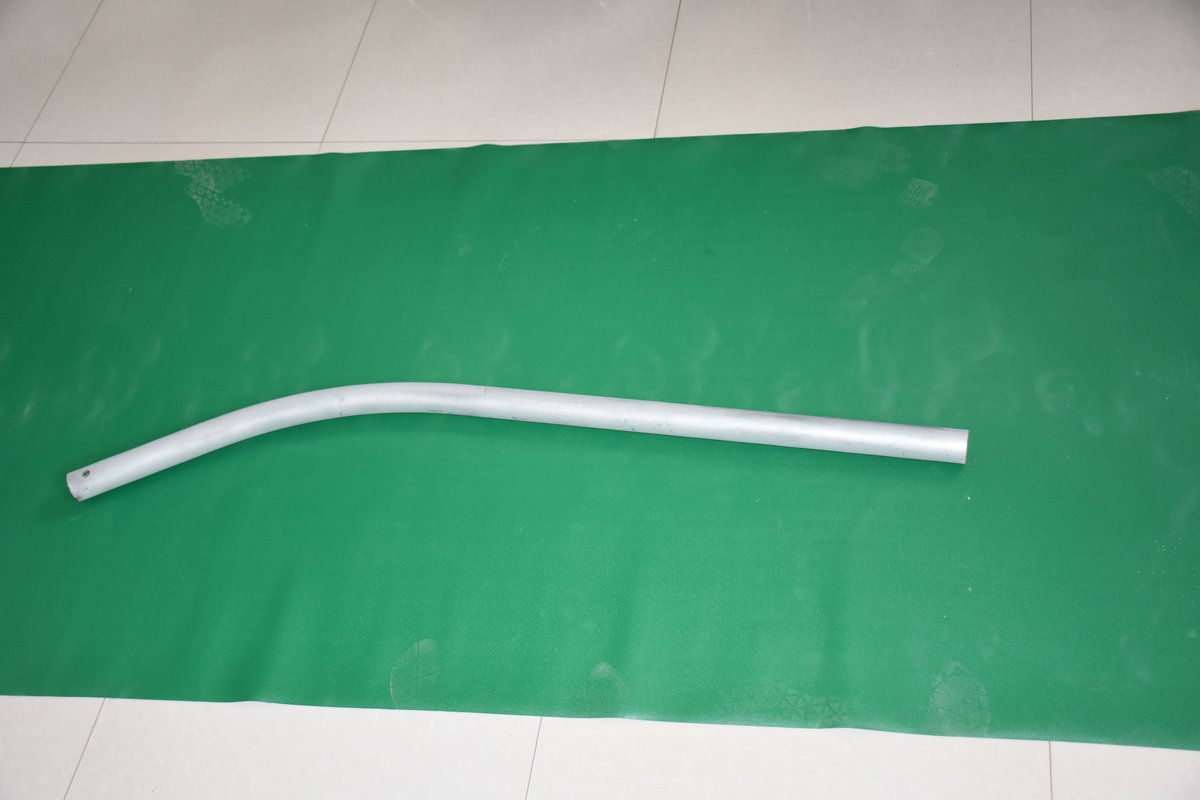
Arched support tube for low-clearance tunnels — plug-in (A) or flanged (B) base connection, Q355B hot-dip galvanized.
Specifications
| Model | 22-3A / 22-3B |
|---|---|
| Drawing No. | 22-3A |
| Standard | TB/T 2075.22-2024 — Part 22: Tunnel support and positioning devices |
| Materials | Q355B steel, cold-bent, welded, hot-dip galvanized |
| Installation | Fixed to the tunnel wall or hanging post, forming the low-clearance OCS support structure |
The 22-3 bow cantilever is the arched support tube of tunnel support and positioning devices. Where tunnel clearances rule out masts, the arch fixes to the tunnel wall or to a hanging post and carries the contact suspension in a compact envelope: its curved body simultaneously serves as the messenger wire support and as the mounting face for the positioning components.
Two connection variants match the tunnel base interfaces: Type A with plug-in (insertion) connections and Type B with flanged connections. The body is Q355B steel, cold-bent to the arch profile, welded and hot-dip galvanized — giving the required geometry, strength and durable protection against the humid tunnel atmosphere.
Design Features
- Arch geometry makes full use of the limited tunnel clearance
- Standardized holes along the tube accept messenger seats and positioning fittings
- Insertion (A) or flanged (B) interfaces match the tunnel base design
- Hot-dip galvanized body suited to damp tunnel environments
The product is manufactured under CRCC railway product certification and an ISO 9001 quality management system, with incoming material inspection, in-process control on critical operations and batch-by-batch final inspection before delivery.
Typical applications are railway tunnels and open-cut sections, where the bow cantilever works with tunnel bases, insulators and positioning devices to support and position the suspension. Henan Chuangwit supplies the complete tunnel support kit against your cross-section drawings. In tunnels and cut-and-cover sections, where vertical clearances do not allow a normal mast-and-cantilever arrangement: the arched tube fixes to the tunnel wall or a hanging post and carries both the messenger wire seat and the positioning fittings within a compact envelope. Type A uses plug-in (insertion) connections and Type B uses flanged connections to the tunnel base — the choice follows the base interface designed into the tunnel cross-section. The body is Q355B steel, cold-bent to the arch profile, welded and hot-dip galvanized — a combination that gives the curved geometry, the required strength and durable corrosion protection in the humid tunnel atmosphere. Yes. Holes on the tube accept the messenger wire seat and positioning components, and it pairs with the tunnel bases, insulators and hanging posts of the TB/T 2075.22 family.Frequently Asked Questions
Where is the bow cantilever used?
What is the difference between 22-3A and 22-3B?
What material is the bow cantilever made of?
Does it fit standard tunnel fittings?
Performance
Operating Conditions
Service inside railway tunnels and open-cut sections with restricted clearance and humid atmosphere.
Mechanical Performance
Cold-bent arch profile carries suspension loads in a compact envelope; standardized holes accept messenger and positioning fittings.
Applications
Low-Clearance Tunnels
Arch profile uses every centimetre of clearance.
Urban Tunnels
Compact support for metro and mainline tunnels.
Humid Environments
Hot-dip galvanizing resists damp tunnel air.
Cut-and-Cover Sections
Type A / B interfaces match the base design.